My Firebase Chat (Android 15 Supported)
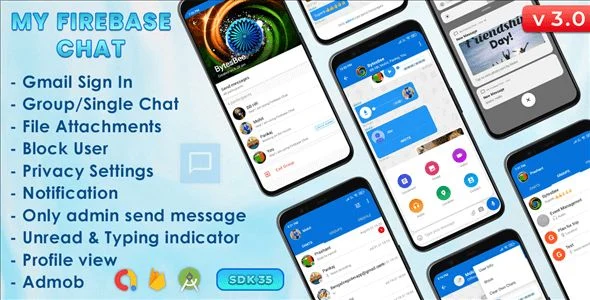
My Firebase Chat Overview & Real-Time Messaging Architecture
My Firebase Chat is a native Android messaging application source code, engineered for mobile developers and agencies to deploy real-time one-to-one and group chat products without maintaining a self-hosted backend. The package eliminates the operational bottleneck of provisioning PHP servers, Java middleware, or third-party admin dashboards by routing every message, attachment, and presence event through Google Firebase. In production workflows, it functions as a re-skinable communication engine that a development team can compile in Android Studio, connect to a client Firebase project, and ship as a Play Store deliverable.
Technical Specifications & Deployment Matrix
| Engineering Metric | Deployment Specification |
|---|---|
| Base Technology / Framework | Native Android development in Java, compiled in Android Studio Otter against SDK 36 |
| Runtime / Language Requirements | Android 9.0 through Android 15.0 (with SDK 36 / Android 16 compatibility declared) and 16 KB memory page support |
| Data Exchange / Communication Protocols | Firebase Realtime Database for message payloads and Firebase Authentication for credential handling, including Gmail sign-in |
| Front-End / Engine Dependencies | Native Android View layer with image loading library, emoji rendering via Microsoft Fluent 3D set, and push notification delivery |
| Database / Persistence Footprint | Zero self-hosted persistence; all chat history, group records, and profile data reside on Firebase servers |
Firebase Event Synchronization & Message Execution Pipeline
The core mechanism is Firebase database listener synchronization driving native UI adapters. When a user composes a message, the application serializes the payload—text, attachment URL, or voice recording metadata—into a Realtime Database node keyed to the conversation. Attached listeners on the receiving client fire change events, and the adapter layer rebinds the RecyclerView with the incoming snapshot, ordered by date and time. Presence operates on the same principle: online and offline status flags propagate to every participant device the moment a connection state changes.
Architectural & Functional Highlights
- Realtime state propagation: Typing indicators, sent/read receipts, and unread counters are implemented as ephemeral database writes that listeners consume and render instantly, mirroring the feedback loops users expect from production messengers.
- Multimedia attachment pipeline: The composer accepts documents (doc, docx, xls, xlsx, ppt, pdf, epub, txt, zip), video (AVI, MOV, MP4, WebM, 3gp, MKV, Mpeg), audio (AAC, AMR, AWB, Mp3, Ogg, Wav, opus), images, live location pins, and contact cards, with slide-to-cancel voice recording matching WhatsApp interaction patterns.
- Group administration controls: Admins can restrict message sending to all participants or administrators only, edit and delete groups, remove members, and upload group icons, replicating established moderation semantics.
- Identity and privacy layer: Firebase-backed registration and Gmail sign-in coexist with privacy toggles that hide a user’s email address and profile picture from the directory, alongside block/unblock filtering per contact.
- Monetization and reach: AdMob integration supplies the revenue layer while Firebase push notifications deliver inbound message alerts, including image-bearing notifications introduced in the 1.3 release.
Production Implementation & Operational Resilience
Deployment requires no purchased hosting plan; the entire backend footprint lives on Firebase servers, which reduces infrastructure cost to Firebase usage tiers. The codebase is documented as straightforward to read, re-skin, and customize, with Gradle build logic that auto-resolves version mismatch errors—a safeguard introduced in the 1.2 release to prevent dependency conflicts across Android Studio upgrades. The 4.0 release adds SDK 36 compilation and 16 KB page-size alignment, which addresses the Google Play target API and 16 KB device compliance thresholds that current submission pipelines enforce.
Error and edge handling appears at the interaction layer: image cropping logic was patched for Android versions 28 and above, attachment downloads function on Android 11 and later, and account deletion cascades across chat and group history rather than orphaning records. RTL support, added in version 1.3, ensures layout mirroring for right-to-left locales. The demo APK wipes chat data weekly, so any evaluation beyond a few days requires binding the build to a personal Firebase account. Developers comparing parallel native Android source packages that lean on Firebase configuration and RTL handling can study Qiblaty as an independent reference point, since that compass project follows the same Java-plus-Firebase delivery model as a separate codebase. For teams whose monetization roadmap spans multiple AdMob-instrumented Android releases rather than messaging alone, VidMate Pro exists as a standalone downloader product bundled with AdMob, Firebase, and OneSignal wiring.
Search and navigation scale through alphabetically indexed user lists with fast scrolling, filters for online/offline status, gender, and profile picture presence, plus a user search counter added in the 3.0 release. Secondary development focuses on theming the native View layer and swapping asset resources; no template override system exists because the package ships as a complete Android Studio project rather than a modular plugin architecture.
Frequently Asked Questions
Does the package require a separate PHP admin panel or Java backend to operate?
No, the application runs entirely on Firebase as its backend layer, with no third-party admin panel or PHP/Java server framework involved. All authentication, storage, and message routing happen through Firebase services.
Can group administrators prevent regular members from posting messages?
Yes, group admin restrictions mirror WhatsApp behavior, allowing an administrator to limit message sending to all participants or to administrators only. Admins also hold exclusive rights to edit groups, delete groups, and remove members.
Does the demo APK preserve conversation history for testing?
No, chats are deleted from the demo build on a weekly basis. Purchasers are directed to connect their own Firebase account, where message history, group records, and profile data persist under their project.
Is the source code usable for RTL-language deployments?
Yes, RTL support was added in version 1.3 and remains part of the current release. Layouts mirror correctly for right-to-left locales, which keeps the package viable for regional custom builds.
SnapDown – Snapchat Stories & Spotlights Downloader | ADMOB, FAN, APPLOVIN, FIREBASE, ONESIGNAL
Insta Downloader – Videos, Images & Audios Downloader | ADMOB, FAN, APPLOVIN, FIREBASE, ONESIGNAL
WhatsPro – WhatsApp & WA Business Status Saver | ADMOB, FAN, APPLOVIN, FIREBASE, ONESIGNAL