Qiblaty – Qibla compass for find direction to makkah
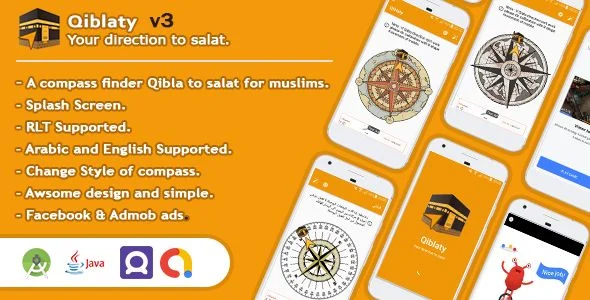
Qiblaty Qibla Compass Overview & Offline-First Android Architecture
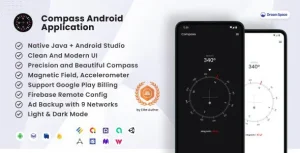
Qiblaty is a Java-based Android application source code, engineered for mobile developers and app studios to ship a Qibla direction finder that orients prayer toward Makkah without any network dependency. The package resolves a persistent constraint in Islamic utility software: traveling Muslims need dependable Qibla orientation at all times, yet connectivity cannot be assumed across regions, networks, or roaming scenarios. Within a production delivery pipeline, the codebase operates as a monetizable white-label asset — reskinnable through XML resources, remotely managed via Firebase, and structured for a direct Google Play release build with minimal reconfiguration.
Technical Specifications & Deployment Matrix
| Engineering Metric | Deployment Specification |
|---|---|
| Base Technology / Framework | Native Android application developed in Android Studio |
| Runtime / Language Requirements | Java with XML layouts, compiled against the latest Android SDK with AndroidX compatibility libraries |
| Supported OS Range | Android 9.0, 10.0, 11.0, 12.0, and 15.0 device targets |
| Data Exchange / Communication | Offline orientation core; AdMob and Facebook ad request layers; Firebase console for remote app management |
| Database / Persistence Footprint | Local .db storage shipped with a deliberately small binary footprint to conserve device space |
Sensor-Driven Orientation & Monetization Pipeline
The execution pipeline resolves the Makkah bearing entirely on device: the compass engine reads hardware sensor input, computes the directional heading, and renders the result on a live dial without issuing a single network request. This offline-first design is the architectural backbone of the package, and it mirrors the sensor-based navigation model found in other utility-grade Android builds such as Flashlight With Compass, which likewise pairs a hardware compass with an AdMob-monetized utility shell. The UI layer stays deliberately shallow — simple navigation flows, a splash screen on launch, and a switchable dial — so rendering cost remains negligible on low-end hardware.
Core Technical Capabilities of Qiblaty
- Offline-First Execution Model: The Qibla orientation logic runs with zero internet dependency, meaning the core user value survives airplane mode, dead zones, and roaming cutoffs — only the ad layers consume network requests.
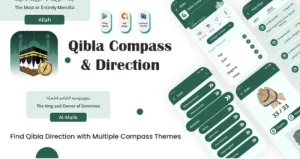
- Switchable Compass Rendering: Three distinct compass dial styles ship in the package and can be exchanged at runtime, giving reskinned builds visual differentiation without touching the orientation logic.
- Dual-Network Ad Monetization: AdMob banner and interstitial formats are wired in alongside Facebook interstitial placements, with a bidding layer included so demand sources compete for each impression and fill rates are arbitrated automatically.
- Firebase-Managed Configuration: The app connects to a Firebase console, allowing operators to adjust behavior and content remotely rather than shipping a new binary for every change.
- RTL Localization Support: English and Arabic string resources ship with full right-to-left layout mirroring, covering the two highest-volume linguistic markets for this app category.
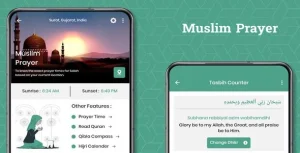
For studios weighing scope on a separate deployment track, Muslim Prayer represents an independent, broader Islamic utility suite covering dua, Quran, azkar, a Qibla compass, tasbih counting, and the Hijri calendar — a parallel codebase rather than an extension of this one.
Production Implementation & Operational Resilience
Deployment follows the standard native Android path: import the project into Android Studio, replace ad unit identifiers for both networks, configure the Firebase project bindings, sign a release build, and submit to the Play Store. The v3 revision of the codebase has already cleared known bug fixes and an SDK refresh to the latest Android target, reducing pre-launch maintenance work for teams adopting it now.
Reskin boundaries are where this package earns its place in an agency workflow. Because the logic lives in Java while presentation lives in XML layouts, drawables, colors, and string resources, a full visual rebrand can be executed by swapping resource files rather than modifying orientation or ad code. The included step-by-step documentation with screenshots walks through this process, which lowers the ramp-up cost for junior developers. Teams producing multiple branded builds can apply the same resource-swap discipline used in graphics-centric Android projects like Logo Creator app, where icon and visual asset replacement drives the entire delivery cycle.
Operational boundaries worth noting before deployment: the offline compass core depends on the device’s physical magnetic sensors, so emulator testing will not reproduce real-world orientation behavior — physical device validation is required. The small binary footprint keeps the app viable on storage-constrained handsets, and the AndroidX compatibility layer preserves behavior across the Android 9.0 through 15.0 range specified in the deployment matrix.
Frequently Asked Questions
Does Qiblaty require an internet connection to display the Qibla direction?
No — the orientation engine executes entirely on device, which is documented as a headline capability of the package. Network access is consumed only by the ad layers when banner, interstitial, or bidding requests are dispatched during sessions.
Are both AdMob and Facebook ad placements wired into the codebase?
Yes — AdMob banner and interstitial formats plus Facebook interstitial placements are integrated, and a bidding layer is included so demand sources compete for impressions. Unit identifiers must be swapped to your own accounts before a store submission.
Which file types are delivered inside the source package?
Yes, the deliverable spans four formats — the compiled .apk for immediate testing, plus .java sources, .xml layouts and resources, and the .db data file — accompanied by step-by-step documentation containing screenshots for the full setup sequence.
Can the visual theme be replaced without rewriting the Java logic?
Yes — reskinning is designed as a straightforward process isolated to XML layouts, drawables, and string resources. The sensor-driven orientation logic and ad integration code remain untouched, and the bundled documentation covers the procedure with screenshot walkthroughs.