Tri Peaks Poker HTML5 Game – Construct 3 (.c3p)
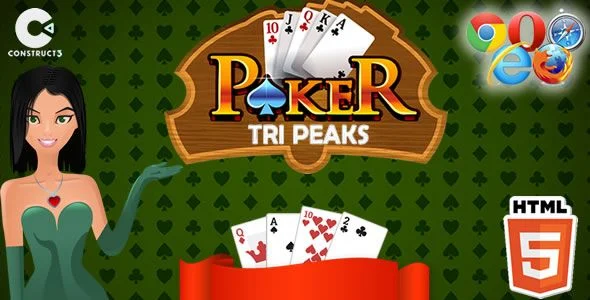
Tri Peaks Poker Overview & Editable Construct 3 Game Architecture
Tri Peaks Poker is a Construct 3 solitaire-card HTML5 game engineered for studios and publishers who need a fully editable, browser-based deck-clearing title that runs across mobile and desktop environments. The project targets a specific production bottleneck: closed, non-modifiable game builds that force teams to reverse-engineer compiled output whenever logic or visuals must change. Within an agency delivery pipeline, the package operates as a self-contained web asset — ready for arcade portals, promotional microsites, and Webview-embedded distribution — because the editable .c3p project, a pre-exported HTML5 build, and written documentation ship together in one deliverable.
Technical Specifications & Deployment Matrix
| Engineering Metric | Deployment Specification |
|---|---|
| Base Technology / Framework | Construct 3 engine, native editable .c3p project file |
| Runtime / Language Requirements | HTML5, CSS, and JavaScript output generated by the Construct 3 exporter |
| Data Exchange / Communication Protocols | Client-side only; LocalStorage key-value reads and writes |
| Front-End / Engine Dependencies | None beyond the engine’s own canvas renderer and bundled runtime scripts |
| Database / Persistence Footprint | Zero server-side storage; session state persisted in browser LocalStorage |
Pyramid Deck-Clearing Logic & Event-Sheet Execution Pipeline
The core mechanism is a rank-chaining solitaire loop driven by the active waste-pile card. Players remove peak cards that rank one step above or below the current waste card, progressively unlocking the three pyramid layers until the board is cleared or the draw pile is exhausted. Every removal decision is evaluated inside Construct 3 event sheets rather than external scripts, which means the validation logic — rank comparison, peak-unlock cascades, draw-pile depletion checks, and win/lose state transitions — lives in editable visual blocks that any developer with the editor can inspect and modify.
When a card is tapped or clicked, the engine dispatches a unified touch/pointer input event, matches the target sprite instance against the current waste-rank variable, and a Boolean gate determines whether the removal tween fires or the input is rejected. Deck and menu sequences run on timeline-driven animations, so card deals, peak reveals, and screen transitions execute through the engine’s native tween system instead of hand-written keyframes. Persistence is handled on the client: score and progress variables are serialized to LocalStorage and rehydrated on the next session load, removing any dependency on a session backend. For studios evaluating additional standalone Construct 3 releases, Neon Shot HTML5 Game follows a comparable editable-source delivery model.
Core Technical Capabilities of Tri Peaks Poker
- Editable .c3p source project: every rule, layout, and animation exists as Construct 3 event-sheet and layout objects, so card values, difficulty pacing, and UI flow can be adjusted without patching compiled runtime code.
- LocalStorage progress persistence: session state is written to the browser storage domain, letting returning players resume where the previous session ended with no server round-trips.
- Timeline-driven card and menu animations: deck deals, peak reveals, and menu transitions run through engine-native tween objects, keeping visual pacing consistent at the renderer level.
- Unified touch and pointer input: a single input abstraction covers mouse clicks on desktop and tap gestures on mobile, so one codebase serves both device classes.
- Layered PNG asset structure: graphics ship as layered source files, enabling complete visual reskins by swapping art layers while the underlying event logic stays untouched.
Production Implementation & Operational Resilience
Deployment requires nothing beyond static file hosting: the exported bundle — HTML entry point, CSS, and the engine runtime — can be uploaded to any web server or CDN edge and launched directly in the browser. Documented compatibility spans Internet Explorer 9, 10, and 11 plus Edge, Firefox, Safari, Opera, and Chrome, covering both legacy enterprise channels and current evergreen browsers. Because all communication is client-side, no CORS preflight or cross-origin header configuration is needed unless the build is embedded into a parent application that injects external scripts. Error states such as an exhausted draw pile resolve through the engine’s own layout events, so failure paths render in-engine rather than surfacing browser-level exceptions.
For secondary development, all modification happens through the Construct 3 editor: open the .c3p file, adjust event sheets or layouts, and re-export. The practical boundary is that the exported runtime should not be hand-patched — changes belong in the source project so re-exports remain reproducible. Reskinning follows the same discipline: replace the layered PNG art, remap sprite references in the layout editor, and regenerate the bundle. Teams broadening a browser-arcade catalog can also assess Happy Smile as an independent Construct 3 project occupying a separate casual-game niche.
Frequently Asked Questions
Does the download include both the editable .c3p project file and a ready-to-run HTML5 export?
Yes, the deliverables contain the native Construct 3 project, a pre-exported HTML5 build, layered PNG graphics, and written documentation, so the game can be deployed immediately or modified at source level before re-export.
Can the visual theme be replaced without modifying the event-sheet logic?
Yes, graphics arrive as layered PNG source files, meaning a full reskin is achieved by editing art layers and remapping sprite references in the Construct 3 layout editor while the underlying rank-comparison and animation logic stays untouched.
Can the exported HTML5 bundle be loaded inside a native mobile Webview container?
Yes, the game is documented as playable across mobile and desktop platforms, and because the runtime is a self-contained client-side bundle it can be embedded in a native Webview shell for app-channel distribution.
Has the exported build been verified across both legacy and modern browsers?
Yes, documented compatibility covers Internet Explorer 9 through 11 plus Edge, Firefox, Safari, Opera, and Chrome, confirming operation across legacy enterprise environments and current evergreen desktop browsers.