Tap Away + Level Editor – HTML5 Game (Construct 3)
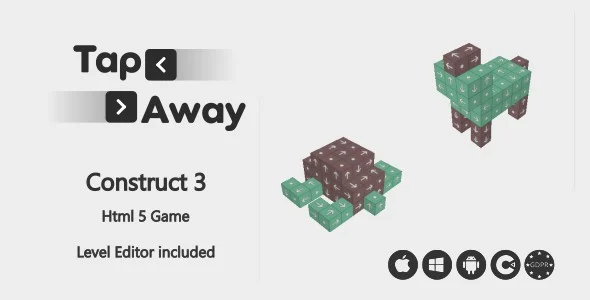
Tap Away Overview & 3D Puzzle Engine Architecture
Tap Away is a Construct 3 HTML5 3D puzzle game engineered for mobile studios and web publishers to deploy a tap-direction cube-disassembly experience across desktop and mobile browsers. The project tackles the core challenge of translating a three-dimensional cube grid—where every block carries a fixed movement vector—into a validated touch-dispatch loop that removes each block only when its exit path stays clear of neighboring geometry. Within production workflows, it operates as a self-contained playable build with editable source, positioned for reskinning, AdMob monetization wiring, and multi-platform store release.
Technical Specifications & Deployment Matrix
| Engineering Metric | Deployment Specification |
|---|---|
| Base Technology / Framework | Construct 3 project (.c3p), built exclusively with native runtime plugins |
| Runtime / Language Requirements | HTML5 build exported as JavaScript, JSON project data, and HTML entry files |
| Browser Compatibility | Chrome, Firefox, Edge, and Opera on PC, desktop, and web environments |
| Data Exchange / Communication | AdMob banner, interstitial, and rewarded ad units gated by an integrated GDPR consent flow |
| Persistence Footprint | Level progression, daily bonuses, and shop state managed client-side; no server database required |
Directional Collision Dispatch & Execution Pipeline
The core mechanism resolves every tap as a directional vector exit check against adjacent cubes. Each of the 72 levels loads a predefined cube arrangement in which every cube stores a fixed orientation. When a touch event fires, the runtime reads the tapped cube’s vector, traces the path along that direction, and rejects the input if any other cube currently occupies the trajectory. Cubes with a clear lane translate off the grid and are destroyed; the level completes its state machine once the entire arrangement has been dismantled without a single collision. This design produces a puzzle loop where reading spatial relationships matters more than reaction speed, and it scales naturally from simple starter layouts to dense configurations that demand sequenced removal planning.
For studios assembling a multi-title HTML portfolio, Tri Peaks Poker ships the same .c3p-plus-HTML5 deliverable pattern in the card genre, giving one export pipeline across two puzzle categories.
Core Technical Capabilities of Tap Away
- Directional collision validation: every tap dispatches a vector-path check before cube translation, so the no-collision rule is enforced at the engine layer rather than through scripted exceptions per level.
- Bundled level editor: the editor lets designers construct new cube arrangements and orientation assignments without modifying event sheets, decoupling content authoring from runtime logic and extending the 72-stage library indefinitely.
- Economy layer with daily bonuses and shop: timed reward logic and an in-game shop run inside the runtime, providing retention mechanics that function entirely on the client with no backend services.
- AdMob monetization stack: banner, interstitial, and rewarded ad units are wired in, with the GDPR consent flow gating ad requests for European audiences before traffic is initiated.
- Responsive viewport scaling: layout adapts to PC, tablet, and mobile screens through runtime scaling, with touch controls mapped for handheld play alongside desktop input.
Production Implementation & Operational Resilience
Deployment follows the standard Construct 3 export path: publish the HTML5 folder to any static host, or wrap it inside a native WebView container for Android and iOS distribution. A debug APK is bundled in the package so teams can validate touch input, ad unit behavior, and rendering on physical Android hardware before committing to a store build. Because the project uses only native Construct 3 plugins, runtime upgrades and re-exports remain predictable—no third-party plugin dependencies can break between Construct releases.
Reskinning is deliberately isolated from logic: sprite and texture assets can be replaced in vector or raster editors such as Adobe Illustrator, Photoshop, or Inkscape without touching event sheets, so art overhauls never risk regressions in the collision or economy systems. Two operational boundaries deserve attention before launch. First, the GDPR consent flow must be configured with correct region targeting so ad requests comply with European data rules. Second, monetization testing should confirm each AdMob format—banner, interstitial, and rewarded—fires at its intended game-state transition rather than blocking the dispatch loop. For publishers diversifying engagement formats beyond tap-dispatch puzzles, Visual Word Hunt operates as an independent HTML5 word-puzzle deployment on the same static hosting model.
Frequently Asked Questions
Are debug APK files included for on-device Android testing?
Yes, the package contains a debug APK alongside the Construct 3 source and HTML5 files, allowing teams to verify touch input, ad behavior, and rendering on real Android hardware before preparing a signed store release.
Can the visual assets be reskinned without modifying the event logic?
Yes, graphics are replaced in editors such as Adobe Illustrator, Photoshop, or Inkscape. Because artwork sits apart from the event sheets, a full art swap leaves the collision validation, level progression, and economy systems untouched.
Does the build include GDPR consent handling for ad serving?
Yes, a GDPR flow has been added to the project. It gates AdMob banner, interstitial, and rewarded ad requests, so European users encounter consent handling before advertising traffic is initiated by the runtime.
Can the game be published to iOS as well as Android?
Yes, the project is documented as playable across PC, web, Android, and iOS. The HTML5 export wraps into a native WebView container for Apple distribution using the same source files supplied in the package.