Reverse Image Finder App
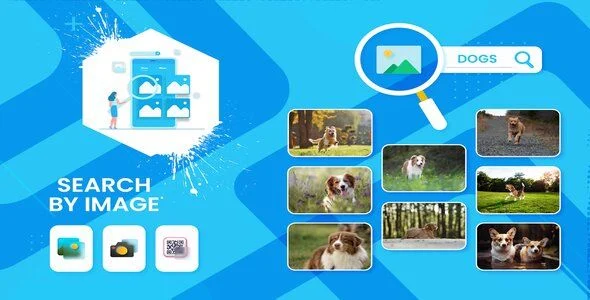
Reverse Image Finder App Overview & Mobile Visual Search Architecture
Reverse Image Finder App is a native Android application source package, engineered for mobile developers and agencies to deploy a visual search product that locates the origin and related matches of any photograph. The package addresses a concrete mobile engineering bottleneck: wiring camera capture, gallery selection, and text query inputs into a single dispatch pipeline that feeds an external visual search engine, all while maintaining a responsive interface across fragmented Android hardware. In production delivery, the codebase functions as a standalone, rebrandable Android client that studios can compile, restyle, and publish under their own listing identity on app stores.
Technical Specifications & Deployment Matrix
| Engineering Metric | Deployment Specification |
|---|---|
| Base Technology / Framework | Native Android application (Java source, XML layouts) |
| Runtime / Language Requirements | Android 9.0, 10.0, 11.0, and 12.0 |
| Data Exchange / Communication Protocols | Image submission to external reverse image search engine; REST-style visual query dispatch |
| Front-End / Engine Dependencies | Device camera capture pipeline; gallery media picker; barcode/QR scanning module |
| Database / Persistence Footprint | No local database; queries processed through remote search endpoints |
| Deliverable Formats | .apk build artifact, .java sources, .xml resources |
Multi-Input Query Engine & Execution Pipeline
The core mechanism routes three distinct input sources—typed text, camera capture, and gallery selection—into one unified reverse lookup request flow. When a user submits a text query, the app forwards the string to the connected search backend and renders categorized result sets. When an image is captured live through the device camera, the photo is passed through the capture intent, buffered, and submitted as the query payload for origin and related-content matching. Gallery-driven searches follow the same dispatch path, with the media picker returning a URI that the module normalizes before submission.
Beyond image lookup, the architecture integrates a dedicated scanning layer that decodes QR codes and barcodes, extending the input matrix beyond visual search into structured code recognition. An object recognition pathway allows items within photographs to be pinpointed and categorized, narrowing result sets to images containing specific objects. Every interaction surface—query entry, capture trigger, picker invocation, and scan mode—operates on the same activity lifecycle, keeping state transitions predictable during configuration changes such as rotation.
Core Technical Capabilities of Reverse Image Finder App
- Tri-Mode Input Dispatch: Text, camera, and gallery inputs converge on a single query pipeline, reducing duplicated request logic and ensuring consistent result rendering regardless of how the search payload originates.
- Camera Capture Integration: Native camera intents capture photographs in-session and feed them directly into the reverse photo search flow without requiring intermediate export steps or external apps.
- QR & Barcode Scanning Module: A bundled decoder handles both QR codes and linear barcodes, allowing the same binary to serve as a general-purpose scanning utility alongside its image search functions.
- Object Recognition Categorization: Detected objects within a submitted image are pinpointed and grouped into categories, enabling filtered discovery of images featuring specific items.
- Responsive Native UI: Java and XML layout resources deliver an interface that adapts across the supported Android 9 through 12 device spectrum without web-view overhead.
Production Implementation & Operational Resilience
Because the deliverables include raw .java sources and .xml resources alongside a compiled .apk, teams can audit the full codebase before store submission and verify behavior on the four documented Android versions (9.0–12.0). The absence of a local persistence layer means the runtime footprint stays minimal; query state lives in memory, and results depend on the availability of the remote search engine. Deployment planning should therefore account for network variance—device-side validation should confirm a valid image payload exists before dispatch, and connectivity failures will interrupt result retrieval since no offline cache is documented.
For secondary development, the separation of Java logic from XML layouts gives agencies two distinct override surfaces: visual identity (colors, strings, layout structure) can be restyled entirely through resource files, while query behavior and categorization logic live in the Java classes for deeper modification. Store release builds require standard signing and package-name configuration through the normal Android build chain. Teams structuring a multi-app client portfolio often run this package alongside a parallel UI foundation; for studios exploring separate standalone alternatives on the same platform, TravelBnB demonstrates a comparable Android UI template approach for booking-oriented products, while agencies diversifying across ecosystems can study Do It Today as a decoupled iOS productivity implementation outside the Android stack entirely.
Frequently Asked Questions
Does the package include the original Java source code and XML layout files, or only a compiled binary?
Yes, the deliverables contain .java source files and .xml resources in addition to a ready-to-install .apk build, giving developers full access to modify query logic and interface resources before store submission.
Can the app perform searches on images captured directly from the device camera?
Yes, reverse picture search is supported immediately after capturing a photo from the camera, with the captured image passed directly into the search dispatch pipeline alongside gallery and text input modes.
Is QR code and barcode scanning included as a built-in feature?
Yes, the application integrates a scanning module that decodes both QR codes and barcodes, extending the utility beyond reverse image lookup into structured code recognition within the same binary.
Does the app run on Android versions older than 9.0?
No, the documented compatibility matrix covers Android 9.0, 10.0, 11.0, and 12.0 only; behavior on earlier Android versions is not specified in the official technical documentation.
Music Finder – Audio & Lyrics Recognition, Trending & Search Music, Shazam Clone with Admob
VidoStatus – AI Image Generator & Video Status Maker, Status Saver, Quotes Creator, Admob Ads
Insta Downloader – Videos, Images & Audios Downloader | ADMOB, FAN, APPLOVIN, FIREBASE, ONESIGNAL