Rail Maze Puzzle [ Construct 3 , HTML5 ]
Rail Maze Puzzle Overview & Deployment-Ready HTML5 Game Module
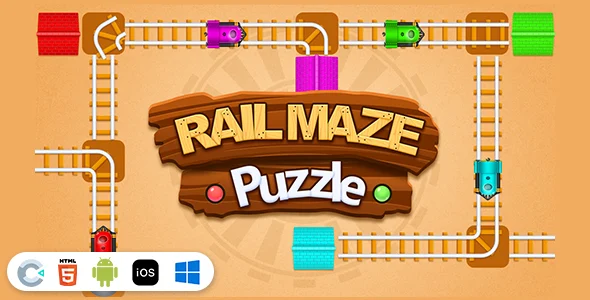
Rail Maze Puzzle is a Construct 3 HTML5 puzzle game, engineered for casual game publishers and web studios to deploy a railway track-switching experience across desktop and mobile browsers. The package resolves a recurring bottleneck in hypercasual game delivery: shipping a self-contained, animation-driven puzzle loop that runs entirely client-side without server dependencies or browser plugins. Within a production pipeline, it functions as a drop-in HTML5 module suited to static hosting, WebView embedding, and gaming-portal distribution.
Technical Specifications & Deployment Matrix
| Engineering Metric | Deployment Specification |
|---|---|
| Base Engine / Framework | Construct 3 (event-sheet driven project, c3p source file included) |
| Deliverable File Formats | JavaScript JS, HTML, CSS — HTML5 export ready to upload |
| Browser Runtime Coverage | IE6 through IE11, Firefox, Safari, Opera, Chrome, Edge |
| Display Classification | Standard resolution output (not flagged as high-DPI) |
| Bundled Artwork | 512×512 game icon for storefront or launcher use |
| Content Volume | More than 30 maze puzzle levels with per-level animation and sound layers |
| Target Platforms | Desktop browsers and mobile devices via responsive HTML5 build |
Track-Switching Logic & Level Execution Pipeline
Each level executes one core loop: the player reads the rail color and switches the track junction before the train commits to a route. Because a wrong switch causes an immediate crash state — a blast sequence — the design forces forward planning rather than reactive input. The engine routes every decision through Construct 3 event sheets, where track states, collision zones, and level-completion triggers are bound to the rendered scene. Thirty-plus stages escalate from starter configurations to layouts that demand multi-step route calculation, giving the title a difficulty curve aimed at children, families, and skill-training audiences alike.
Architectural & Functional Highlights
- Color-Coded Track Switching: Junction logic is keyed to rail color matching, so the puzzle mechanic depends on visual parsing and timed track changes rather than reflex-only input. A missed match triggers the blast failure state and a level restart.
- Thirty-Level Progression Structure: The level set spans starter layouts through multi-junction mazes, each defined inside the c3p project so designers can inspect, reorder, or duplicate stage configurations directly in the Construct 3 editor.
- Dynamic Obstacle Layers: Tunnels, bridges, and moving trains act as variable routing elements within levels, converting each stage from a static path trace into a timing-and-routing problem the player must solve.
- Per-Level Animation and Audio Feedback: Every stage ships with its own animation set and sound cues, so level transitions, crashes, and completions carry distinct feedback without requiring external asset sourcing.
- Cross-Device Input Handling: The build accepts both pointer and touch input, letting the same exported bundle serve desktop browser sessions and mobile play without separate code branches.
For studios evaluating additional Construct-built arcade inventory on a separate canvas footprint, Crazy Fishing HTML5 Game Construct 2/3 exists as an independent source kit with its own 720×1280 portrait configuration and upgrade system.
Production Deployment & Implementation Considerations
Deployment requires only a static web target: the HTML5 export folder — containing the HTML entry point, compiled JavaScript, and CSS — can be uploaded to any shared host, CDN, or object storage endpoint and served as-is. The same build embeds cleanly inside a native WebView container for teams wrapping browser games into shell applications. Implementation boundaries are worth noting before scoping. The project is a fixed-content puzzle title with a defined set of more than 30 levels; it carries no backend, no database footprint, and no remote content service, so dynamic level delivery or server-driven events fall outside its architecture. The display classification is standard resolution rather than high-DPI, which affects art scaling expectations on retina-class screens. Customization runs through the included c3p file: opening it in the Construct 3 editor exposes event sheets, layouts, sprite objects, and audio banks, allowing level edits, re-skinning, and re-export to HTML5. For education-sector teams building a separate marketing site outside the game runtime, Studypress – Education Course HTML Template operates on a purely static HTML path with no coupling to this engine.
Frequently Asked Questions
Does the download include the editable Construct 3 project file?
Yes. The package ships the c3p project alongside the exported HTML, JavaScript, and CSS build, so level layouts, event sheets, and assets can be modified inside the Construct 3 editor and re-exported for deployment.
Is any server-side API or database required to run the game?
No. The exported build runs fully client-side in the browser, which means uploading the HTML5 output to a static host or embedding it in a WebView container is sufficient for production play without backend provisioning.
Are the animations and sounds bundled with each level?
Yes. Each of the more than 30 levels carries its own animation set and sound cues, so extended or re-skinned stages retain built-in feedback for crashes, transitions, and completions without importing external asset libraries.