NFTs Finder – iOS Swift (OpenSea NFT Marketplace)
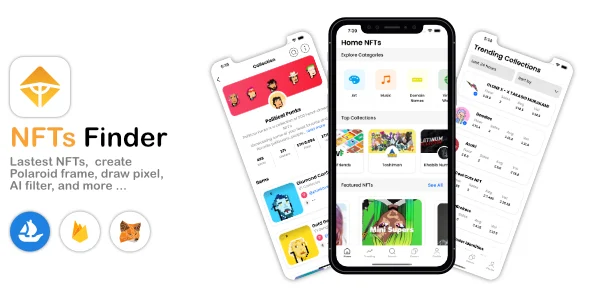
NFTs Finder Overview & Native iOS Marketplace Client Architecture
NFTs Finder is a native Swift 5 iOS application template engineered for indie developers and mobile agencies to launch an OpenSea-connected NFT discovery and creation client on iPhone. The codebase removes the ground-up cost of wiring REST-based marketplace queries, wallet display, pixel-art generation, and ad-based monetization into a single App Store-ready build. Within production workflows, it operates as a compile-and-reskin starting point: teams open the project in Xcode 15+, bind their Firebase and AdMob credentials, restyle the interface, and ship a market-discovery product without authoring the underlying engine from scratch.
Technical Specifications & Deployment Matrix
| Engineering Metric | Deployment Specification |
|---|---|
| Base Technology / Framework | Swift 5 codebase authored on Xcode 15+, with SwiftUI and SpriteKit components plus .xib/.nib interface files |
| Runtime / Language Requirements | iOS 15, iOS 14, and iOS 13 deployment targets; macOS development machine with CocoaPods preinstalled |
| Data Exchange / Communication Protocols | OpenSea REST API for marketplace reads; Firebase for account management, database, and data storage |
| Front-End / Engine Dependencies | MetaMask wallet connection (read-only display), AR feature module, AI photo filters, layered PNG assets |
| Database / Persistence Footprint | Firebase-hosted backend with an in-app Coin economy; no on-device transaction signing or local wallet custody |
OpenSea Data Pipeline & Client-Side Execution Flow
The execution pipeline routes every marketplace read through the OpenSea API while Firebase governs identity, persistence, and user state.
Inbound discovery requests are dispatched from the interface layer as structured queries against the OpenSea endpoint, returning live feeds for the latest NFTs, bundles, categories, trending collections, and upcoming drops. Search actions pass user input through the same request path, and profile screens pull or mutate a user’s stored record inside Firebase. Rendering is handled across .xib-based views with automatic dark-mode and light-mode variants, keeping visual state synchronized with the system appearance setting without duplicated layout code.
On the creation side, a SpriteKit-backed pixel drawing canvas produces NFT-ready artwork, while an AI filter module and a Polaroid frame compositor transform user photos into collectible-format visuals. An AR module places generated pieces into the device camera view for preview. The gamification layer runs three embedded titles — Sudoku, Mastermind, and Solitaire — that award Coins, an internal currency consumed to unlock additional in-app features.
Architectural & Functional Highlights
- Read-Only Wallet Integration: The MetaMask connection surfaces a user’s NFT holdings for display purposes only; the module never signs or broadcasts transactions, keeping the client inside Apple’s App Store policy boundary.
- Bounty-Based Referral Flow: Each user receives a personal short link to share; when recipients complete purchases on the OpenSea web destination, the originating account accrues bounties, and shared favorite-NFT links follow the same redirect pattern.
- Self-Contained Game Modules: The three bundled games are written directly inside the project rather than imported from third-party SDKs, so their rendering loops and Coin-payout logic can be modified without external dependency conflicts.
- Dual Monetization Stack: AdMob banners and interstitials generate display revenue, while a StoreKit in-app purchase removes advertising, giving operators two independent revenue channels in one build. For studios evaluating a decoupled Android monetization path as a separate product line, DocScan demonstrates the same AdMob-plus-in-app-billing pattern on a native scanner utility.
Production Implementation & Operational Resilience
Deployment begins on a Mac with CocoaPods already installed, since several frameworks in the dependency manifest resolve only through Pod installation. A Firebase project must be provisioned to absorb account management, database, and storage duties, and an AdMob account is required wherever advertising is enabled — omitting the AdMob configuration disables that revenue channel without breaking the core discovery flow. The project targets iOS 13 through iOS 15, so builds should be validated across those deployment targets before submission.
Operational boundaries are deliberately narrow: the client performs no buying or selling of NFTs. Purchase intent is handed off by copying an NFT link or redirecting the user to the external purchase page, and every data read depends on live network availability to the OpenSea API and Firebase. Because this template is distributed to many buyers, the interface — fonts and color tokens in particular — should be restyled before an App Store submission to differentiate the published binary. Teams running parallel multi-platform delivery may also evaluate Tranz Swift as an independent React Native Expo template outside the Swift toolchain, suited to logistics-domain clients rather than merged into this codebase.
Frequently Asked Questions
Does the app complete NFT purchases inside the native interface?
No, the client never processes transactions directly. Users can copy an NFT link or get redirected to the external purchase page, because in-app trading would violate Apple’s review policy; bounty accrual follows the same external hand-off pattern.
Are the bundled Sudoku, Mastermind, and Solitaire games third-party SDKs?
No, all three games were designed and written by the template author inside the project itself. Their source code ships with the package, so Coin-payout logic and gameplay behavior can be modified without licensing or dependency concerns tied to external libraries.
Does the MetaMask connection authorize blockchain transactions from the device?
No, wallet connectivity exists only to display a user’s NFT holdings. The integration deliberately avoids signing any transactions, which keeps the read-only display flow aligned with App Store rules governing cryptocurrency activity.
Can the app deliver marketplace data while fully offline?
No, live connectivity is required. Latest NFTs, trending collections, bundles, and search results are fetched on demand from the OpenSea API, while accounts and stored records resolve through Firebase, so an active network connection is a runtime prerequisite.