Camping Hero App | SwiftUI Full iOS Application
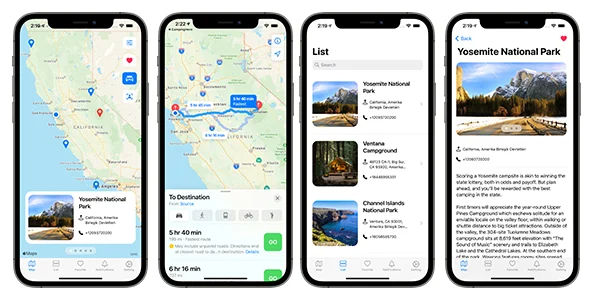
Camping Hero App Overview & Native iOS Discovery Foundation
Camping Hero App is a native SwiftUI iOS application engineered for developers, entrepreneurs, and agencies to launch location-discovery platforms for campgrounds and outdoor destinations. The package eliminates the recurring engineering cost of binding a declarative Swift 5 interface to a remote data layer, because campground records are already structured against a Firebase backend with push notification delivery wired into the build. Within a production delivery pipeline, it operates as an App Store-ready codebase that can be provisioned, re-skinned, and submitted without writing a new application layer from scratch.
Technical Specifications & Deployment Matrix
| Engineering Metric | Deployment Specification |
|---|---|
| Base Technology / Framework | Swift 5 with a SwiftUI declarative interface layer |
| Runtime / Language Requirements | iOS 14.0 or later; Xcode project compiled against Apple native toolchain |
| Data Exchange / Communication Protocols | Firebase backend services for record storage and push notification dispatch |
| Front-End / Engine Dependencies | Native SwiftUI view hierarchy with dark mode appearance tracking |
| Database / Persistence Footprint | Firebase-hosted campground dataset, shipped with a pre-populated sample database |
Firebase-Backed Discovery Pipeline & Execution Flow
The application retrieves campground records from Firebase and renders them through SwiftUI declarative views. On launch, the view layer establishes a read path against the Firebase database, where each campground entry is modeled as a structured record consumed by the browsing and search interface. Because SwiftUI manages state reactively, a change in the underlying dataset propagates into the rendered list without manual view-invalidation code, keeping the presentation layer synchronized with the remote data source.
Detail navigation follows the same declarative pattern: selecting a campground record transitions the view hierarchy to a detail screen populated directly from the decoded record fields. Push notifications travel a separate delivery channel through the Firebase messaging integration, allowing operators to broadcast updates and alerts to installed devices without shipping an application update. Since the entire dataset lives server-side, content teams can add, edit, or retire locations from the Firebase console and the change is reflected on the client without rebuilding the binary. For studios assembling a broader portfolio of SwiftUI source deliverables, Shapes & Colors Adventure operates as an independent educational-app template built on the same declarative framework, illustrating a separate niche a single codebase discipline can address.
Core Technical Capabilities of Camping Hero App
- Firebase Data Layer: Campground records are stored and administered in a Firebase database, decoupling content management from the compiled binary and enabling server-side dataset updates across the installed base.
- Push Notification Channel: A Firebase messaging integration dispatches updates and alerts to devices, giving operators a re-engagement path that requires no App Store resubmission for new announcements.
- Adaptable Codebase for Vertical Repositioning: The architecture supports repurposing beyond campgrounds into hiking trails, picnic areas, fishing spots, or glamping directories by substituting dataset content rather than rebuilding navigation logic.
- Dark Mode Rendering: The interface tracks system appearance preferences, adjusting view rendering for low-light readability without a parallel layout fork.
- App Store-Ready Build Configuration: The project ships prepared for submission, reducing the release-engineering phase to provisioning and signing rather than restructuring.
Production Implementation & Operational Resilience
Deployment begins in Xcode, where the iOS 14.0 minimum target keeps the binary compatible with a wide installed-device base. Operators must provision a Firebase project and connect it to the application before content displays; the included sample database shortens this phase by supplying pre-populated campground records, so the interface renders meaningful data immediately after the backend link is established. Push notification delivery additionally depends on Apple developer certificate configuration, since iOS routes remote messages through Apple infrastructure before Firebase dispatch reaches the device. The full step-by-step documentation bundled with the package walks through each of these setup stages, from backend provisioning to submission preparation.
Re-skinning boundaries are deliberately kept shallow: the visual identity can be adapted to match a brand through the SwiftUI styling layer without disturbing the data-decoding and navigation logic underneath. This separation matters for agencies running parallel client engagements, because one engineering pass on the Firebase schema serves multiple branded builds. Operational limits worth planning around include the iOS 14 floor for legacy-device reach and the dependence on an active Firebase project for any content visibility, meaning offline-first behavior is not part of the shipped architecture. For developers evaluating additional native audio deliverables on the same platform, My RadiOS SwiftUI APP Radio iOS 18 stands as a separate single-station radio template, demonstrating another independent deployment path within the Apple ecosystem.
Frequently Asked Questions
Does the package include pre-populated data so the interface is not empty after initial setup?
Yes, a sample database ships with the source package, allowing the browsing interface to render campground records immediately once the Firebase project is connected, before any custom content is authored.
Can the visual design be re-skinned without restructuring the underlying data logic?
Yes, the package is built for easy re-skinning, so branding adjustments are handled at the SwiftUI presentation layer while the Firebase data model and navigation flow remain intact across modified builds.
Is the codebase limited to camping listings, or can it serve other location categories?
No, the architecture is not camping-specific. Because records are managed in Firebase, the same codebase can be repurposed for hiking trails, picnic spots, fishing locations, or glamping directories through dataset substitution.
Does the application render correctly when the device switches to dark mode?
Yes, dark mode support is included in the build. The SwiftUI interface responds to system appearance changes, adjusting view rendering for comfortable reading in low-light conditions without manual toggling.
Fuel Costs App & Widget | Average Fuel Consumption – SwiftUI Full iOS Application
Heroes – A Desert Adventure Unity Match 3 Game Project with Admob ad for Android and iOS
SwipeClean – Photo & Storage Cleaner iOS App | Swift SwiftUI | Swipe to Delete