Math Quest for Kids 2 – Educational Game – HTML5, Construct 3
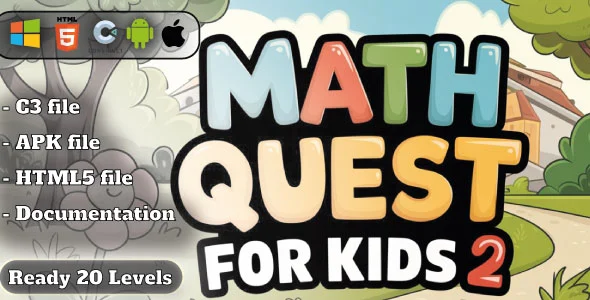
Math Quest for Kids 2 Overview & Educational Game Engine Architecture
Math Quest for Kids 2 is an HTML5 Construct 3 educational game source package, engineered for studios and publishers deploying arithmetic-learning experiences across web and Android runtimes. The codebase targets a persistent instructional bottleneck: converting repetitive addition and subtraction drills into an interactive question-sequence loop that keeps children progressing through 20 graded difficulty levels. Within production workflows, the package functions as a self-contained learning module, delivering editable Construct 3 project files, a ready-built Android APK, and an HTML5 web build from a single event-driven architecture.
Technical Specifications & Deployment Matrix
| Engineering Metric | Deployment Specification |
|---|---|
| Base Technology / Framework | Construct 3 event system (C3P project file included) |
| Runtime / Language Requirements | HTML5-capable browser: Chrome, Edge, Firefox, Safari, Opera |
| Data Exchange / Communication Protocols | Client-side rendering; no external plugins or server calls required |
| Front-End / Engine Dependencies | Canvas-based output, Full HD graphics, embedded sound effects |
| Database / Persistence Footprint | No database layer; level and score state managed inside the engine runtime |
Question-Sequence Gameplay Loop & Execution Pipeline
The engine executes a question-dispatch pipeline that drives every learning interaction. Construct 3’s event sheet receives a level-selection trigger, loads the corresponding question set for that stage, and renders each arithmetic prompt one at a time on the canvas layer. The player submits an answer through the on-screen touch keypad or a physical keyboard; the input handler compares the submitted value against the expected result held in the level’s event variables. A match dispatches a scoring event, increments the progression counter, and queues the next question, while an incorrect submission keeps the learner on the current prompt until the correct value is produced.
Difficulty scales across the 20 pre-designed levels, each stage introducing fresh addition and subtraction problems with progressively larger operands and tighter cognitive load. Touch input is unified across both deployment targets: the same tap-and-type gesture model serves mobile WebView sessions and desktop pointer events without branching code paths. Because the runtime carries zero external plugin dependencies, the web build runs entirely from static hosting, and the Android build wraps the same logic inside a native application container.
Core Technical Capabilities of Math Quest for Kids 2
- Twenty-Level Graded Progression: Each level is pre-authored with its own question sequence, letting the difficulty curve rise deterministically as players complete stages, without runtime-generated math.
- Dual Input Architecture: The answer-entry layer accepts both on-screen keypad taps and keyboard strokes, so a single event sheet serves mobile touch sessions and desktop interaction models.
- Full HD Rendering with Embedded Audio: Graphics render at Full HD resolution and sound effects ship inside the project bundle, eliminating CDN asset fetches during play sessions.
- Zero-Plugin Runtime: The exported HTML5 build depends on no external plugins or libraries, allowing deployment on any static web host or LMS embedding context that supports standard browser APIs.
- Simple Reskinning Pipeline: Art and audio assets can be swapped inside the Construct 3 editor without touching event logic, shortening the turnaround for themed rebrands.
Production Implementation & Operational Resilience
Deployment starts from the included C3P project inside the Construct 3 editor, where studios adjust question content, art, and audio before exporting. The HTML5 export drops onto any static host or embedding surface, while the included APK file provides an immediate Android distribution artifact without requiring a fresh Cordova build cycle. Cross-browser behavior is verified across the five major engines—Chrome, Edge, Firefox, Safari, and Opera—so rendering differences between WebGL and canvas fallback paths are handled at export time rather than patched per-browser. High-resolution visuals are rendered from the engine’s native scaling, keeping layout consistent across viewport sizes on phones, tablets, and desktop monitors.
For secondary development, customization is confined to the reskinning layer the documentation explicitly exposes: replacing sprite sheets, swapping audio files, and reworking question data inside the event sheets. Since there is no server-side component or database footprint, operational risk sits almost entirely in asset weight; large Full HD sprite replacements should be optimized before export to keep initial load times acceptable on mobile networks. Studios running multiple educational titles on a single portal should treat each export as an isolated static bundle, since the runtime persists no cross-session player data outside the browser session.
Teams assembling a broader casual-games catalog can position this arithmetic module alongside complementary HTML5 titles without merging codebases. For decoupled implementations outside the educational niche, Rail Maze Puzzle supplies a 60-level Construct 3 puzzle variant for retention-focused portals, while Halloween Idle Fly offers an independent C3P arcade path with one-tap controls and mobile export, each deployed as a separate static bundle on the same hosting layer.
Frequently Asked Questions
Does the package include the raw Construct 3 project file for editing?
Yes. The downloadable bundle contains the full C3P project file alongside the exported HTML5 web build and a compiled Android APK, giving developers the editable source plus two ready-to-ship deployment artifacts.
Can the game run in browsers without installing external plugins?
Yes. The runtime requires no external plugins, extensions, or server-side dependencies. Any modern browser—Chrome, Firefox, Safari, Opera, or Edge—executes the HTML5 build directly from static hosting.
Does the game generate math questions randomly at runtime?
No. All 20 levels ship pre-designed with fixed addition and subtraction question sequences. Content changes require editing the event sheets inside the Construct 3 editor and re-exporting the project.
Is an Android build provided, or must developers create one?
Yes, a compiled APK file is included in the package. Developers can distribute it immediately or regenerate a fresh build from the C3P source after applying custom question sets or reskinned assets.