Genion – Creative Digital Agency Elementor Template Kit
Genion Overview & Creative Agency Layout Architecture
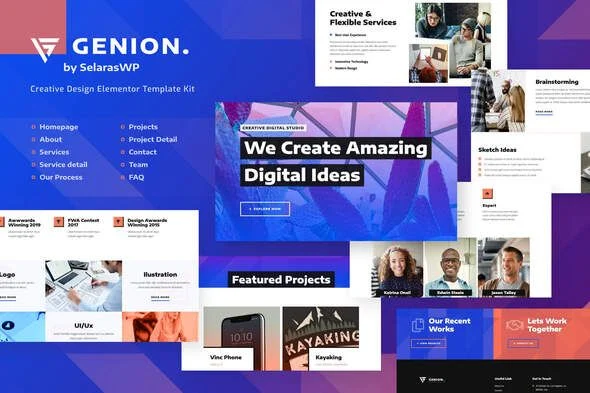
Genion is an Elementor template kit engineered for creative digital agencies, marketing studios, SEO companies, and portfolio builders that need production-ready page layouts without hand-coding. The package removes the blank-canvas bottleneck of Elementor page composition by shipping ten pre-structured templates and more than twenty reusable sections as importable library assets. Within an agency delivery pipeline, it operates as a layout accelerator: teams import the kit through the Template Kit Import workflow, then adapt typography, color tokens, and section composition directly inside the Elementor panel.
Technical Specifications & Deployment Matrix
| Engineering Metric | Deployment Specification |
|---|---|
| Base Technology / Framework | Elementor page builder; compatible with Elementor 3.10.x and Elementor 3.8.x |
| Runtime / Environment Requirements | WordPress installation with the Elementor builder active; Hello Elementor theme documented as the reference base theme |
| Data Exchange / Import Protocol | Kit zip archive ingested via the Template Kit Import plugin available from the official WordPress plugin directory |
| Front-End / Engine Dependencies | Elementor Pro is listed by the vendor as the required premium plugin; all styles and effects are authored inside the Elementor panel |
| Persistence Footprint | No external data layer; imported templates persist as Elementor library entries after the zip-import sequence completes |
Teams comparing digital-agency kit architectures before committing to a vertical can benchmark Findgency as a parallel import-based option operating within the same Elementor workflow.
Template Import Pipeline & Design Token Architecture
Genion executes through a zip-import pipeline that materializes pre-built page structures directly into the Elementor library. Once the Template Kit Import plugin ingests the archive, each template is parsed into Elementor-native layout data — nested container structures, widget instances, and section definitions — rather than compiled theme files. Teams then attach any selected template to a page and continue editing through the standard drag-and-drop builder, where every element stays inspectable and modifiable at the widget level.
The ten included page templates cover a complete agency sitemap: Homepage, Services, Service Detail, Projects, Project Detail, Our Process, About, Team, FAQ, and Contact. Layered beneath these are more than twenty section blocks that can be mixed across pages, letting a team assemble a service landing page from portfolio and process sections without rebuilding layouts from an empty canvas. Because all composition happens inside the builder, the kit remains decoupled from theme-level PHP work entirely. For studios benchmarking SEO-vertical alternatives inside the same kit runtime, Analog offers a comparable import-driven architecture oriented toward search marketing agencies.
Core Technical Capabilities of Genion
- Modular section library: More than twenty pre-designed sections operate as reusable composition blocks across all ten page templates, reducing per-page build effort to selection and reordering rather than structural reconstruction.
- Global design tokens: Typography is anchored to free Google Fonts, and the color palette is defined as editable hues, so a token change propagates through styling controls without external stylesheet edits.
- Panel-native styling engine: Every style and effect is created within the Elementor panel itself, which means restyling requires no CSS authoring and survives builder version updates within the documented compatibility range.
- Fluid responsive layout logic: Templates ship with responsive behavior tuned for desktop, laptop, and mobile viewports, including retina-ready image rendering and pixel-consistent spacing across breakpoints.
Production Implementation & Operational Resilience
Deployment follows a deterministic sequence: install a base theme (Hello Elementor is the documented reference), activate the Elementor builder, install the Template Kit Import plugin, upload the kit zip through the Tools > Template Kits screen, then attach imported templates to pages. Because zip ingestion expands multiple layout payloads in a single request, hosts configured with a conservative wp_memory_limit can abort the operation mid-import; raising the PHP memory allocation before upload prevents truncated template libraries in staging and client environments.
Resilience boundaries are asset-scoped rather than code-scoped. Demo imagery originates from Envato Elements and Twenty20 collections, so production deployments must either license those assets from their sources or substitute owned media — the layouts tolerate direct image replacement without structural side effects. Customization stays within style and content boundaries: typography, hues, section order, and widget content are overridable in the panel, while the package itself ships no hooks or child-theme extension layer because it is not a theme. Teams that instead require a complete theme runtime with template hierarchy control can evaluate Beorx as an independent creative agency theme outside the kit-based workflow.
Frequently Asked Questions
Does Genion install as a standalone WordPress theme?
No, the package is an Elementor template kit, not a theme. It requires a base theme such as Hello Elementor plus the Elementor builder, and its templates enter WordPress through the Template Kit Import plugin rather than the standard theme installer.
Can the demo images be published on a live client site without additional licensing?
No, the preview imagery is drawn from Envato Elements and Twenty20. Agencies must license those assets from their original sources or replace them with owned media, and the layouts accept direct image substitution without breaking the underlying section structure.
Can templates be imported selectively instead of as the full ten-page set?
Yes, the documented import flow lets teams add only the templates they want. Individual pages such as the Contact or FAQ layouts can be pulled into the Elementor library while unused templates remain excluded from the final site build.