Bookinga – Multipurpose Django Booking and Directory Template
Bookinga Multipurpose Django Template Overview & Booking Front-End Architecture
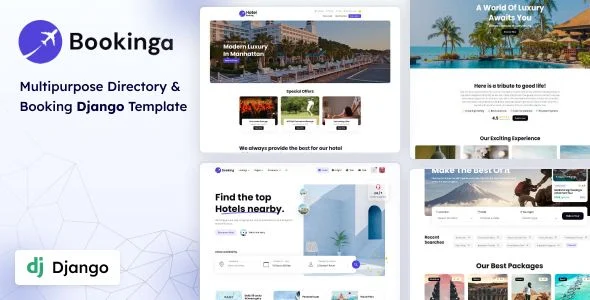
Bookinga is a multipurpose Django booking and directory template engineered for Python development teams and agencies that must ship reservation-driven websites across hospitality, travel, and mobility verticals. The package resolves a concrete production bottleneck: assembling five distinct domain page sets — hotel booking, flight booking, cab and car rental, tour operations, and directory listing — without reconstructing each layout from zero. Within an agency delivery pipeline, it operates as the presentational layer of a Django project, supplying pre-structured page markup that a developer binds to application views, URL routes, and downstream data models.
Technical Specifications & Deployment Matrix
| Engineering Metric | Deployment Specification |
|---|---|
| Base Technology / Framework | Python Django template layer built on Bootstrap 5.x |
| Runtime / Language Requirements | Django-hosted Python environment; HTML, SCSS-compiled CSS, and JavaScript deliverables |
| Browser Compatibility | Verified rendering in IE11, Firefox, Safari, Opera, Chrome, and Edge |
| Layout System | Responsive grid supporting 4+ column arrangements with high-resolution assets |
| Included Source Files | CSS Files, SCSS Files, JS Files with well-commented structure |
| Persistence Footprint | Static presentational template; no database schema or bundled back-end logic ships with the package |
Domain Layout Engine & Rendering Pipeline
The package organizes five complete vertical page sets under a single component-oriented architecture. When a Django view renders one of these templates, the markup flows through the framework’s standard template engine, meaning every page inherits the same utility-driven class vocabulary that Bootstrap 5.x uses natively. Because the codebase follows the same coding practices as Bootstrap core, engineers extend or replace components using the patterns they already know: grid utilities, spacing tokens, and modular class composition rather than one-off overrides. Each vertical — hotels, flights, cabs, tours, and directory listings — carries its own full page inventory, and the architecture explicitly supports mixing and matching layouts across verticals, so a resort site can borrow a listing grid or a travel agency can reuse a flight search panel without refactoring.
The styling pipeline runs through a SASS variable layer. Color schemes are declared as tokens at the top of the SCSS chain, so recompiling the stylesheet after editing those variables propagates a new palette across every component — a measurable time saver when a client brand requires multiple skins on the same structure. Comments segment the code into identifiable blocks, which allows a developer to copy a search bar, card grid, or detail section into another page and delete the remainder without breaking adjacent markup. Third-party plugin dependency is deliberately kept low, shrinking the JavaScript footprint and reducing the surface area for version conflicts during long maintenance cycles. For teams evaluating a pure static markup path fully decoupled from the Python runtime, the Beyond – Hotel Booking Html Template covers the accommodation vertical in standalone HTML form.
Core Technical Capabilities of Bookinga
- Five complete vertical page inventories: Hotel, flight, cab, tour, and directory-listing page sets ship together, allowing a single deployment to serve resorts, B&Bs, vacation rentals, taxis, tour operators, and travel agencies from one codebase.
- SASS token-driven color system: Palette changes compile from variable declarations rather than hand-edited CSS, so multi-brand deployments regenerate skins through one recompile cycle.
- Bootstrap core-aligned component code: Component markup mirrors Bootstrap 5.x conventions, so customization follows documented framework patterns instead of proprietary wrappers.
- Low third-party plugin dependency: Fewer external libraries means a smaller JS payload, fewer update conflicts, and predictable behavior across the six supported browsers.
- Layout portability across verticals: Well-commented blocks allow page sections to be copied, removed, or recombined between domains without cascading breakage.
Production Implementation & Operational Resilience
In agency staging environments, the template behaves as static presentation: there is no bundled database layer, no ORM migration path, and no business logic to configure, so integration effort concentrates on wiring page markup to the Django views and models a team builds or already operates. The supplied documentation walks through template setup, component structure, and color scheme changes, which shortens onboarding for developers inheriting the codebase mid-project. Because the sales specification lists IE11 among supported browsers, QA passes on client projects should include legacy rendering checks alongside modern Chrome, Edge, Firefox, Safari, and Opera targets — legacy engines often expose flexbox and grid quirks that modern browsers silently absorb. Customization boundaries are stylistic and structural rather than programmatic: acceptable extension paths include overriding SCSS variables, recompiling stylesheets, replacing image assets, and recombining the commented markup blocks. The package is not a standalone HTML template — only the Django variant ships — so scope documents should reflect that deliverable boundary. When a client engagement extends past server-rendered pages into a native mobile dispatch product for the cab vertical, the MyTaxi – Complete Flutter Taxi App | Full Taxi Booking Solution with Intercity & Parcel runs as a separate Flutter codebase handling GPS dispatch, parcel delivery, and intercity bookings.
Frequently Asked Questions
Does the package include a standalone HTML version of the layouts?
No, the deliverable is the static Django template only; the author explicitly states the HTML version is not included, so teams needing raw markup without the Python layer must plan around that boundary.
Are SCSS source files included so the color scheme can be recompiled?
Yes, SCSS Files ship alongside CSS Files and JS Files in the package. Color schemes are driven by SASS variables, so editing the token layer and recompiling regenerates the palette across all components.
Can page sections be reused across different booking verticals?
Yes, the codebase is built for layout recombination. Well-commented blocks let developers copy a component from one domain page set into another, and the architecture supports mixing hotel, flight, cab, tour, and listing layouts.
-
16 May 2025 LatestOct 20, 2026