
 My Account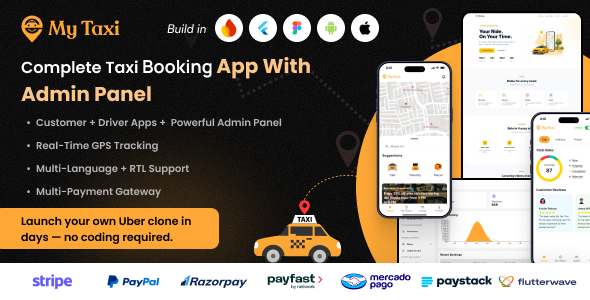
MyTaxi – Complete Flutter Taxi App | Full Taxi Booking Solution with Intercity & Parcel operates as a cross-platform mobile dispatch architecture built on Flutter with an integrated RESTful backend for real-time ride-hailing and courier operations. The application coordinates passenger, driver, and administrative roles through bi-directional WebSocket channels and Firebase Cloud Messaging for persistent telemetry. Geolocation coordinates stream dynamically from client devices through Google Maps Direction API services to calculate route polylines and estimated time of arrival metrics. The underlying codebase isolates state transitions through reactive design patterns, preventing unnecessary widget rebuilds during active GPS tracking sessions.
Core Geolocation & Dispatch Architecture of MyTaxi
Continuous coordinate streaming forms the operational baseline of the platform, executing real-time location pings without degrading mobile CPU cycles. Native location providers hook directly into device sensors through high-accuracy GPS daemons to manage battery profiles during active transit sessions. Network payloads between the Flutter client and the REST API maintain an average payload size below 15 kilobytes per synchronization event. This lightweight JSON transport mechanism allows the platform to maintain stable connections across varying cellular signal boundaries.
Key Functional Modules of MyTaxi for Urban Mobility
- Multi-Modal Booking Engine: Inside MyTaxi, dispatch routines route point-to-point urban rides, parcel deliveries, and intercity trips through dedicated calculation algorithms and isolated fare matrices.
- Real-Time Telemetry Pipeline: WebSockets broadcast driver coordinate deltas to passenger map canvases with low latency, updating vehicle rotation angles smoothly.
- Fare Calculation & Matrix Routing: The backend calculates surge multipliers, toll additions, base charges, and distance-time metrics synchronously before transaction commitment.
- Dual Verification Security Layer: Transactional safety relies on automated four-digit one-time passcodes verified server-side prior to trip initialization.
Operational Implementation Scenarios
- Urban Fleet Operations: Metro-wide ride hailing deployments manage concurrent vehicle fleets across dense geographic zones using dynamic geofencing clusters.
- Intercity & Courier Logistics: Regional freight and long-distance passenger routes leverage pre-scheduled itineraries and consignment weight verification workflows.
Technical Specifications & Ecosystem Support
| Runtime Environment | Flutter 3.x, Dart 3.x, PHP 8.1+ / Laravel Framework |
|---|---|
| Performance Benchmarks | 60 FPS interface rendering, sub-300ms API response latency |
| Database & Cache Footprint | MySQL 8.0 with spatial indexing, Redis session broker |
| Ecosystem Interoperability | Google Maps SDK, Firebase Cloud Messaging, Stripe, PayPal |
As a production-ready taxi booking solution, the system synchronizes database transactions through atomic lock mechanisms to prevent race conditions during driver trip acceptances.
Technical & Integration FAQ for MyTaxi
How does the driver app synchronize real-time coordinate updates without triggering excessive battery drain?
The client application binds native Android and iOS location daemons to adaptive distance filters that suspend continuous polling when stationary. Location updates transition to batched network dispatches during steady-state cruising to conserve device battery.
How does the backend resolve concurrent ride acceptance collisions when multiple drivers bid for the same dispatch?
A Redis atomic lock claims the trip identifier instantaneously upon the first driver acknowledgment, immediately rejecting subsequent responses. This taxi booking solution issues cancellation payloads to rival clients within milliseconds.
What state management pattern governs real-time UI mutations across the application views?
The Flutter interface implements reactive state controllers that decouple map canvas rendering from peripheral billing widgets. This architecture confines state mutations strictly to active UI subtrees without initiating full widget tree invalidations.