Akpager – Multipurpose Landing Page Template Kit
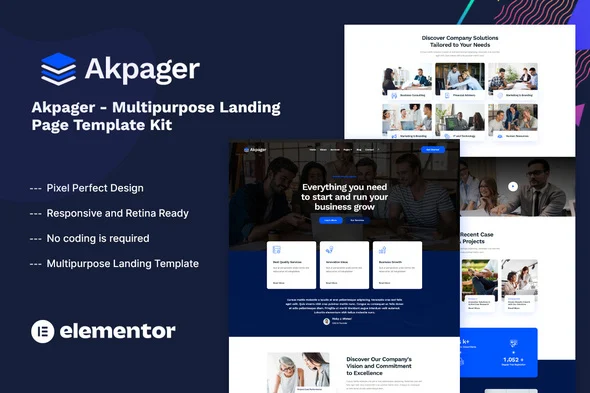
Akpager Overview & Multipurpose Landing Page Delivery Architecture
Akpager is a multipurpose landing page Template Kit built on the Elementor 3.10.x page builder runtime, engineered for agencies and startup teams that need to publish SaaS, software, and digital marketing landing pages without writing code. The kit removes the blank-canvas construction bottleneck by supplying prebuilt JSON layout structures that import into a WordPress install and convert into fully editable Elementor documents. Within agency delivery workflows, it functions as a repeatable starting artifact for client acquisition funnels, software subscription pages, team-management sections, and web application showcases.
Technical Specifications & Deployment Matrix
| Engineering Metric | Deployment Specification |
|---|---|
| Base Technology / Framework | Envato Template Kit for WordPress, targeting Elementor 3.10.x |
| Runtime / Language Requirements | WordPress hosting with the free Elementor build; the Pro edition is not required |
| Required Front-End Dependencies | Themesflat Addons for Elementor, MetForm, and Jeg Elementor Kit (all free) |
| Data Exchange / Import Mechanism | JSON layout payloads processed through the standard Envato kit import workflow |
| Persistence Footprint | Layouts persist as standard Elementor page data; no custom storage schema is introduced |
Design Token Architecture & Import Execution Pipeline
Akpager ships as a collection of JSON layout blueprints that install through the standard Envato kit import workflow. During import, each JSON payload is parsed and reconstructed as native Elementor documents: containers, sections, and widget instances map onto the page builder’s data model, after which every region becomes editable through the visual panel. Because the layouts depend only on Elementor’s free build, no Pro-gated widgets appear anywhere in the import chain. Global typography and color definitions operate as design tokens; adjusting a token at the site level propagates the change across every section that references it, which is the primary mechanism for re-skinning the kit for different client brands. Studios comparing options inside the same import workflow can also evaluate inTechzo, a sibling Elementor kit aimed at startup and IT company verticals.
Core Technical Capabilities of Akpager
- Header & Footer Builder: The included builder elements reconstruct the page’s header and footer regions inside the kit itself, overriding the active theme’s default output for those areas and giving editors full visual control over navigation and site framing.
- Carousel Slide Box: Themesflat Addons supplies a slider constructor that accepts any widget content as slide material, letting teams assemble promotional sliders without installing an external slider plugin or embedding shortcodes.
- MetForm Integration: Contact and lead-capture sections render through MetForm, which provides field validation and submission handling so conversion points work immediately after import.
- Global Design Tokens: Centralized color and typography variables span every page variant, so a single token edit re-brands the full layout set rather than requiring per-section restyling.
- Zero-Code Editing: Every module is adjustable through Elementor’s visual controls, removing the need for stylesheet authoring during routine content and layout revisions.
Production Implementation & Operational Resilience
Deployment targets any WordPress environment running the free Elementor build alongside Themesflat Addons for Elementor, MetForm, and Jeg Elementor Kit. Administrators should verify that the server’s wp_memory_limit accommodates the JSON payload volume during bulk template import, since reconstructing multiple full-page layouts in a single pass can push low-default allocations past their ceiling; a 256 MB floor is a sensible pre-deployment check on shared hosting. The rendered front end is documented as cross-browser compatible and retina-ready, with responsive breakpoints adapting section stacking for tablet and phone viewports. Search-engine optimization is addressed at the markup level through semantic heading order, descriptive alt attributes on imagery, and mobile-first layout behavior. The demo imagery originates from Envato Elements, so agencies must either acquire those assets from that platform or swap in owned media; image replacement is a standard asset-swap operation inside the editor and requires no structural rework. Secondary development stays within the Elementor boundary: style adjustments route through the global token panel, and structural edits happen at the container level rather than in code files. For decoupled front-ends that live outside the WordPress runtime entirely, Pintex exists as an independent ReactJS landing page codebase and cannot be merged into this kit’s architecture. Subsequent kit revisions arrive at no additional cost, keeping long-lived client builds aligned with the current Elementor release line.
Frequently Asked Questions
Does Akpager require the paid Elementor Pro plugin to render its full layout set?
No, the kit runs entirely on the free Elementor build; the documentation states explicitly that Elementor Pro is not required. All page sections, headers, and footers reconstruct through the free editor together with the bundled free add-on plugins.
Can the bundled demo images be published on a live client site as-is?
No. Preview imagery originates from Envato Elements and must be acquired from that platform or swapped for your own assets before production deployment; the shipped files act as placeholders inside the imported layouts until replaced.
Is the kit locked to a specific WordPress theme?
No. The package is documented as compatible with any WordPress theme, because header and footer regions are rebuilt through the kit’s own builder elements rather than inherited from the active theme’s template output.