NextApp – App Landing Page Template Kit
NextApp Overview & Front-End Landing Page Architecture
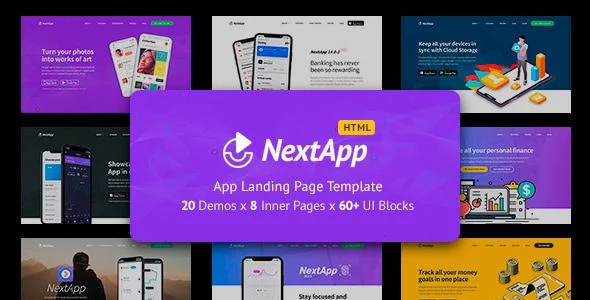
NextApp is a Bootstrap 4 HTML5 landing page template pack, engineered for app publishers, startups, and digital agencies to ship conversion-focused marketing pages without rebuilding layout markup from scratch. The package targets a recurring production bottleneck: assembling a browser-consistent, W3C-valid, mobile-first landing structure that renders identically across IE10, IE11, Firefox, Safari, Opera, Chrome, and Edge. Within agency delivery workflows, it operates as a static front-end foundation—20 ready demos plus 8 inner pages—where PHP is invoked only at transactional endpoints such as contact, registration, comment, and MailChimp subscription processing.
Technical Specifications & Deployment Matrix
| Engineering Metric | Deployment Specification |
|---|---|
| Base Technology / Framework | Twitter Bootstrap 4.1.2 with HTML5/CSS3, W3C-valid markup |
| Runtime / Language Requirements | PHP-enabled web server required for form endpoints; static HTML/CSS/JS rendering for all page views |
| Data Exchange / Communication Protocols | HTTP form POST handling via PHP scripts (contact, registration, comments) plus a working PHP MailChimp subscription form |
| Front-End Dependencies | Google Fonts, 630+ Font Awesome icons, 120 SVG Flaticon icons, 200+ PNG icon assets |
| Database / Persistence Footprint | None — fully stateless static pages; no SQL schema or CMS installation involved |
Bootstrap Grid Execution & Landing Page Delivery Pipeline
The core mechanism is a static render pipeline: browsers parse W3C-valid HTML5, apply a Bootstrap 4.1.2 grid of four or more columns, and hydrate interaction states through bundled JavaScript. Each of the 20 demos is a self-contained page entry point; no server-side templating engine or database layer participates in view construction. Because markup ships as flat files, response generation terminates at the web server layer, which keeps time-to-first-byte governed entirely by static asset delivery rather than application logic.
Form flows diverge from the render path. When a visitor submits a contact, registration, or comment form, the browser dispatches a POST request to an included PHP script, which validates the payload and dispatches mail through the host’s mail transport. The MailChimp form follows the same pattern but routes subscriber data toward the Mailchimp list API instead of a local mailbox. Modern responsive mobile navigation is driven by the Bootstrap JavaScript component set, collapsing multi-level menus into a touch-accessible drawer below the defined viewport breakpoints.
Architectural & Functional Highlights
- SEO-Optimized Page Structure: Heading hierarchy and semantic markup follow search-engine-friendly conventions across all demos, allowing crawlers to map content relevance without post-processing the DOM.
- Cross-Browser Rendering Contract: Layout and script behavior are validated against IE10, IE11, Firefox, Safari, Opera, Chrome, and Edge, reducing per-browser QA cycles during client sign-off.
- Native PHP Transaction Endpoints: Contact, register, and comment handlers plus a Mailchimp subscription form ship as working PHP files, so lead capture functions on any standard LAMP host without additional plugins.
- Layered Icon Delivery: 630+ Font Awesome glyphs, 120 SVG Flaticon icons, and 200+ PNG assets cover vector-scalable and raster-fallback scenarios within the same codebase.
- Google Analytics Hook: Demos are prepared for immediate analytics instrumentation, letting teams wire tracking snippets directly into the documented markup locations.
Teams that prefer managing launch pages inside a full CMS rather than through flat files can evaluate Appku as an independent WordPress-native route for comparable app landing delivery pipelines.
Production Implementation & Operational Resilience
Deployment reduces to copying the PHP, HTML, CSS, and JS files onto any PHP-capable host and configuring the mail transport for the form handlers. Because the architecture is stateless, there is no migration path, no schema versioning, and no cache-invalidation logic to coordinate; staging and production differ only in server configuration. Cross-origin concerns are effectively absent since forms post to same-origin scripts, though teams proxying assets through a CDN should verify header consistency at the edge.
Graceful degradation is handled at the CSS layer: Bootstrap 4.1.2 grid rules adapt layouts across PC, tablet, and phone viewports, while the documented browser matrix confirms legacy IE10/IE11 support. Secondary development is intentionally scoped to style overriding and asset replacement—developers adjust SCSS-derived CSS values, swap Google Fonts, or replace icon and image assets, because the commented codebase exposes clear structural boundaries without a dynamic server engine beneath it. The included documentation walks through file organization and form configuration, which shortens onboarding for handover to client maintenance teams. For studios weighing a theme-level alternative that bundles one-click demo import and WooCommerce support on the WordPress stack, Foton Pro exists as a separate, decoupled option outside this static HTML package.
Frequently Asked Questions
Does the package include functional server-side form processing?
Yes. Working PHP files handle contact, registration, and comment submissions, and a PHP MailChimp form pushes subscriber data to your mailing list, provided the hosting environment supports PHP mail dispatch.
Are the icon assets delivered in multiple formats?
Yes. The kit bundles 630+ Font Awesome icons, 120 SVG Flaticon icons, and 200+ PNG icons, covering vector rendering, brand-style glyphs, and raster fallbacks within a single asset set.
Does the kit function without a database or CMS installation?
Yes. All 20 demos and 8 inner pages render as static HTML5 with CSS and JavaScript; no SQL database, CMS core, or plugin installation is required—only a PHP runtime for the form endpoints.