
Restart Taxi & Delivery- Perfect Taxi Solution with Parcel Delivery
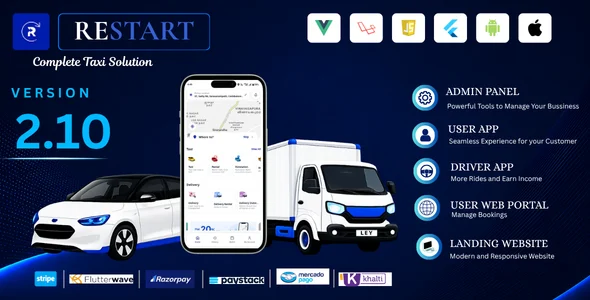
Restart Taxi & Delivery: Engineering Overview & Architecture
Restart Taxi & Delivery- Perfect Taxi Solution with Parcel Delivery is a full-stack ride-hailing and courier platform built on a Laravel MVC backend with RESTful API contracts, serving fleet operators, delivery startups, and regional taxi dispatch businesses. The application separates rider, driver, and admin domains into isolated modules, so each role loads only its required controllers, models, and assets, which keeps response payloads small during peak booking hours. Booking state transitions are processed through asynchronous job queues, meaning ride requests, driver assignments, and parcel status updates push WebSocket events to connected clients without a full page reload.
Integration is handled through versioned REST endpoints that serve the passenger and driver apps, while the admin panel consumes the same API layer, guaranteeing a single source of truth for fares, zones, and vehicle categories. The centralized administrative panel configures base fare, per-kilometer and per-minute pricing, commission percentages, surge multipliers, and geo-fenced service zones directly from the database-backed settings module. Every configuration change is validated server-side and propagated to the apps on the next request cycle, eliminating manual redeployment for pricing adjustments.
Key Functional Features of Restart Taxi & Delivery for Modern Deployments
- Real-Time Driver Tracking: Driver apps push GPS coordinates to the server at configurable intervals, and the dispatch engine matches incoming ride requests against available drivers using distance and bearing calculations, rendering live vehicle movement on the rider map via WebSocket channel updates.
- Parcel Delivery Module: The courier workflow supports pickup and drop-off address entry, package dimensions, weight-based pricing rules, and item photos, with each parcel assigned a verifiable status chain (requested, accepted, picked up, in transit, delivered) visible to both sender and recipient.
- Dynamic Fare Engine: Fare calculation runs server-side using distance matrix results combined with configurable base fare, time-based charges, surge zones, and vehicle-category multipliers, and the computed amount is locked at booking time so no client-side tampering can alter the final price.
- Multi-Role Authentication: Separate credential flows for riders, drivers, and administrators use token-based session handling, with driver onboarding including document upload, verification queues, and an approval gate that blocks unverified drivers from receiving dispatch requests.
- In-App Wallet & Payment Ledger: A double-entry transaction ledger records every wallet top-up, ride payment, commission deduction, and refund, giving administrators an auditable financial trail and drivers a transparent earnings history per trip.
- ride & Parcel History with Analytics: The admin dashboard aggregates completed trips, canceled requests, driver utilization, and revenue by date range, presenting the data through server-rendered charts that query indexed database tables for fast reporting at scale.
Real-World Deployment Scenarios
- City Taxi Fleet Operator: A 50-vehicle urban fleet deploys the platform to replace radio dispatch, with the auto-assignment engine routing requests to the nearest verified driver and surge pricing activating automatically during rush-hour demand spikes.
- On-Demand Courier Startup: A local delivery business uses the parcel module exclusively, configuring same-document and package deliveries with weight-based pricing, photo proof of pickup, and recipient-side status notifications end to end.
- Regional Ride-Hailing Launch: An operator entering a secondary market combines both modules, using geo-fenced zones to open service district by district while the analytics dashboard tracks driver supply gaps and booking funnel drop-off weekly.
Technical Architecture & Compatibility Standards
The backend targets PHP 8.x with the Laravel framework, relies on MySQL with indexed tables for bookings, drivers, and transactions, and uses queued jobs for notifications and dispatch processing so request latency stays low under concurrent load. REST endpoints follow versioned contracts with JSON responses, and the WebSocket layer handles real-time channel events for tracking and status pushes, all deployable on standard VPS or cloud hosting with a configured queue worker and cron scheduler.
Frontend rendering keeps asset weight minimal, with map components loading tiles on demand and interactive elements updating through partial state changes rather than full document reloads. The codebase is structured with separable service layers, so custom vehicle categories, additional payment gateways, or third-party SMS providers can be wired into the existing hooks without modifying the core dispatch logic.
Frequently Asked Questions
Does Restart Taxi & Delivery handle both ride booking and parcel delivery in a single deployment?
Yes, the platform ships with a dual-module architecture where taxi dispatch and parcel delivery run on the same codebase, sharing the fare engine, driver pool, and admin panel while keeping separate workflows for each service type.
Can I configure surge pricing and geo-fenced service zones without modifying code?
Yes, the administrative settings panel exposes surge multipliers, time-based rates, and geo-fenced zone boundaries as editable parameters, and all changes take effect on the next booking request without redeployment.
Does the dispatch engine assign drivers automatically or only manually?
Yes, automatic driver assignment is built in; the engine matches ride and parcel requests to the nearest available verified driver using distance calculations, with manual override available to dispatchers from the admin panel.
Is the platform a native mobile app sold on app stores?
No, this is a PHP-based server application with API-driven frontends; the core product is the Laravel backend and web interfaces, and mobile integrations connect through its REST endpoints rather than pre-published store apps.
Can driver earnings, commissions, and wallet transactions be audited after deployment?
Yes, a double-entry ledger records every payment, commission deduction, and wallet movement, and administrators can filter the transaction history by driver, date range, and service type for full financial reconciliation.
-
v2.0 LatestOct 10, 2026
MyTaxi – Complete Flutter Taxi App | Full Taxi Booking Solution with Intercity & Parcel

Sticker Maker for WhatsApp – Stickers in WhatsApp – Sticker Maker-WhatsApp – Sticker Maker for WA

Voice Calculator – Speaking Calculator – Calculator – Voice Typing Calculator – Talking Calculator