Zomo – Online Organic Food Delivery Bootstrap Template + Admin Template
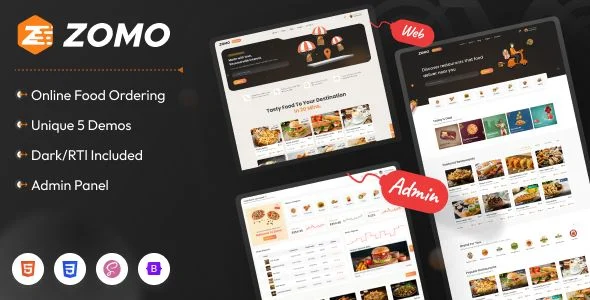
Zomo Overview & Front-End Delivery Storefront Architecture
Zomo is a Bootstrap 5 HTML template package engineered for front-end developers and delivery-focused agencies to prototype and ship organic food, grocery, and restaurant ordering interfaces without building layout systems from scratch. The package addresses the recurring bottleneck of assembling multi-page commerce journeys — menu grids, checkout, order tracking, address forms, and payment screens — by supplying 35+ prebuilt HTML pages organized across 5 unique demos, plus an admin dashboard included as a bonus deliverable. In production workflows, it functions as a static presentation layer that agencies skin with brand tokens and wire to any back-end API of their choosing, covering storefront, authentication, and back-office mockups within a single download.
Technical Specifications & Deployment Matrix
| Engineering Metric | Deployment Specification |
|---|---|
| Base Technology / Framework | Bootstrap 5.x responsive grid and component library |
| Runtime / Language Requirements | Static HTML5, CSS, SCSS, and JavaScript; standard web server hosting, no server-side runtime needed |
| Delivered File Formats | HTML files, supporting CSS and JS files, SCSS source files, HTML documentation |
| Front-End Dependencies | Google web fonts, Google Map integration, animated CSS/JS components |
| Browser Compatibility | IE11, Firefox, Safari, Opera, Chrome |
| Layout Configuration | 4+ column responsive layout, LTR and RTL directions, dark and light display modes |
Ordering Interface Composition & Page Execution Pipeline
The architecture is a pure static document pipeline: browsers request an HTML file, the linked CSS assets render the Bootstrap 5 grid, and vanilla JavaScript modules drive animations, mode toggles, and map widgets — with no database footprint or server-side rendering involved. Layout switching between LTR and RTL is handled at the stylesheet level, which is what allows the same markup to serve Arabic, Urdu, and other right-to-left locales without duplicating page trees. The dark and light display modes operate through a CSS state toggle exposed in the options menu, reducing eye strain for late-shift operators browsing during night hours. Page inventory spans the complete ordering funnel: menu listing and menu grid views, address entry, checkout, order confirmation, offer pages, order tracking, payment, and restaurant listing, alongside authentication flows (signup, signin, OTP), plus 404, about, contact, empty cart, FAQs, profile, testimonial, and wishlist pages. The bundled admin template covers the back-office side of the operation — order monitoring, dashboard views, and management screens — so agencies can present a full-stack visual narrative to grocery and restaurant clients before any API integration begins. For teams needing deeper dashboard variants at the presentation layer, Dayone operates as a standalone HTML admin dashboard built on the same Bootstrap foundation, giving decoupled back-office mockups beyond what ships in this package.
Core Technical Capabilities of Zomo
- RTL & Multi-Language Direction Support: Direction-aware stylesheets let the same HTML source render left-to-right or right-to-right layouts for Arabic, Urdu, and comparable scripts, removing the need to fork page templates per locale.
- Dark and Light Mode Switching: A CSS-driven state toggle in the options menu swaps color schemes at runtime, letting night-shift users reduce eye strain without a page reload.
- SCSS Variable Layer for Unlimited Colors: Because the styling layer is compiled from SCSS sources, developers override variable tokens once and recompile, propagating brand palettes across all 35+ pages instead of hand-editing CSS rules.
- Valid HTML5 Markup & Cross-Browser Rendering: The markup validates against HTML5 standards and is tested across IE11, Firefox, Safari, Opera, and Chrome, which reduces layout regression work during QA cycles.
- Google Map Integration: Embedded map components support address selection and order-tracking screens, aligning the front end with the location-aware expectations of delivery platforms such as Zomato, Swiggy, UberEats, and Foodpanda interfaces.
Production Implementation & Operational Resilience
Deployment requires nothing beyond static file hosting — the package runs on any web server capable of serving HTML, CSS, and JS, and ships with commented, organized code plus HTML documentation to shorten onboarding. Because it is a presentation-only codebase, there is no built-in persistence engine: cart state, payment processing, and order records must be implemented by connecting the checkout and tracking screens to an external application layer through whatever API contract the delivery project defines. This boundary is intentional and should shape project scoping — the template defines how data is displayed, not how it is stored or validated. Error surfaces such as the 404 and empty-cart pages provide graceful fallback states for common failure paths in the ordering funnel. For customization, the SCSS variable layer is the sanctioned extension point: color tokens, typography via Google web fonts, and component-level spacing can be recompiled without touching compiled CSS, while structural changes should respect the existing Bootstrap 5 grid to preserve responsive behavior across the 4+ column breakpoints. Since graphic images and videos are demo placeholders only, agencies should budget for licensed media replacement before client handover. Where a project outgrows static pages and requires a native content-managed grocery storefront on WordPress as a separate architectural path, Vecna exists as an independent organic and grocery theme for that platform — a parallel option rather than an extension of this HTML codebase.
Frequently Asked Questions
Does the purchase package include the graphic images and videos shown in the demos?
No, all graphic images and videos are used for demo sampling only and are excluded from the delivered package, so production deployments require licensed replacement media before launch.
Does the package include a working back-end for processing real orders and payments?
No, this is a static HTML template suite covering front-end pages and a bonus admin template; cart persistence, payment processing, and order data handling must be connected to an external application layer separately.
Are SCSS source files included so the color scheme can be re-themed?
Yes, SCSS files ship inside the package, allowing developers to modify style variables and recompile the stylesheet to apply a custom palette across all pages, supporting the advertised unlimited color configuration.