Weberium | Responsive WordPress Theme Tailored for Digital Agencies
Weberium Overview & Agency-Site Presentation Layer
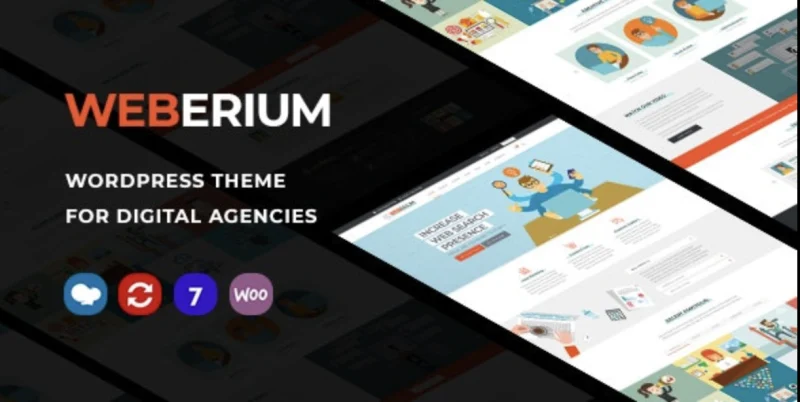
Weberium Responsive WordPress Theme is a PHP/MySQL-based theme package engineered for digital agencies, marketing firms, SEO consultants, and web development studios to publish service-driven websites without hand-writing front-end markup. The package removes the bottleneck of assembling agency-grade page structures—service grids, case-study sections, team profiles, and portfolio archives—by shipping multiple pre-designed homepages and inner pages that install onto a standard WordPress setup. Within a production delivery workflow, it operates as the presentation layer above WordPress core, letting teams compose, restyle, and deploy client-facing pages through a drag-and-drop builder engine and a centralized options panel.
Technical Specifications & Deployment Matrix
| Engineering Metric | Deployment Specification |
|---|---|
| Base Technology / Framework | WordPress theme package (PHP templates, responsive CSS/JS front end) |
| Runtime / Language Requirements | PHP and MySQL served by a maintained WordPress core release |
| Data Exchange / Communication Protocols | WordPress template hierarchy rendering; options store persistence for panel settings |
| Front-End / Engine Dependencies | Integrated drag-and-drop page builder; bundled premium slider plugin; WooCommerce storefront layer |
| Database / Persistence Footprint | Content and layout metadata stored in native WordPress tables; no manual database provisioning required |
Template Rendering & Page Builder Execution Pipeline
Weberium routes each page render through the WordPress template hierarchy and its page builder engine. On an inbound request, WordPress core resolves the matching template file—home, standard page, or custom archive—and the builder engine reads the layout metadata attached to that post, assembling the final DOM server-side before the response is serialized as HTML. Builder-generated modules enqueue their own CSS and JS fragments, so an active minification or concatenation step in the asset pipeline measurably reduces request counts and supports LCP and CLS targets under Core Web Vitals evaluation. Because the bundled slider plugin registers its media payloads through the same enqueue system, hero media should be compressed and dimensioned before upload to limit layout shift during first paint.
The storefront layer inherits WooCommerce’s theming contracts: template overrides align with the plugin’s expected file structure, so product archives, single-product views, and checkout screens render inside the theme’s layout containers. Agencies requiring B2B commerce behavior beyond the standard storefront—tiered pricing, quote requests, or customer group rules—can extend that layer by integrating B2BKing, which operates as a WooCommerce plugin alongside the theme rather than a modification of its template files.
Core Technical Capabilities of Weberium
- Drag-and-drop page builder integration: layouts persist as structured metadata within post content and are parsed into DOM nodes at render time, removing manual PHP template editing from routine page changes.
- Centralized theme options panel: header and footer configuration, layout selection, and color schemes are written to the options store and applied globally across every template, converting site-wide restyling from a file operation into a panel operation.
- Portfolio and gallery layouts: multiple archive and single-item presentation modes are exposed through the theme’s template set, giving case-study and project content distinct rendering paths without custom post type development.
- WooCommerce storefront compatibility: commerce templates inherit the theme’s container and typography systems, allowing product pages and checkout flows to publish inside the same visual framework as marketing pages.
- Mobile-first, retina-ready, cross-browser output: responsive breakpoints govern layout reflow on small viewports, while high-density image handling keeps rendered assets sharp on retina displays across current browser engines.
Production Implementation & Operational Resilience
In agency staging environments, the package installs through the standard WordPress theme upload path and expects a maintained core release running on a conventional PHP and MySQL stack. Builder editing holds layout structures in memory during save and render operations, so server memory allocation should be sized for pages with dense module trees before replication to production. For client engagements that require an IT-solutions positioning rather than a creative-agency one, Techco exists as a parallel WordPress theme oriented toward lead capture and service clarification.
Operational resilience depends on where customization happens. Settings changed through the options panel—header layouts, color schemes, footer composition—are persisted to the database and survive theme file updates, so routine restyling should never require touching template files. PHP-level modifications, by contrast, belong in a child theme; direct edits to parent templates are overwritten whenever the package is updated. Front-end behavior under load is governed by asset volume: builder modules and the slider plugin each enqueue separate stylesheets and scripts, and consolidating those fragments through a caching or optimization layer is the practical lever for holding LCP within target on traffic-heavy pages.
Search visibility is addressed at the markup level, with the codebase structured for crawler readability; ranking outcomes still depend on heading hierarchy and copy decisions made inside builder modules. For decoupled implementations outside a full PHP theme package—where a team standardizes on a kit-based workflow—Agence functions as an independent design path for agency sites, operating at the JSON layout layer rather than the template hierarchy. Weberium itself remains a self-contained option for studios that want builder-driven page assembly, commerce support, and portfolio presentation governed by a single theme framework.
Frequently Asked Questions
Does Weberium include pre-designed homepages and inner pages that install without building layouts manually?
Yes, the package ships with multiple pre-designed homepages and a set of inner pages covering typical agency needs, which can be activated and then edited through the page builder rather than assembled from empty canvases.
Is a premium slider plugin bundled with the theme, or must one be sourced separately?
Yes, a premium slider plugin is bundled as part of the package, so hero and media slideshow functionality is available at installation without sourcing a separate slider component from another vendor.
Is the theme structured for search engine visibility without additional configuration?
Yes. The codebase is optimized for search engine visibility, giving SEO-focused agencies a markup foundation for organic ranking; final ranking outcomes still depend on heading structure and copy decisions within builder modules.
-
1.23 LatestSeptember 25, 2026