Tradexpro-Future trade Addon
Tradexpro Future Trade Addon Overview & Derivatives Functional Engine
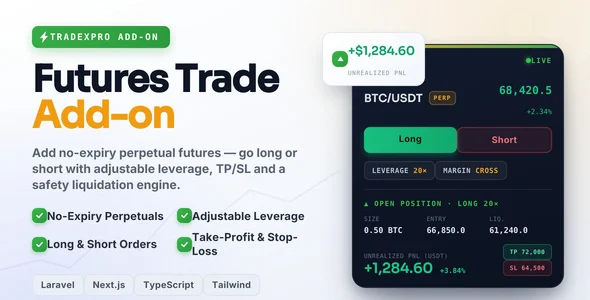
Tradexpro Future Trade Addon is a Laravel-based perpetual contracts module, engineered for exchange operators who need to extend Tradexpro Exchange with derivatives capabilities. It resolves the absence of leverage and margin functionality in spot-only platforms by adding long and short positions, adjustable leverage, real-time PNL tracking, and an automated liquidation engine. In production workflows, it functions as the layer that converts an existing spot venue into a full futures trading platform for both retail and professional traders.
Technical Specifications & Deployment Matrix
| Engineering Metric | Deployment Specification |
|---|---|
| Base Technology / Framework | Laravel (PHP 8.x codebase) |
| Runtime Requirements | PHP 8.x on an unmanaged Linux Ubuntu VPS with terminal access |
| Web Server | Nginx |
| Database / Persistence | MySQL (latest version preferred) |
| Hardware Baseline | 8 GB RAM minimum, 80 GB disk minimum, 4 CPU cores minimum |
| Asset Bundle | JavaScript, HTML, CSS, and PHP source files |
| Browser Support | IE9, IE10, IE11, Firefox, Safari, Opera, Chrome, Edge |
Perpetual Contracts Engine & Execution Pipeline
Orders enter the Laravel backend, which validates leverage, margin mode, and wallet balances before execution.
Architectural & Functional Highlights
- Perpetual contract execution: Contracts carry no expiration date, so positions remain open until the trader or the risk engine closes them. Market orders fill at current feed prices, limit orders rest at user-defined targets, and both long and short exposure are supported, letting traders profit from either price direction.
- Leverage and margin model: A slider interface selects leverage within admin-defined ceilings. Cross margin shares the wallet balance across all open positions, while isolated margin confines risk to the collateral assigned to a single position. The interface also displays the exact liquidation price implied by the current leverage setting, and upfront cost calculation shows required funds before a buy or sell is submitted.
- Risk management pipeline: Take-profit and stop-loss levels attach at order creation, so the system closes positions automatically to secure gains or cap drawdowns. A liquidation engine monitors position health continuously and force-closes accounts that breach margin thresholds, protecting platform solvency, while status notifications fire when orders fill, positions open or close, or liquidations occur.
- Market data and telemetry: A live order book streams current bid and ask depth, candlestick charts cover 5-minute through 1-day intervals, and 24-hour highs, lows, and volume metrics refresh continuously. PNL recalculates in real time against entry and mark prices.
- Administration and accounting: Separate maker and taker fees deduct automatically from user wallets, and a backend control panel allows admins to add coin pairs, edit pair settings, adjust fees, and audit complete order, position, and trade histories across the platform.
Teams that also publish broker comparisons or market commentary on the WordPress side can run Tradexy as a parallel review-and-affiliate presentation layer, an independent content property that shares no runtime with the exchange itself.
Production Deployment & Implementation Considerations
Production rollout demands an unmanaged Linux Ubuntu VPS: shared hosting and control-panel environments fall outside the supported matrix, and terminal access is required for server configuration. The documented hardware floor is 8 GB RAM, 80 GB disk, and 4 CPU cores — the CPU allocation exists specifically so the market-making bot performs adequately. Nginx serves as the web server, PHP 8.x executes the codebase, and a recent MySQL build persists exchange data. A critical implementation boundary is dependency: the module registers inside the Tradexpro Exchange core and cannot operate as an isolated application, so the main platform must already be deployed. Customization flows through the admin control panel, where new futures coin pairs, pair settings, fee levels, and leverage ceilings can be adjusted without editing source files. Security ownership sits with the operator — penetration testing before launch and ongoing server maintenance are operator responsibilities rather than bundled services. Operators who additionally need a public marketing site can adopt Tradent as an independent WordPress front end for trading and ICO landing pages, decoupled from this Laravel runtime.
Frequently Asked Questions
Can the module operate as a standalone exchange without the Tradexpro Exchange core?
No. The module is a functional extension that requires the Tradexpro Exchange platform to be installed first; the futures engine registers its pairs, wallets, and order routing inside the main Laravel application rather than running as an independent service.
Is shared hosting deployment supported?
No. The documented baseline is an unmanaged Linux Ubuntu VPS with terminal access, Nginx, PHP 8, MySQL, 8 GB RAM, 80 GB storage, and 4 CPU cores; control-panel and shared hosting environments are explicitly excluded from the supported deployment matrix.
Does the download bundle include setup documentation?
Yes. The package contains the Future trade addon main files together with documentation, enabling self-hosted operators to follow the written installation path on their own server environment. Demo imagery shown in previews is not part of the bundle.
Can funds move between the spot and futures wallets while positions are open?
No. Wallet transfers between the spot and futures balances are processed only when the account holds no open positions, which prevents funds from being withdrawn from under active margin obligations on the exchange.
-
v1.0 Latest