Tonmart – Electronics & Multi-Purpose Shopify Theme
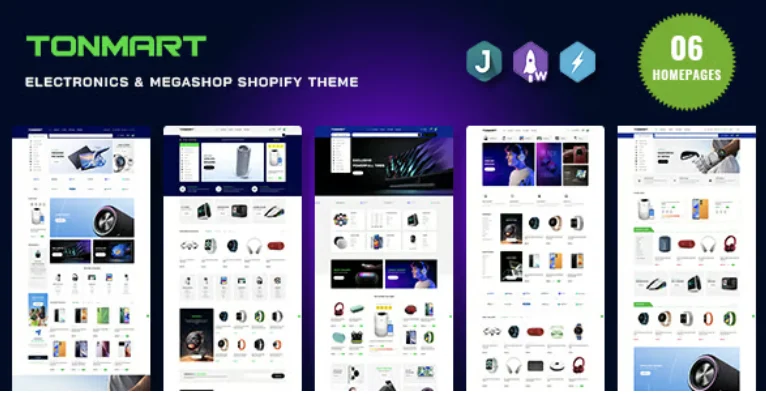
Tonmart Electronics Shopify Theme Overview & Storefront Architecture
Tonmart is a Shopify Online Store 2.0 theme engineered for electronics retailers, gadget shops, and dropshipping operators running multi-category catalogs supplied through Amazon, AliExpress, eBay, or Alibaba. The architecture targets the structural bottleneck of high-volume tech storefronts: surfacing thousands of phone, laptop, smart-home, and accessory SKUs while keeping product discovery, cart mutation, and checkout flows responsive on mobile connections. Within agency delivery pipelines, the package operates as a production-ready storefront foundation, pairing six pre-built homepage demos with drag-and-drop section control so routine layout changes never demand hand-written Liquid.
Technical Specifications & Deployment Matrix
| Engineering Metric | Deployment Specification |
|---|---|
| Base Platform | Shopify Online Store 2.0 with sections enabled on every page |
| Runtime / Templating | Liquid rendering on Shopify-hosted infrastructure |
| Deliverable Assets | CSS files and JS files included in the ThemeForest package |
| Front-End Grid | Bootstrap 4.x compatible layout framework |
| Browser Coverage | Firefox, Safari, Opera, Chrome, Edge |
| Display Layer | Responsive layout, high-resolution asset support, RTL stylesheet direction |
| Data Persistence | Native Shopify product, collection, and cart storage managed by the platform |
Liquid Section Rendering & Storefront Execution Pipeline
Tonmart renders every page through Shopify OS 2.0 sections assembled in JSON templates. Each homepage demo ships as a pre-arranged section stack — hero banners, video banner sections, deal countdown blocks, and Ajax product tab modules — that merchants reorder through the visual editor. Because sections exist on every page rather than only the homepage, collection layouts (eight-plus variants), product page layouts (twelve-plus variants), blog list styles (five-plus), and blog detail styles (three-plus) inherit the same reordering logic. Collection output can be organized by numbered pagination, a load-more button, or infinite scroll, and shoppers switch between grid and list modes with a price range slider applied on top of dynamic product filtering. The mobile menu renders as an off-canvas drawer whose menu tree is configured independently from desktop navigation, while mega-menu and vertical-menu structures govern desktop category traversal. Auxiliary templates cover 404, contact, about, FAQs, size guide, testimonial, and store location or direction pages. For merchants outside the electronics vertical who need the same section-based model, Furniture Shopify Theme – Furni provides a parallel home-goods implementation on the identical Shopify runtime.
Core Technical Capabilities of Tonmart
- Ajax Cart State Synchronization: Add-to-cart actions, cart drawer popups, quick-edit and quick-update cart operations, and cross-sale collection injection on the cart page all mutate cart state without full page reloads, preserving scroll position during merchandising.
- Variant Merchandising Layer: Product variant image swatches and pattern swatches, Quick Shop with variation selection directly on the homepage, and 360-degree, 3D, and video product imports give buyers full configuration context before the cart.
- Discovery & Conversion Modules: Search auto-suggestion with trending keyword output, deal product countdown timers, a free shipping threshold bar, dynamic checkout buttons, and sticky add-to-cart bars concentrate purchase intent at decision points.
- Cross-Border Readiness: Multiple languages and multiple currencies operate alongside RTL stylesheet direction, while the built-in wishlist app and quick-view app extend session persistence for international traffic.
Production Implementation & Operational Resilience
Deployment follows the standard Shopify theme upload path: the package’s CSS and JS files compile into the storefront, and section data persists in JSON templates that survive theme duplication across client stores. Lazy loading defers image payloads until viewport intersection, which constrains initial bandwidth on image-heavy electronics catalogs. Resilience mechanisms operate at the commerce layer rather than the server layer — Shopify hosts the runtime — so operational risk concentrates in template configuration. Out-of-stock products expose a notify-me subscription instead of dead-end listings; back-in-stock demand converts into email capture. Popup banners and newsletter popups run on first-visit triggers, while Ajax login and registration popups authenticate sessions without page redirection. Documented compatibility with the Judge.me review app allows review data to render inside product layouts without custom Liquid injection. Sticky headers, recently-viewed sections on collection and product pages, and related-product carousels extend session depth, and estimate-shipping-rate plus per-order note fields carry checkout-context data. For decoupled storefronts in the floral vertical operating on the same runtime, Pookal – Flower Shop & Florist Shopify Theme stands as an independent vertical alternative. Secondary development stays within section reordering, layout variant selection (grid versus list, pagination versus infinite scroll), and app-block configuration; the architecture exposes no external PHP execution surface since all logic executes through Liquid and Shopify’s platform APIs.
Frequently Asked Questions
Can store administrators rearrange homepage sections without editing Liquid code?
Yes. The theme runs on Shopify OS 2.0 with drag-and-drop section editing, so homepage and page-level layouts are reconfigured through the visual editor rather than through direct template file edits.
Does the package interoperate with the Judge.me product review app?
Yes. Compatibility with Judge.me is explicitly documented, allowing review content to render within product page layouts through the app’s standard integration path rather than requiring custom template work.
Is there a built-in mechanism for capturing demand on out-of-stock products?
Yes. A Notify Me When Out of Stock subscription function replaces unavailable items’ buy buttons on product pages, converting lost purchase intent into a recoverable email capture stream for restock campaigns.