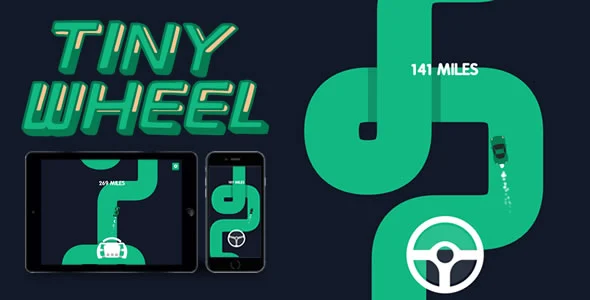
Tiny Wheel – HTML5 Game
Tiny Wheel Overview & Canvas-Rendered Steering Arcade Architecture
Tiny Wheel is an HTML5 arcade driving game built on the CreateJS library, engineered for web studios and game-portal operators who need a self-hosted, score-driven casual title that runs across desktop and mobile browsers. The package implements a rotation-based steering mechanic: players spin an on-screen wheel to hold the vehicle on the road, and survival distance converts directly into the accumulated high score. Within production delivery pipelines, the codebase operates as a drop-in embed that scales between a 1280×768 landscape build and a 768×1024 portrait build, so a single deployment covers both orientations without manual layout branching.
Technical Specifications & Deployment Matrix
| Engineering Metric | Deployment Specification |
|---|---|
| Base Technology / Framework | CreateJS suite rendering to HTML5 Canvas |
| Runtime / Language Requirements | JavaScript, HTML, CSS; PHP file included in the distribution |
| Browser Compatibility | Chrome, Edge, Firefox, Safari, Opera, IE9 through IE11 |
| Input Layer | Unified mouse and touch event handling |
| Resolution & Scaling | 1280×768 and 768×1024 builds with devicePixelRatio-aware proportional scaling |
| Persistence & Distribution | Local high-score tracking with share endpoints for Facebook, Twitter, WhatsApp, Telegram, Reddit, and LinkedIn |
Steering Loop, Vehicle State & Execution Pipeline
Every input event is routed through a single steering-rotation handler that maps wheel angle to lateral vehicle movement inside the CreateJS ticker. The execution path proceeds in a fixed sequence: pointer or touch input produces a rotation delta on the steering image, that delta is applied as lateral velocity to the active vehicle, the road renderer advances beneath the chassis, off-road conditions are detected against the configured road width, and the validated survival state increments the score counter before the next frame. Because each stage reads from isolated settings objects, changing a single parameter never forces a rewrite of the loop logic itself.
Five unlockable wheels — Car, Boat, F1, Jet, and X-Wing — are defined as discrete configuration records rather than hard-coded branches. Each record carries its own image assets, steering image, sound assignment, and score profile, so swapping a vehicle is a data substitution rather than a code change. Studios assembling a multi-title casual portal alongside this package can deploy Orc Typer as a parallel typing-based entry point, since both assets ship as standalone HTML5 embeds with no shared runtime dependency.
Core Technical Capabilities of Tiny Wheel
- Modular Vehicle Configuration: Each wheel variant exposes image assets, steering image, sound, and score as editable settings, allowing reskinners to introduce new vehicles through configuration alone.
- Road and Engine Parameterization: Road width and color, engine speed, and particle emission are exposed as discrete settings, giving direct control over difficulty geometry and visual feedback density without touching render code.
- Multi-Network Score Distribution: The share layer dispatches scores to Facebook, Twitter, WhatsApp, Telegram, Reddit, and LinkedIn, covering the six dominant social referral channels from a single UI action.
- Dual-Orientation Responsive Scaling: The 1280×768 and 768×1024 builds scale proportionally with devicePixelRatio correction added in version 1.3, preventing blurred output on high-density mobile displays.
- Session Control Primitives: Enter FullScreen, Mute Sound, and Exit Game options are wired into the base template as standard runtime controls.
Production Implementation & Operational Resilience
Deployment requires only a static file host capable of serving the JavaScript, HTML, CSS, and PHP files contained in the ZIP package; no database or server-side runtime is mandated by the base game. The template ships with a dedicated browser-not-supported fallback page, which activates when a visitor arrives on an engine outside the documented compatibility matrix — IE9 through IE11, Firefox, Safari, Opera, Chrome, and Edge — and prevents a blank-screen failure mode on legacy deployments. The devicePixelRatio corrections introduced in version 1.3 and the HTML5 template rebuild in version 1.3 through 1.5 address the scaling artifacts and social-share defects reported in earlier revisions, so operators deploying the current build inherit those fixes by default.
Reskinning is bounded to asset replacement: a layered Photoshop PSD file is included in the distribution, and the complete text display and image assets are overridable through the documented settings layer. An optional leaderboard add-on extends the base game with score submission and a Top 10 ranking view, but it is an additional module that requires the core package to already be in place — it is not a standalone replacement. Teams planning a broader HTML5 entertainment section on a client site can pair this title with Arden’s Journey as a separate platform-game entry, since both run as independent embeds and impose no shared server requirements.
Frequently Asked Questions
Does the package include editable Photoshop source files for reskinning?
Yes, a layered PSD file ships alongside the JavaScript, HTML, CSS, and PHP sources, and the documented settings layer maps image assets and text display to replaceable slots within that design file.
Can players submit scores to a ranked leaderboard?
Yes, but only through the optional leaderboard add-on, which requires the base game to function and provides score submission plus a Top 10 rankings view as an additional module.
Does the game support portrait orientation on mobile devices?
Yes, the ZIP contains a dedicated 768×1024 portrait build alongside the 1280×768 landscape build, and both scale proportionally to fit the current screen with devicePixelRatio-aware rendering.
Can the five unlockable wheels be replaced or extended?
Yes, each wheel — Car, Boat, F1, Jet, and X-Wing — is defined through vehicle settings covering image assets, steering image, sound, and score, so replacements are configuration-driven rather than hard-coded.