Tagxi Delivery App- Trucking Solution
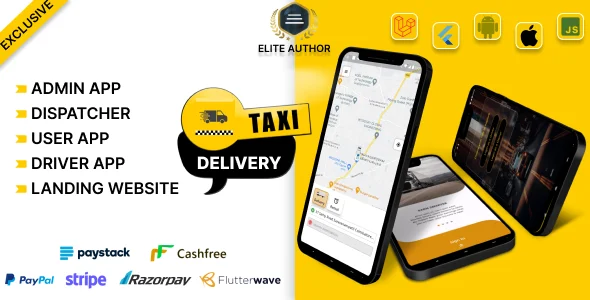
Tagxi Delivery App Overview & On-Demand Dispatch Architecture
Tagxi Delivery App is a Flutter-based ride and goods delivery management system engineered for transport startups and development agencies to operate taxi, truck booking, and parcel courier services from one codebase. The package resolves the dispatch coordination bottleneck — matching incoming ride requests against driver availability, computing traffic-aware fares, and synchronizing live vehicle positions across four separate clients — through a single backend API. In agency delivery workflows, the admin portal acts as the operational control plane, governing zones, vehicle types, fare rules, driver approvals, and complaint workflows.
Technical Specifications & Deployment Matrix
| Engineering Metric | Deployment Specification |
|---|---|
| Base Technology / Framework | Flutter 3.x client apps written in Dart; builds verified up to Flutter 3.35.2 in the v1.13 release |
| Server Runtime Requirements | VPS on Ubuntu 20.04 preferred; PHP backend with API source included; Flutter SDK 3.24.4 and Xcode 14.0.1 for client builds |
| Included Source Files | Dart, PHP, YAML, and XML files spanning the user app, driver app, admin panel, and dispatcher portal |
| Data Exchange & Services | REST/JSON API between mobile clients and the server-app backend; Firebase push notifications; Google Maps APIs; Twilio and SMSala SMS gateways |
| Platform Services Dependency | Billing-enabled Google Cloud and Firebase console access; Google Play Integrity for device verification |
Four-Client Dispatch Pipeline & Execution Flow
The engine routes every booking through a request-response chain linking the user, driver, dispatcher, and admin applications to one server-side API. A customer pins pickup and drop-off coordinates on the map layer, views nearby vehicles in real time, and either books on demand or schedules ahead; the request enters the dispatch pool, where the fare API computes a price from distance plus live traffic data before a driver accepts. The driver begins the trip only after OTP verification, streams location updates throughout the journey, and completes it through a structured flow that feeds ratings, invoices, and history filters back to the rider. When automatic matching is undesirable, the dispatcher portal exposes manual dispatch, driver filters on the map, and a real-time timeline of every event in the ride lifecycle. Operators running adjacent delivery verticals often evaluate separate platforms; for a self-contained florist ordering stack, the Flower Shop Online Flowers Delivery App functions as an independent single-vendor alternative outside this runtime.
Core Technical Capabilities of Tagxi Delivery App
- Traffic-aware fare engine: the API factors trip distance and real-time traffic into price calculation, with surge multipliers configurable per zone and per day/time window by the administrator.
- OTP-secured trip lifecycle: rides start only after OTP validation, and cancellations on both sides flow through admin-configurable dynamic reason lists that feed reporting and complaint categories.
- Geofenced zone operations: the admin panel defines zones with per-zone price configuration and airport pickup/drop fees, plus a heat map and a God’s Eye driver map view for fleet visibility.
- Multi-currency, multilingual clients: both apps ship with localization and multi-currency handling, wallet top-ups by debit or credit card, and cash, card, or wallet settlement options.
- Dispatcher tooling: rental rides, multiple-stop routing, scheduled bookings, and manual assignment run through the dispatcher portal with real-time status per ongoing ride.
For teams that also need a native vehicle marketplace outside this dispatch runtime, Motors exists as an independent Android and iOS classified-listing application for automotive inventory.
Production Implementation & Operational Resilience
Deployment assumes a self-hosted posture: operators need a VPS on Ubuntu 20.04, billing-enabled Google Cloud and Firebase console access, Flutter SDK 3.24.4 or later, and Xcode 14.0.1 for iOS builds, with prior knowledge of mobile development and server installation expected from the deploying team. The Android client targets API 35, handles Android 15 edge-to-edge rendering as of v1.12, and relies on Play Integrity — a migration away from the deprecated SafetyNet check — for Firebase device authentication, while single-device authentication restrictions lock each account to one active handset. Background resilience on Android is handled through bubble and wakeup functionality that keeps driver location streams alive between trips.
Exception paths are structured rather than ad hoc: cancellation reasons, complaint categories with state management, and SOS number configuration are all admin-defined, so operational edge cases resolve through configuration instead of code changes. Push notification templates for both user and driver audiences are editable from the admin panel, and SMS dispatch runs through the Twilio or SMSala gateways. Reporting covers users, drivers, travel, and financials, with invoice export available from the admin panel since v1.7. Businesses wanting a complementary web storefront on a different stack — such as a WordPress channel for food-truck rentals — can run Takorent as a decoupled booking theme alongside, never merged into, the Flutter deployment.
Frequently Asked Questions
Does the purchase package include the Flutter source code for both mobile apps plus the backend?
Yes. The deliverable contains the Dart source for the user and driver apps, a server-app folder holding the admin panel and backend API source, and online documentation covering setup, configuration, and the full module structure.
Can administrators enable or disable the taxi and delivery modules independently?
Yes. Since version 1.3, the admin application exposes a module toggle that activates or deactivates taxi and delivery functions, letting a single deployment operate as a ride-hailing service, a courier service, or both simultaneously.
Does the system support rental rides and multi-stop trips with staged completion?
Yes. The dispatcher portal includes the rental ride feature and multiple-stop routing, and the v1.9 release added a mechanism to end all stops, so staged drop-offs are tracked and closed individually within a single trip record.
Are Android 15 edge-to-edge display behaviors and the latest target API handled?
Yes. The v1.12 update raised the Android target API to 35, resolved edge-to-edge rendering issues in both mobile clients, and added an edit-destination capability to the user app alongside fixes in the admin panel.
Ionic 8+ Food Delivery (Android + iOS) Apps, Angular 19+ Admin Panel with Firebase
Website | Courier | Delivery | Logistics | Booking | On demand | Parcel | Transportation
6 App Template| Online Medicine Ordering App| Medicine Delivery App| Pharmacy eCommerce| Pharmazone