Website | Courier | Delivery | Logistics | Booking | On demand | Parcel | Transportation
Pick Courier On-Demand Delivery Web App Overview & Three-Tier Logistics Architecture
Pick Courier is an Angular-based on-demand delivery web application, engineered for logistics operators, courier startups, and delivery agencies to manage parcel booking, dispatch, and fulfillment across a complete order lifecycle. The package resolves the coordination bottleneck of routing customer orders, automated quotations, driver assignment, and payment settlement through three synchronized clients: a customer-facing WebApp, a Web Admin Dashboard for fleet and order control, and a companion Android driver application that executes pickup and delivery handoffs. Within a production workflow, the codebase functions as a self-hosted deployment foundation, giving an agency a ready customer ordering surface, an administrative control plane, and a driver-side execution channel in a single deliverable set.
Technical Specifications & Deployment Matrix
| Engineering Metric | Deployment Specification |
|---|---|
| Base Technology / Framework | Angular (latest version); source code updated October 04, 2024 (v4.0) |
| Runtime / Language Requirements | JavaScript runtime; included source files span JavaScript JS and JavaScript JSON |
| Data Exchange / Communication Protocols | JSON-based data exchange coordinating the WebApp, Web Admin Dashboard, and Android driver app |
| Front-End / Engine Dependencies | Google Maps integration (paid API keys supplied by the operator); Stripe payment gateway |
| Database / Persistence Footprint | Self-hosted database with wallet ledger, order records, driver earnings, and promo code data |
Order Lifecycle & Execution Pipeline
The core mechanism is a JSON-driven order pipeline that moves each parcel record from quotation to delivered status across all three clients. A session begins on the customer WebApp, where a registered account or an integrated Guest Mode entry point produces an order draft. Address verification logic then validates and corrects pickup and delivery locations before the record is committed, reducing failed handoffs caused by malformed input. An automated pricing algorithm computes the shipping quote from distance, package size, and weight, returning the cost to the customer during ordering rather than after dispatch.
Once an order is placed, the request enters the admin control plane, where fleet operators assign or monitor the job while the Android driver application receives it for acceptance. Delivery state transitions — Accepted, Picked-up, and Delivered — propagate in real time back to the customer interface, letting senders and recipients track shipment progress without manual status calls. Google Maps renders the location context for verification and tracking; the mapping layer requires the operator to provision paid API keys on their own infrastructure, a deployment prerequisite to budget before launch.
Architectural & Functional Highlights
- Automated Quotation Engine: Calculates shipping cost from distance, package dimensions, and weight parameters, delivering instant quotes inside the ordering flow and eliminating manual rate negotiation from the pipeline.
- Multi-Path Payment Stack: Supports Stripe card processing via an integrated gateway, a wallet balance maintained on the user side, and cash-on-delivery settlement, with the admin able to deposit funds directly into user wallets.
- Fleet Management Control Plane: The Web Admin Dashboard exposes user management, driver management, order management, sub-admin creation, promo code generation, and driver payout release on payout requests, consolidating back-office operations in one surface.
- Localization and Vehicle Layer: Multi-language support, country-wise and city-wise location selection, and dynamic vehicle administration allow operators to configure regional service coverage and fleet composition without code-level changes.
- Guest Access Mode: Guest login lowers the registration barrier for one-time senders while preserving the full ordering and tracking flow available to authenticated accounts.
Production Implementation & Operational Resilience
Deployment begins with building the Angular source into a self-hosted environment, after which the operator provisions Google Maps API keys and Stripe credentials as configuration inputs. The database shipped with the current release was reset during the v4.0 transition, meaning legacy booking records were purged — a fresh instance carries no historical order data, which simplifies first-time staging but requires teams migrating from older versions to plan for archival extraction beforehand. Because the mapping and payment layers depend on third-party services, environment-level key validation should be executed during staging to catch credential or quota errors before client go-live.
Resilience considerations center on the three-client synchronization model: if the driver application is not deployed or drivers are unavailable, orders cannot progress through acceptance and delivery completion, so the Android component is an operational requirement rather than an optional companion. On the administrative side, payout workflows are triggered by driver requests, so finance teams should reconcile wallet movements and driver earnings through the dashboard’s earning management views. For agencies widening a transportation portfolio beyond parcel dispatch, the Tripcar Car Rental Service Elementor Template Kit exists as an independent design path for rental booking sites on a separate WordPress stack. Similarly, teams pursuing an adjacent grocery fulfillment vertical can evaluate the Hungry Grocery Delivery Android App and Delivery Boy App as a standalone codebase outside this Angular architecture, since cross-stack merging of the two systems is not a supported operation.
Frequently Asked Questions
Does the package include an Android application for drivers?
Yes, the deliverables comprise the customer WebApp, the Web Admin Dashboard, and an Android driver app. Testing the complete functional cycle requires a driver to accept orders and complete deliveries through the driver application.
Can customers place orders without creating a registered account?
Yes, Guest Mode and Guest Login were integrated in the v3.0 release (July 04, 2024), allowing one-time senders to submit orders through the WebApp while registered accounts retain wallet and history features.
Does the mapping functionality work without operator-supplied API keys?
No, the Google Maps integration requires paid APIs provisioned from the operator’s side. Location selection, address verification, and tracking views depend on these keys being configured in the deployment environment.
Can the admin dashboard delegate administration to additional staff accounts?
Yes, the fleet management layer introduced in v2.2 allows the primary admin to create sub-admin accounts, alongside generating promo codes and processing driver payout requests directly from the dashboard.
Hungry Grocery Delivery Android App and Delivery Boy App with Interactive Admin Panel
6 App Template| Online Medicine Ordering App| Medicine Delivery App| Pharmacy eCommerce| Pharmazone
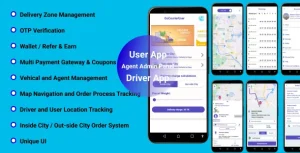
GoCourier – On Demand Delivery System Native App | Service Provider + Backend + Driver & Vendor app