Swipe Tower – Unity project
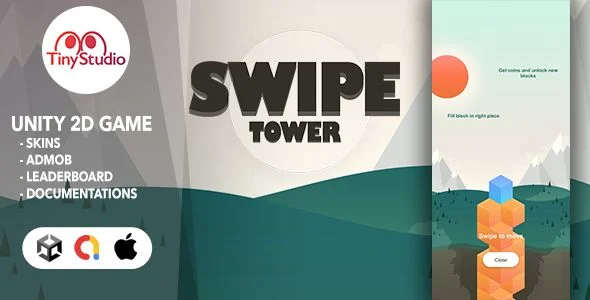
Swipe Tower Overview & Endless Arcade Architecture
Swipe Tower is a Unity2D mobile game source code, engineered for iOS developers and hypercasual publishers to ship an endless block-stacking arcade title without rebuilding core systems from scratch. The package consolidates player retention mechanics, a coin-driven skin economy, social sharing, GameCenter scoring, and AdMob monetization into a single commented C# codebase, removing the multi-week engineering effort those subsystems typically demand. Within a production pipeline it functions as a ready-to-compile asset: teams replace art files, insert their own ad identifiers, and export an iOS build using Unity 2021.3.27f1 or newer.
Technical Specifications & Deployment Matrix
| Engineering Metric | Deployment Specification |
|---|---|
| Base Technology / Framework | Unity2D engine with gameplay scripts written in C# |
| Runtime / Editor Requirements | Unity 2021.3.27f1 or a newer release recommended for build generation |
| Target Platforms | iOS 12, iOS 13, iOS 14, iOS 15, and additional supported deployment targets |
| Native Deliverables | .h and .xib/.nib files included alongside the Unity project |
| Monetization Layer | AdMob framework with developer-configurable ad identifier slots |
| Persistence Footprint | On-device local storage for collected coins and unlocked skins, no backend dependency |
Swipe-Driven Gameplay Loop & Execution Pipeline
Each session processes swipe gestures as positional inputs that steer blocks toward validated slots on an endlessly generated tower. The input layer translates touch events into displacement commands, the placement validator checks alignment against the target position, and misalignment produces the fall behavior that defines the arcade challenge. Because the loop runs on Unity2D rather than a full 3D pipeline, rendering overhead remains low while the endless-generation logic keeps stacking complexity predictable. Coins collected during play feed a local economy that gates skin unlocks, and gameplay variables such as spawn behavior and reward values are exposed as configurable values rather than hardcoded constants, allowing difficulty retuning without touching script internals.
Core Technical Capabilities of Swipe Tower
- Local Notification Retention Layer: Re-engagement messages fire at 2, 6, and 22 hours after a session, scheduled entirely on device with no push server or backend infrastructure required.
- Share Function with Short-Link Injection: The share module appends a configurable short link to outbound messages, converting each player share into a measurable user-acquisition channel.
- Coin-Gated Skin Economy: Players spend collected coins on unlockable skins, and the included documentation defines the exact procedure for appending new skin entries without restructuring shop logic.
- AdMob Monetization Framework: Ad units are wired through the AdMob framework, so store-ready publishing requires only replacing placeholder identifiers with a developer’s own ad IDs.
- Complete Session Framework: Pause, tutorial, rate-us prompt, and GameCenter integration ship pre-connected, covering the standard session lifecycle of a commercial hypercasual release.
The C# scripts are commented throughout, which shortens onboarding for engineers inheriting the codebase mid-project. For studios evaluating standalone Unity projects on a separate production track, Ancient Defence Game provides a tower-defense alternative targeting both Android and iOS deployment from one project.
Production Implementation & Operational Resilience
Deployment begins in the Unity editor — builds should be produced on 2021.3.27f1 or newer — followed by inserting AdMob identifiers, replacing art assets, and exporting through the included native iOS deliverables. Reskinning operates on a file-replacement model: the project treats visuals and audio as swappable files, so a full visual overhaul requires no scene surgery or script refactoring. Game-process behavior is adjusted by changing exposed values, which confines tuning mistakes to configuration data rather than compiled logic, and the underlying program architecture keeps input handling, economy, and monetization separated into distinct modules.
Operationally, the retention system runs entirely on device: notification scheduling at the 2, 6, and 22 hour marks executes through iOS local notifications, eliminating server costs, API dependencies, and ongoing infrastructure maintenance. The primary environmental boundary is editor versioning — building on Unity releases older than 2021.3.27f1 is not recommended — while monetization output depends on correctly provisioned AdMob identifiers before submission. Studios that need contextual help have the bundled documentation as the reference point for skin expansion and value tuning.
For teams comparing standalone mobile game templates outside the Unity ecosystem, BEE PUZZLE implements a comparable coin-and-ad loop on Android Studio with GDPR handling built in.
Frequently Asked Questions
Can Swipe Tower operate and retain players without any backend server?
Yes. Retention is driven by iOS local notifications scheduled at 2, 6, and 22 hours after play, coin persistence and skin unlocks are stored on device, and sharing works through the OS share sheet, so no server-side infrastructure is required.
Is a specific Unity editor version required to generate builds?
Yes. The project documentation recommends the latest Unity version, or at minimum 2021.3.27f1, for reliable build output. Compiling on older editor releases is outside the tested path and may introduce compatibility issues during iOS export.
Can new skins be added without rewriting the shop or economy scripts?
Yes. The documentation describes the exact workflow for adding skins, treating them as content entries within the existing coin-purchase flow. Developers append new skin assets following that procedure rather than modifying the underlying shop architecture.
Does the package include native iOS files in addition to the Unity project?
Yes. The deliverables contain .h and .xib/.nib files alongside the Unity project and its C# scripts, supporting the native side of the iOS build pipeline when the exported project is prepared for App Store submission.