2D Games Master Collection – Unity Source Code
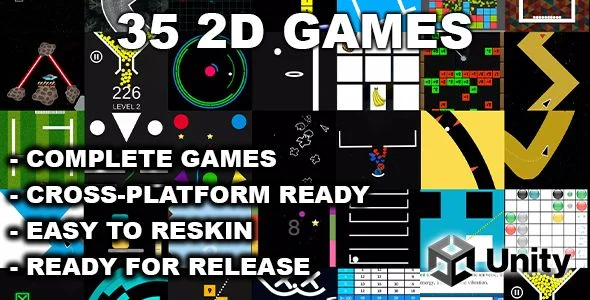
2D Games Master Collection Overview & Multi-Platform Game Template Library
2D Games Master Collection is a Unity-based game source code bundle engineered for indie studios and mobile publishers to ship reskinned casual and hyper-casual titles across six runtime targets. The package addresses the pipeline bottleneck of assembling a genre-diverse catalog from scratch by supplying 35 complete, independently structured 2D projects spanning endless runners, arcade shooters, physics puzzles, and reflex trainers. Within agency and publisher workflows, it operates as a production seed library: each title can be opened in the Unity editor, rebranded at the artwork level, and compiled directly for Android, iOS, WebGL, PC, Linux, or macOS distribution.
Technical Specifications & Deployment Matrix
| Engineering Metric | Deployment Specification |
|---|---|
| Base Technology / Framework | Unity engine with C# scripting and 2D project configurations |
| Runtime / Language Requirements | Unity editor and runtime; C# MonoBehaviour game logic; AdMob SDK for monetized builds |
| Data Exchange / Communication Protocols | On-device local execution; ad network requests routed through the integrated AdMob layer |
| Front-End / Engine Dependencies | Unity 2D sprite renderer, physics engine, scene management, and UI system |
| Database / Persistence Footprint | No external database dependency; titles run as self-contained compiled builds |
Unity Execution Pipeline & Multi-Genre Gameplay Architecture
Each of the 35 titles executes as a self-contained Unity project driven by C# MonoBehaviour scripts. Game logic runs inside the engine’s per-frame Update loop, where input from touchscreens, mouse pointers, and keyboards is polled and dispatched to active gameplay controllers. Scene transitions carry players between menu, gameplay, and game-over states, while the 2D renderer composes sprite layers into every frame. Titles such as Fill The Trucks, Wrecking Balls, and Through The Hoop rely on the 2D physics system, where rigidbodies and colliders simulate gravity, collisions, and impulse responses. Grid-based entries including Color Blocks, Rolling Maze, and Stack Tower instead run on deterministic board logic.
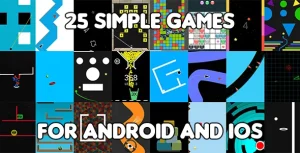
The catalog spans reflex arcade (Zig Zag, Fast Finger, Neon Yellow Ball), shooters (Neon Space Fighter, Asteroids), tap-driven sports games (Finger Football, Arrow Racer), logic and skill challenges (Brain Workout, Typing Test, Yamb), and physics fillers (Fill The Cups, Connect Balls), giving publishers coverage across multiple audience segments from one codebase family.
Core Technical Capabilities of 2D Games Master Collection
- Six-target build pipeline: Every project compiles through Unity’s build system into Android, iOS, WebGL, Windows, Linux, and macOS binaries from a single C# codebase, removing per-platform rewrites from the release cycle.
- AdMob monetization layer: The collection carries AdMob integration, so publishers can bind their own ad unit identifiers into menu and game-over flows before store submission.
- Input-agnostic control loops: Tap, hold, drag, and swipe handlers route through Unity’s input APIs, letting one controller script serve touch devices and desktop pointers without branching codepaths.
- Hybrid physics and logic systems: Rigidbody2D-driven simulations and deterministic grid algorithms coexist across the catalog, matching the engine subsystem to each genre’s requirements.
For teams weighing a native Android Studio path decoupled from the Unity toolchain, Puzzle Block Simple stands as a standalone puzzle release with its own AdMob and GDPR configuration.
Production Implementation & Operational Resilience
Deploying any title follows the standard Unity production cycle: import the project into the editor, switch the active build target, configure the bundle identifier and icons, then export. Android builds compile into installable packages through the Android SDK, iOS builds generate an Xcode project requiring signing credentials before App Store submission, WebGL output produces a browser-hostable bundle, and the remaining targets compile to standalone executables for Windows, Linux, and macOS.
Once titles ship, publishers typically need a presentation surface for the released catalog. For studios building that surface outside the game engine, Omero operates as a dedicated WordPress theme for indie game studio sites, handling portfolio and release pages as an independent web layer.
Operationally, each project runs as a self-contained build with no documented server-side backend, so gameplay content lives inside the compiled binary. Monetization activation requires registering your own AdMob application identifiers and ad unit IDs before release. Store submission demands the standard platform prerequisites: an Apple developer account and provisioning profile for iOS, and a signed keystore for Android. Performance ceilings scale with each target device’s CPU and GPU profile rather than any shared runtime service.
On the secondary development side, the C# scripts, prefabs, and scene graphs remain fully editable, so difficulty tuning, level layouts, and UI flow can be reworked without external dependencies. For publishers addressing the educational segment as a separate market, Kids Preschool Learning Games exists as an independent, publish-ready alternative outside this arcade catalog.
Frequently Asked Questions
Are layered PNG artwork sources included for reskinning the titles?
Yes. The deliverables list layered PNG files, meaning designers can open each sprite composition in a layered editor, swap palettes and characters, and export replacements without reconstructing artwork from flattened images.
Can the games be evaluated in a browser before committing to a local build?
Yes. The author publishes browser-playable test links on each project description, so WebGL behavior, controls, and difficulty curves can be verified directly before any source code is imported into the Unity editor.
Do the iOS builds support devices running iOS 12?
Yes. The documented compatibility band spans iOS 12 through iOS 15, covering older handsets alongside current-generation devices, which widens the addressable install base for App Store releases.
Does the bundle ship each of the 35 games as a separate project?
Yes. Every title, from Infinite Line Runner to Fill The Cups, is enumerated as its own project entry with an individual description, allowing studios to import, modify, and build any single game independently of the rest.