Swigo – Fast Food And Restaurant WordPress Theme
Swigo Overview & Restaurant Commerce Foundation
Swigo is a WordPress theme engineered for fast food restaurants, pizzerias, burger joints, and cafe operators to publish menus and sell food through a self-hosted storefront. It removes the bottleneck of assembling a restaurant site from scattered plugins by bundling an Elementor-driven layout pipeline, WooCommerce commerce bindings, Redux theme options, and one-click demo content into a single installable package. Within agency delivery workflows, it operates as the presentational and transactional layer that renders menu archives, blog layouts, and checkout flows on top of the native WordPress template hierarchy.
Technical Specifications & Deployment Matrix
| Engineering Metric | Deployment Specification |
|---|---|
| Base Technology / Framework | WordPress theme on Bootstrap 5.x with latest jQuery and SCSS source layer |
| Runtime / Language Requirements | WordPress 5.9.x through 7.0.x; PHP, CSS, SCSS, and JS files included |
| Page Builder & Editor Layer | Elementor page builder plus Gutenberg-optimized block rendering |
| Commerce / Plugin Interoperability | WooCommerce 7.x–9.x.x, Contact Form 7, WPML, MailChimp, reCaptcha |
| Localization / Persistence Footprint | .pot translation files, WPML multilingual support, Redux-based options stored in the WordPress database |
| Layout & Rendering Targets | 4+ column grids, responsive and retina-ready output, box and frame layout modes, sticky header, unlimited sidebars |
| Browser Compatibility Matrix | Chrome, Edge, Firefox, Safari, Opera |
Template Rendering & Elementor Execution Pipeline
Swigo routes every inbound request through the standard WordPress template hierarchy before handing layout control to Elementor widgets. Each page template loads its stylesheet bundle compiled from the bundled SCSS sources, while the Redux options panel persists typography and color decisions—drawn from the Google Fonts library, defaulting to Poppins and Lobster—as database-backed settings that the templates read at render time. Demo import runs through a one-click installer that provisions homepages, inner pages, blog layouts, and special menu page structures automatically after activation, so a staging environment reaches a near-production DOM state without manual page assembly.
Because widget coverage determines how far a build can go without custom code, teams that exhaust the bundled custom Elementor elements often extend the builder surface with ElementsKit Elementor Addons and Templates – WordPress plugin, which supplies additional widget modules and layout templates on the same Elementor runtime.
Core Technical Capabilities of Swigo
- Elementor Widget Pipeline: Custom Elementor elements and variable content sections allow page composition through drag-and-drop operations while the theme retains pixel-level control over rendered output.
- Redux Options Framework: Typography, color schemes, and layout modes are managed through a database-persisted options panel, enabling multi-scheme deployment from a single install without stylesheet rewrites.
- WooCommerce Storefront Bindings: Compatibility with WooCommerce 7.x through 9.x.x lets menu items and food products flow through native cart, checkout, and order endpoints without template conflicts.
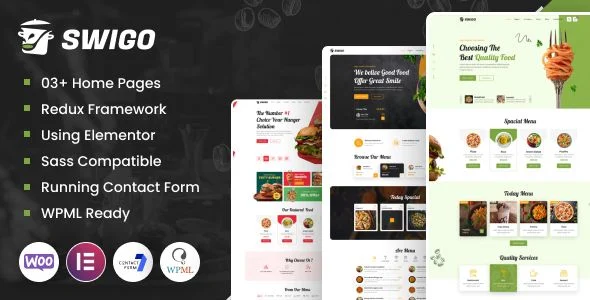
- One-Click Demo Provisioning: The installer seeds 3+ homepages, 40+ inner pages, 16+ blog layouts, and 5+ special menu pages, compressing initial build time for agency client handoffs.
- Localization & Form Layer: .pot files and WPML support drive multilingual output, while Contact Form 7, MailChimp, and reCaptcha integrations handle lead capture and newsletter subscription endpoints.
Production Implementation & Operational Resilience
Swigo has been tested on real devices and against WordPress multisite networks, which matters when an agency hosts multiple restaurant clients on a single network installation. The release history shows a continuous compatibility cadence—WordPress 6.7.1, 6.8.1, and 7.0.1 alignment, WooCommerce 9.8.5 verification, bundled plugin refreshes, PHP deprecation cleanup, and security hardening—indicating an actively maintained codebase rather than an abandoned asset. Restaurant operators needing table-reservation workflows beyond the bundled page set can evaluate Dinenos – Restaurant WordPress Theme as a parallel Elementor-based alternative with reservation-oriented widgets.
Styling extension should happen at the SCSS variable layer or through a child theme, both of which the package supports by shipping source files rather than compiled CSS alone. This preserves upgrade paths: SCSS-level overrides survive theme updates, whereas direct edits to parent templates would be overwritten. Layout modes—boxed versus framed—plus sticky headers, mobile sidemenus, and unlimited sidebar registration give per-client visual differentiation from shared components. Cross-browser rendering has been verified across Chrome, Edge, Firefox, Safari, and Opera, reducing per-browser QA cycles before launch.
For food-sector merchants whose catalog extends into specialty protein retail rather than prepared meals, Boskery – Butcher & Meat Shop WordPress Theme covers the butcher-shop storefront vertical as a separate WordPress build, keeping Swigo deployments focused on fast food and cafe ordering flows. Widget-ready regions and multiple color options round out the customization surface without requiring PHP intervention.
Frequently Asked Questions
Does the Swigo package include SCSS source files alongside the compiled stylesheets?
Yes. The delivered files include PHP, CSS, SCSS, and JS assets, so developers can override design tokens at the source-variable level and recompile, rather than patching compiled CSS or injecting override stylesheets.
Can a full demo site be installed without manually rebuilding each page?
Yes. The one-click installer imports demo content after theme activation, and the bundled pages—including homepages, inner pages, blog layouts, and special menu pages—populate automatically without requiring page-by-page manual construction.
Is translation possible without purchasing a third-party multilingual plugin?
Yes. The theme ships with localizable .pot translation files, so string translation can be handled through standard WordPress translation tooling; WPML is supported optionally for sites running multiple languages in parallel.
-
5 January 2024 LatestSeptember 22, 2026