Suseio – AI Application Technology WordPress Theme
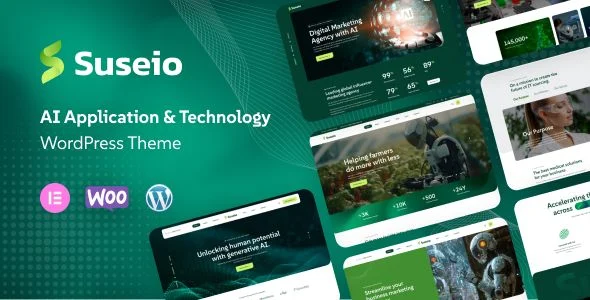
Suseio AI Application Technology WordPress Theme Overview & Front-End Delivery Architecture
Suseio is an Elementor-driven WordPress theme engineered for AI application vendors, technology startups, and software service agencies to publish product, pricing, and team pages without writing custom front-end code. The package targets the recurring bottleneck of assembling conversion-oriented marketing surfaces for AI products by supplying pre-built service layouts, pricing plan templates, project showcases, and team sections that render through the standard WordPress template hierarchy. In production agency workflows, the codebase operates as a deployable presentation layer that connects natively to WooCommerce for selling software licenses, subscriptions, and digital downloads.
Technical Specifications & Deployment Matrix
| Engineering Metric | Deployment Specification |
|---|---|
| Base Technology / Framework | WordPress theme package (PHP, CSS, and JS source files) with Elementor Page Builder integration |
| Runtime / CMS Compatibility | WordPress 6.0.x through 7.0.x; browser support spans IE10, IE11, Firefox, Safari, Opera, and Chrome |
| Commerce Layer | WooCommerce 5.x.x through 10.x.x, with template files maintained against each major release line |
| Form & Builder Dependencies | Contact Form 7 for lead capture; Elementor for visual layout composition; Gutenberg optimization is not implemented |
| Layout & Widget Footprint | Responsive layout at high resolution, 4+ column grid structures, widget-ready regions for sidebar content |
Template Rendering & Commerce Execution Pipeline
At its core, the theme routes inbound requests through overridden WordPress template files rather than default hierarchy stubs, delegating layout composition to the Elementor engine. When a visitor loads a page, WordPress resolves the template, the Elementor data structures populate the DOM tree, and page-level CSS/JS assets enqueue only where the builder’s widgets are active. This architecture keeps column grids, pricing tables, and service blocks editable at the widget level while the underlying PHP layer handles markup assembly, asset registration, and Swiper-driven carousel behavior — a dependency the developers patched specifically for Elementor 3.26.3 to guarantee correct stylesheet loading.
The commerce pipeline extends the same override mechanism into WooCommerce territory. The package ships maintained copies of cross-sells.php, related.php, up-sells.php, tabs.php, and single-product-reviews.php, which replace the corresponding plugin templates during single-product and cart rendering. Version 1.0.9 represents the current state of a maintenance cadence that has refreshed these files against WooCommerce 10.1.x and 10.3.x releases, keeping template signatures aligned with the plugin’s evolving output contracts.
Architectural & Functional Highlights
- Elementor-native layout composition: Every section — services, projects, team, pricing plans — is built as builder content, letting developers restructure the DOM visually while PHP templates remain untouched beneath the presentation layer.
- WooCommerce storefront integration: Maintained template overrides plus compatibility from WooCommerce 5.x through 10.x enable subscription, software, and digital download sales without patching plugin files after upgrades.
- Responsive multi-column grid system: 4+ column structures with high-resolution assets adapt layout geometry across viewport widths, supported across all major browsers including legacy IE10/IE11 targets.
- Contact Form 7 lead capture: Form handling plugs into the theme’s styling layer, allowing inquiry flows to inherit the design system instead of requiring per-form custom CSS.
- Widget-ready content regions: Registered sidebars and widget areas accept standard WordPress widgets, giving operators a code-free path to inject supplementary content blocks.
For teams that also need programmatic content production alongside this presentation layer, integrating WriteBot within the same WordPress installation lets editors generate AI-drafted articles and posts that inherit the theme’s typography and layout rules.
Production Implementation & Operational Resilience
Deployment requires a WordPress 6.0.x–7.0.x host running a current PHP version, with the theme’s PHP, CSS, and JS files transferred via standard installation paths. Because the package replaces WooCommerce templates directly, operators should stage upgrades in a development environment whenever the WooCommerce line crosses a major version boundary — the change log demonstrates that template file refreshes are how this codebase stays compatible, and skipping them risks deprecation notices or markup drift on product pages.
Typography carries an explicit environmental boundary: certain demos rely on Adobe Fonts (formerly Typekit), and when those font subscriptions are unavailable, the system substitutes default fonts or Google Fonts rather than breaking the cascade. Demo imagery follows the same principle — preview assets exist for demonstration only and must be swapped for properly licensed images before a client site ships. Page speed outcomes are similarly conditional: measured scores depend on the selected demo, the active theme configuration, server provisioning, and page content, and some theme features will depress automated speed grades. Cross-browser behavior down to IE10/IE11 is accounted for in the CSS layer, which constrains the modern layout techniques available when customizing stylesheets. Agencies evaluating parallel storefront options within the same ecosystem can weigh Bridge as an additional Elementor and WooCommerce-capable theme for commerce-heavy engagements.
Secondary development stays within expected WordPress conventions: the included PHP, CSS, and JS files permit template overrides, stylesheet extension, and script augmentation, while Elementor handles most layout iteration visually. Note that the theme does not target the Gutenberg block editor, so block-first teams should plan around the Elementor workflow. For studios exploring separate standalone alternatives in AI agency positioning, Auregon exists as an independent theme package on the same platform.
Frequently Asked Questions
Is Suseio optimized for the Gutenberg block editor?
No. The theme’s official attributes list Gutenberg Optimized as No, and all layout composition is built around Elementor Page Builder instead of native block editor workflows.
Can the demo preview images be used on a live client site?
No. Sample images shown in the live preview are for demonstration purposes only and must be replaced with the customer’s own licensed images in the final deployed product.
Will the typography break if Adobe Fonts are unavailable?
No. Demos using Adobe Fonts (formerly Typekit) fall back to default fonts or Google Fonts when those typefaces are not available, preserving the visual cascade without errors.