Sudoku – iOS Game Swift 5
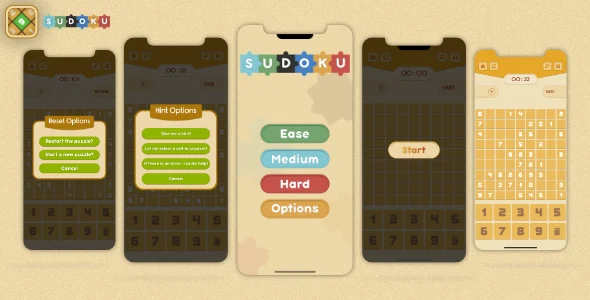
Sudoku iOS Game Overview & Native Swift Puzzle Engine
Sudoku iOS Game is a Swift 5 application source package, engineered for indie iOS developers and mobile agencies to ship a logic-puzzle product on the App Store without engineering a solver, grid renderer, or session layer from scratch. The codebase eliminates the heaviest portion of Sudoku delivery — board state management, difficulty modes, and progress persistence — by shipping those mechanisms pre-wired inside a single Xcode project. Within agency production pipelines it operates as a reskin-ready native template: teams swap the layered PNG art set, bind their own AdMob identifiers, and archive a distribution build for App Store review.
Technical Specifications & Deployment Matrix
| Engineering Metric | Deployment Specification |
|---|---|
| Base Technology / Framework | Swift 5 native codebase with SpriteKit-based game rendering |
| Runtime / Language Requirements | macOS build host running Xcode 26 or later; deployment targets iOS 12 through iOS 15 |
| Data Exchange / Communication Protocols | AdMob SDK for interstitial ad request and fill cycles; no server-side API dependencies |
| Front-End / Engine Dependencies | .xib/.nib interface files plus layered PNG graphic assets for UI composition |
| Database / Persistence Footprint | On-device session storage that saves board state automatically when the player exits |
Puzzle Engine Mechanics & Execution Pipeline
The execution pipeline is centered on a native Swift 5 game loop driven by SpriteKit scene rendering. Touch input is captured through the iOS responder chain and dispatched into the scene graph, where cell-selection events update the puzzle board model before the renderer repaints the affected nodes. Because the interface layer is composed from .xib/.nib files, menus, settings, and mode-selection screens are wired through Interface Builder outlets rather than programmatically generated view hierarchies, which keeps non-gameplay screens decoupled from the SpriteKit scene lifecycle.
Game state follows a straightforward model-view pattern: the board model holds candidate values, conflict checks, and completion status, while the scene layer reads that model each frame to reflect entries, errors, and win conditions. When the app transitions to the background or the player exits a session, the persistence layer serializes the current board configuration and timer state to on-device storage so the round can resume on the next launch. Difficulty selection feeds the generator parameters before a board is materialized, allowing multiple game modes to share one rendering path.
Monetization is handled through the AdMob SDK, with interstitial units triggered at defined points in the session flow rather than on every interaction, preserving pacing between rounds. Audio runs on two independent toggle channels — sound effects and music — so players can mute one without silencing the other. The entire loop executes offline; no network round-trips gate gameplay logic.
Core Technical Capabilities of Sudoku iOS Game
- Multi-mode board engine: A single board model serves several game modes, with mode parameters injected at round initialization so difficulty variants reuse the same validation and rendering code paths.
- Automatic session persistence: Exit events trigger serialization of the active board and progress state to local storage, enabling resume-on-launch behavior without any backend service.
- AdMob interstitial integration: The SDK is wired into the session flow with interstitial placements triggered at configured transition points, requiring only identifier substitution to activate on a developer account.
- Offline execution and dual audio channels: Gameplay logic, puzzle validation, and rendering run entirely on-device, with separate sound and music toggles persisting as user preferences.
For studios evaluating parallel Swift-native products on independent tracks, the same native-code distribution model applies to utilities such as Click to Chat for WhatsApp, which ships as a separate Xcode deliverable rather than a component of this puzzle codebase.
Production Implementation & Operational Resilience
Compilation requires a macOS environment with Xcode 26 or later; the project cannot be built on Windows or Linux toolchains. Before submission, teams sign the archive with an Apple Developer distribution certificate, replace the bundled AdMob unit identifiers with their own, and verify interstitial fill behavior on physical devices across the supported iOS 12–15 range. Because the package ships layered PNG assets, visual rebranding is confined to asset replacement and .xib layout adjustments — gameplay logic in the Swift source can be modified for custom rules, but the rendering pipeline assumes the SpriteKit scene structure provided.
Resilience characteristics are largely local: with no server dependencies, there are no CORS, timeout, or API-versioning failure modes to mitigate, and ad request failures degrade gracefully to uninterrupted gameplay. Session persistence protects against forced app termination, restoring board state on relaunch. Agencies juggling multiple native deliverables — for instance, an AI Expense Manager maintained in a decoupled repository — can apply the identical archive, sign, and review workflow to this puzzle project, since both follow the standard App Store submission path for Swift applications. The primary operational boundary to plan for is device-level testing: Game Center, controller support, and cloud sync are not part of the documented feature set, so any such additions require custom engineering beyond the shipped template.
Frequently Asked Questions
Can the project be compiled without a Mac and Xcode installation?
No, building the application requires a macOS machine with Xcode 26 or later, since the Swift 5 source, .xib interface files, and SpriteKit dependencies are compiled exclusively through Apple’s native toolchain.
Does gameplay require an active internet connection?
No, the game runs fully offline. All board logic, session saving, and rendering execute on-device, and only AdMob interstitial requests depend on network availability, which does not gate the core puzzle experience.
Are sound effects and music controlled by a single mute switch?
No, the settings layer exposes separate on/off controls for sound and music, allowing players to disable one audio channel independently while the other continues playing during active rounds.
Is unsaved progress lost when the player exits mid-round?
No, the persistence layer captures the board state automatically at exit, so the current round resumes on the next launch without requiring the player to restart the puzzle from the beginning.
Zilla NFTs – iOS Swift (OpenSea NFT Marketplace)
AI Chess Master iOS – Premium Chess Game Template with AI | 18 Themes | AdMob | In-App Purchase
Fire and Water (PRO) – BUILDBOX CLASSIC game – Easy To Reskine