Sajo – Personal Portfolio Elementor Template Kit
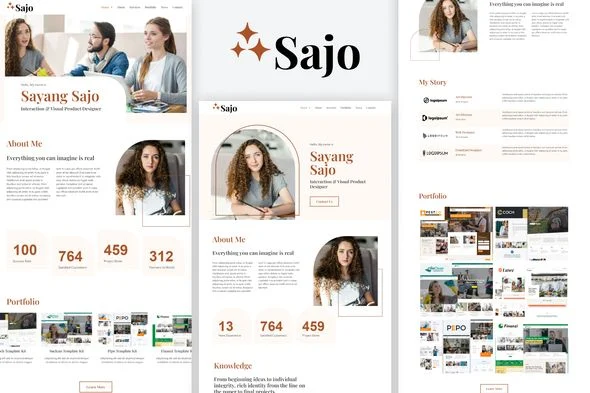
Sajo Personal Portfolio Elementor Template Kit Overview & Layout Architecture
Sajo is an Envato Template Kit built on the Elementor page builder, engineered for freelancers, web developers, and marketing professionals who need to publish a personal portfolio, CV, resume, or vcard site without writing code. The package eliminates the blank-canvas problem of assembling a personal brand site from scratch by supplying pre-composed page structures — three homepage variants plus About, Services, Portfolio, News, and Contact templates — as importable Elementor documents. In agency and solo delivery workflows, it functions as a layout starting point that plugs into the Elementor editor, letting content, imagery, and copy be swapped while the underlying grid and typography system stay intact.
Technical Specifications & Deployment Matrix
| Engineering Metric | Deployment Specification |
|---|---|
| Base Technology / Framework | Elementor 3.10.x page builder (Envato Template Kit format) |
| Kit Type | Envato Template Kit — page content package, not a WordPress theme |
| Required Plugins | Elementor, Header & Footer Builder for Elementor, MetForm, PowerPack Lite for Elementor |
| Theme Compatibility | Optimized for Hello Elementor; compatible with most themes supporting Elementor |
| Import Transport | Envato Elements plugin, upload via Elements > Installed Kits (kit file kept zipped) |
| Persistence Footprint | Content stored as Elementor page documents inside WordPress; no separate data layer |
Template Composition & Import Execution Pipeline
The kit’s core mechanism is JSON-based page composition: each template arrives as a structured Elementor document that the import routine parses and converts into editable canvas sections, widgets, and container layouts. Because every layout object is expressed as builder-native data rather than compiled markup, the drag-and-drop editor exposes each heading, image, and form widget for direct manipulation. Typography and color decisions are defined once through global design tokens, so a single change in the kit’s font or palette settings propagates across every imported page, while individual elements can still be overridden per-widget when a specific section needs divergence. The three homepage variants give architects distinct structural starting points — each can be imported independently, then extended with the secondary pages as the site grows.
Architectural & Functional Highlights
- No-code visual editing: All layout mutations happen inside Elementor’s editor through direct manipulation of containers and widgets, with no template file or stylesheet edits required for routine content changes.
- Centralized design tokens: Global fonts and colors are adjustable in one location, and per-element overrides remain available for fine-grained control on individual widgets.
- Pixel-precise responsive layouts: Section and container dimensions adapt across screen sizes, so the rendered output holds its composition from mobile viewports to desktop displays.
- Fast-loading asset posture: The kit ships lean page structures without bundled theme bloat, keeping the document weight low when paired with the Hello Elementor base theme.
- Form pipeline via MetForm: Contact surfaces use the MetForm widget, whose block templates import separately and attach to pages through Elementor’s Navigator and Edit Form workflow.
For teams evaluating parallel portfolio solutions within the same builder ecosystem, Profily – Personal Portfolios & Resume Elementor Template Kit occupies the same niche with an alternative layout system, giving project leads a second compositional reference before committing to a visual direction.
Production Implementation & Operational Resilience
Deployment follows a staged sequence with several operational boundaries worth noting. The Envato Elements plugin must be installed and activated before any import, and the kit archive should be uploaded without unzipping — the plugin handles extraction internally. The Install Requirements step activates the dependent plugins (Elementor, Header & Footer Builder, MetForm, PowerPack Lite) and must run before the first template import; skipping it leaves widgets unregistered and sections rendering as empty placeholders. For stable results, import one template at a time rather than batching, which keeps the request payload small and avoids PHP memory pressure on constrained shared hosting — a practical consideration since Elementor document parsing during import is the heaviest operation in the pipeline. Once pages exist, each should be created as a new Elementor-edited page set to Full Width with the page title hidden, then populated from the My Templates library.
Header and footer regions deploy through the Header Footer & Blocks plugin: the corresponding templates are imported, then bound as new Header and Footer entries set to display across the entire site and published. MetForm blocks follow their own sequence — import the form block template first, then import the page containing the form, open Navigator, select the MetForm widget, and insert the imported form through the builder’s template tab before updating.
Two boundaries define the asset’s scope. First, this is not a WordPress theme; it contains page content only and relies on a host theme — Hello Elementor produces the closest match to the demo output, though most Elementor-capable themes will render it correctly. Second, the demo imagery is pulled from Envato Elements collections and must be acquired under those terms or replaced with project-specific assets before a client handover. For decoupled implementations outside the template-kit model — where a full theme with portfolio features is preferred over imported documents — Oráiste – Creative Portfolio Elementor Theme stands as an independent theme-level alternative serving the same creative portfolio audience.
Frequently Asked Questions
Does Sajo function as a standalone WordPress theme?
No, it is an Envato Template Kit containing Elementor page content only. It requires a host theme — optimized for Hello Elementor — and cannot run as an independent theme layer.
Are the Elementor plugins bundled inside the kit archive?
No, the plugins (Elementor, Header & Footer Builder, MetForm, PowerPack Lite) are activated separately through the kit’s Install Requirements button, which must be clicked before importing any template.
Can the contact forms be imported together with their pages?
No, MetForm block templates must be imported first as separate assets. The page template is then imported, and the form is attached to the MetForm widget via Navigator and the Insert workflow.