Ridda – Web Design Agency WordPress Theme
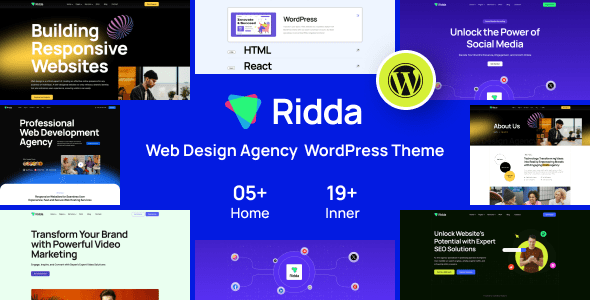
Ridda Web Design Agency WordPress Theme Overview & Agency-Site Delivery Engine
Ridda Web Design Agency WordPress Theme is an Elementor-driven WordPress theme engineered for digital agencies, freelance designers, and SEO companies to launch client-facing websites without deep programming knowledge. The package addresses the core delivery bottleneck in agency workflows: assembling header structures, service layouts, and portfolio sections from scratch typically consumes days of template engineering, whereas its pre-built component library compresses a full demo installation into a 5–10 minute one-click import cycle. In production terms, the codebase operates as a complete site foundation—ten homepage variants (five multi-page, five one-page), WooCommerce shop templates, and blog archives—ready for content replacement on live client staging environments. For studios evaluating parallel options in the same category, Cortex exists as an independent agency-oriented alternative with its own showcase architecture.
Technical Specifications & Deployment Matrix
| Engineering Metric | Deployment Specification |
|---|---|
| Base Technology / Framework | WordPress theme built on Bootstrap 5.x with Sass preprocessing and Codestar framework options layer |
| Runtime / Language Requirements | WordPress 5.5.x through 6.9.x; PHP, CSS, Sass, and JS source files included in the delivery archive |
| Page Builder Engine | Elementor drag-and-drop builder (frontend and backend editing modes), Gutenberg-optimized output |
| Browser Compatibility | IE11, Firefox, Safari, Opera, Chrome, and Edge rendering engines |
| Persistence & Commerce Layer | WooCommerce integration with custom shop design; widget-ready sidebars; Polylang multilingual readiness |
Elementor Rendering Pipeline & Template Execution Flow
Every page render routes through the Elementor page builder engine, which stores layout definitions as structured data and outputs them through the theme’s template hierarchy without requiring manual PHP edits. The architecture follows a layered execution model: WordPress resolves the requested URL against its native template hierarchy, the theme hands rendering control to Elementor, and more than fifty custom widgets—extending the builder’s default element set—dispatch their markup, styles, and icon-font assets into the DOM tree. Because Sass source files ship with the package, stylesheet overrides can be applied at the variable layer rather than through fragile CSS patches stacked at the end of the cascade.
The Codestar framework powers the advanced theme options panel, exposing global controls for typography (Google Fonts library access), unlimited color schemes, and layout parameters. Header and footer regions are not hardcoded template fragments; they are constructed through a dedicated Elementor-based builder, meaning navigation markup, sticky behavior, and footer widget zones can be restructured visually and saved as reusable site-wide chrome.
Architectural & Functional Highlights
- One-Click Demo Importer: A bundled installer replicates full demo content, widget assignments, and theme-option states in a single operation, reducing staging-to-production setup time to minutes.
- 50+ Custom Elementor Widgets: Purpose-built elements extend the default builder library, giving agencies pre-engineered section types that output validated W3C HTML5 and CSS3 markup.
- One-Page Navigation with Smooth Scroll: Built-in anchor routing and scroll-smoothing behavior enable single-page site builds without custom JavaScript, usable across all five one-page homepage demos.
- WooCommerce Shop Layer: Custom shop templates register within the WooCommerce template override structure, letting agencies attach a transactional storefront to a portfolio site.
- Dark Version & Responsive Grid: A dark-mode variant (introduced in version 1.0.4) and a Bootstrap 5 responsive grid ensure the layout adapts across device viewports and the six supported browser engines.
Production Implementation & Operational Resilience
Deployment begins by uploading the theme archive via the WordPress dashboard or FTP, activating it, and triggering the demo importer; the documentation set includes written guides plus video walkthroughs covering setup and customization procedures. Version 1.0.7 added WooCommerce support and a 1.0.8 pass aligned the codebase with the latest Elementor and WordPress core releases while improving demo content, so maintenance cadence has tracked upstream platform changes since the initial 2024 release.
For secondary development, a child theme ships in the package, which is the correct override boundary: custom template copies, stylesheet extensions, and function declarations belong in the child layer so parent updates do not destroy client modifications. Polylang readiness permits multilingual deployments where content duplication across locales is required, and Contact Form 7 compatibility supplies validated form handling for lead-capture workflows. Cross-browser behavior is verified against IE11 through Edge, an unusually wide matrix that matters when agency clients serve legacy enterprise audiences. Agencies whose delivery model centers on search-optimized marketing sites can also examine SEOX as a separate theme package purpose-built for that vertical.
Frequently Asked Questions
Does Ridda include a child theme for safe code customization?
Yes, a child theme is bundled with the package. Developers should place all template overrides, custom stylesheets, and function logic inside the child layer so that parent theme updates apply cleanly without overwriting client-specific modifications.
Are Sass source files included for advanced stylesheet overrides?
Yes, the delivery archive contains Sass files alongside PHP, CSS, and JS sources. This allows front-end developers to modify design tokens at the variable level and recompile stylesheets, rather than appending override rules to the compiled CSS cascade.
Can a one-page website with smooth scrolling be built without custom JavaScript?
Yes, the theme ships built-in one-page navigation options with smooth scroll behavior, and five of the ten homepage demos are pre-configured as one-page layouts, so anchor-based single-page builds require no manual scripting.
-
1.0.8 LatestNov 5, 2026