Retro Snack Game with AdMob Facebook Ads Android
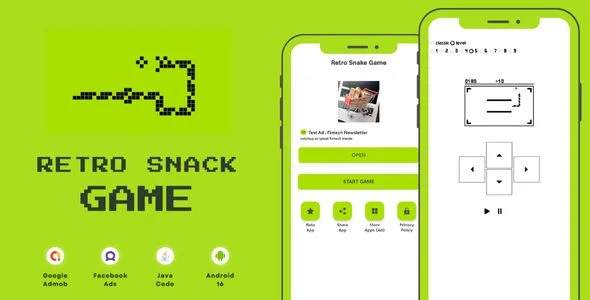
Retro Snack Game Overview & Offline Arcade Build Target
Retro Snack Game is a native Android arcade source package, engineered for indie developers and mobile studios to ship a monetized snake-style title without rebuilding legacy gameplay mechanics from zero. The package removes the boilerplate burden of writing grid-movement logic, directional input handling, and ad-network wiring by delivering a pre-assembled codebase that compiles straight to a release APK. Within an agency or solo production workflow, it operates as a fast-turnaround build target: import the project, bind production ad identifiers, apply a visual reskin, and publish.
Technical Specifications & Deployment Matrix
| Engineering Metric | Deployment Specification |
|---|---|
| Base Technology / Framework | Native Android project built on Java (.java) with XML layouts, plus bundled JavaScript, CSS, and HTML assets |
| Runtime / OS Compatibility | Android 16 support compiled against SDK 36; compatibility range spans Android 9.0 through Android 15.0 and beyond |
| Monetization / Communication Layer | AdMob and Facebook ad SDKs integrated at defined lifecycle points within the build |
| Deliverable File Set | .apk, .java, .xml, JavaScript JS, CSS, and HTML files included in the package |
| Persistence / Connectivity Footprint | Fully offline gameplay; no account creation, no login flow, minimal on-device storage footprint |
Game Loop Execution & Ad Monetization Pipeline
The engine runs a native Android game loop that processes directional input every frame. On-screen buttons dispatch touch events that reassign the snake’s movement vector, and the loop advances the creature across a grid, validating each cell before committing the next position. Consuming a snack increments body length and score; wall or self-intersection terminates the session. Because the bundle carries .java classes and .xml layouts alongside JavaScript, CSS, and HTML assets, presentation layers can be tuned from either the native resource tree or the bundled web files without disturbing game-state logic.
Monetization hooks sit at defined lifecycle points in the code, with AdMob and Facebook SDK calls already wired into the project. Activation requires only the replacement of placeholder identifiers with live ad unit IDs before a store submission, after which the monetization layer begins serving against production inventory. For teams assembling a broader publishing catalog, Real Drum Pad Beat Maker with AdMob Ads Android follows the same dual-network pattern in a music-utility vertical, illustrating how parallel Android source templates can be released side by side under a single developer account.
Core Technical Capabilities of Retro Snack Game
- Native input dispatch: On-screen directional buttons translate touch events into movement-vector changes inside the loop, keeping control logic decoupled from rendering and eliminating gesture-recognition dependencies.
- Offline execution model: Gameplay requires no network session and no authentication handshake, so the APK runs identically on airplane-mode devices, during travel, or in regions with unstable connectivity.
- Dual-network ad layer: Both AdMob and Facebook audiences are addressable from the same codebase, giving publishers a fallback inventory source when one network underperforms in a given geo.
- Compact resource footprint: The build ships with a small download size and lightweight pixel-style visuals, which reduces install friction on low-storage devices and shortens store-download conversion paths.
Production Implementation & Operational Resilience
Deployment begins by importing the project into Android Studio and resolving the Gradle configuration against SDK 36. The build targets Android 16, which aligns releases with current Play Console target-API expectations, while the compatibility floor sits at Android 9.0, covering hardware spanning roughly a decade of device generations. Because the engine performs no server round-trips and no login handshake, staging a client review build reduces to generating a signed APK and installing it on any test handset.
Reskin boundaries are clearly delineated: pixel-art drawables, layout XML files, and the bundled HTML, CSS, and JavaScript presentation assets can be replaced or restyled without touching movement logic, since game-state code resides in the native Java layer. Difficulty pacing is handled through changeable and adjustable speed levels rather than hardcoded constants, letting a publisher rebalance gameplay without refactoring the loop itself.
Operational resilience follows directly from the minimal runtime dependencies: when connectivity is absent, ad requests simply fail without interrupting play, and no authentication wall exists to block a session from starting. Studios diversifying a casual portfolio toward adjacent niches can treat Fun Coloring Book Game Android Studio Project with AdMob Ads as an independent Android Studio template occupying the same monetized-casual slot in an educational vertical, deployed as a separate title under the same developer account.
Frequently Asked Questions
Does the package ship with a prebuilt APK, or only raw source files?
Yes, the deliverables include a compiled .apk alongside the full source set of .java, .xml, JavaScript, CSS, and HTML files, so the game can be side-loaded onto a device for immediate testing before any recompilation or reskin work is performed.
Is account creation or a login flow required before a player can start a session?
No. The build follows an install-and-play model with zero authentication gates; once the APK is installed on a device, gameplay begins directly from launch, which also removes any server-side dependency from the session-start path.
Is the gameplay speed locked to a single fixed difficulty setting?
No. The title exposes changeable and adjustable speed levels alongside a classic mode, allowing players to select their preferred difficulty pace and giving publishers a retention lever that requires no modification to the underlying loop code.