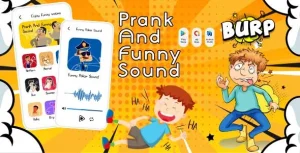
Prankify – Funny Prank Sounds App | ADMOB, FIREBASE, ONESIGNAL
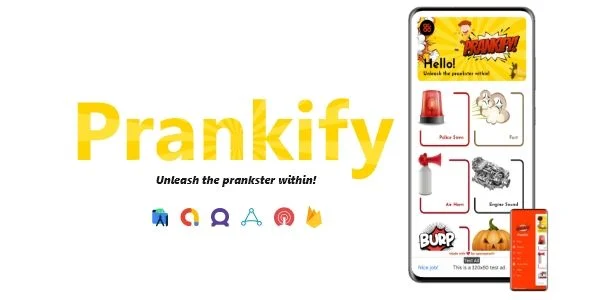
Prankify Overview & Native Android Sound Prank Architecture
Prankify is a native Android prank sounds application source code, engineered for mobile developers and publishers to ship a monetized soundboard utility on Google Play. The package removes the recurring bottleneck of hand-wiring audio playback, ad delivery, and push notification plumbing by supplying a Kotlin-Java codebase with AdMob, Firebase, and OneSignal already scaffolded at the project level. Within an agency delivery pipeline, it operates as a rebrandable production candidate: reskin the interface, attach publisher credentials, then generate a signed release build for store submission.
Technical Specifications & Deployment Matrix
| Engineering Metric | Deployment Specification |
|---|---|
| Base Technology / Framework | Native Android application built with Kotlin and Java |
| Runtime / Build Requirements | Android Studio (latest version); minimum SDK 26 (Android 8 Oreo); target SDK 37 (Android 17) |
| Communication / Service Protocols | AdMob ad request network, OneSignal push notification delivery, Firebase service integration |
| Deliverable / File Footprint | Full Android Studio project shipped as .apk, .java, and .xml files, plus written documentation and a demo APK |
| Compatibility Envelope | Android 8.0 and upward, with listing-verified coverage spanning Android 9 through Android 12 |
Audio Dispatch Pipeline & Monetization Event Flow
User taps dispatch through a native audio layer that plays the selected category sound on demand. The execution path begins at the splash screen, transitions into a category browser holding more than six sound groupings — air horn, fart, haircut, and police siren effects among them — and resolves each selection into either an immediate playback call or a scheduled timer trigger. Ad placements surface at defined points in this flow through the buyer’s own AdMob ad unit identifiers, so impression and click events attribute directly to the publisher’s account with no revenue passthrough. OneSignal operates on a parallel channel: remote notification payloads pushed from the buyer’s dashboard re-engage installed devices without requiring a store update. Firebase connectivity follows the same isolation model, keeping service data inside the publisher’s project boundary.
For studios weighing a separate codebase in the same prank vertical, Air Horn Haircut Prank exists as an independent Android package covering air horn, fart, and police siren effects, evaluated on its own runtime rather than merged into this one.
Core Technical Capabilities of Prankify
- Multi-category sound engine: More than six sound categories sit behind a category browser, with each selection resolving to a native audio playback call on the device rather than a network-dependent stream.
- AdMob monetization layer: Ad units bind to buyer-owned identifiers inside the project configuration, meaning approval, fill, and payout cycles run entirely through the publisher’s account.
- OneSignal push dispatch: Remote notification payloads reach installed handsets from the buyer’s dashboard, supporting re-engagement campaigns that bypass the store release cycle.
- Scheduled playback timer: A built-in timer defers sound activation by a user-defined interval, allowing the device to be positioned before the prank fires.
- UI shell and auxiliary screens: A splash screen, privacy policy, share, rate, more apps, and about sections ship as standard screens reachable from the main navigation, giving the app a complete store-ready surface.
Production Implementation & Operational Resilience
Before a release artifact can be produced, the working environment must run the latest Android Studio release, since the project targets SDK 37 (Android 17). The build envelope spans minimum SDK 26 upward, so any handset on Android 8 Oreo or later executes the compiled output. Signed store artifacts follow the conventional Android release configuration: keystore generation, version code management, and ad unit identifier substitution all occur inside the buyer’s toolchain, with the included documentation walking through the reskin workflow step by step.
Operational boundaries center on the three external services, none of which ship with the purchase. The buyer provisions AdMob, OneSignal, and Firebase independently. Advertising approval and monetization run through the buyer’s AdMob account; Firebase charges may apply once usage exceeds Google’s free-tier limits; and OneSignal costs depend on usage volume measured against that provider’s current pricing policies. Budgeting for these services belongs in the deployment plan, not the codebase.
Because the deliverable includes .java and .xml sources, an Android engineer can audit every layout and handler before modifying behavior — a practical safeguard when adapting the six-plus category structure or swapping sound assets during a client reskin.
For publishers diversifying a monetized Android portfolio beyond prank utilities, GPS Map Camera Timestamp with AdMob Ads Android serves as a decoupled source package for location-stamped photography apps, maintaining its own AdMob configuration path.
Seasonal demand offers another angle: Santa Video Call Prank for Christmas Android App ships as a standalone holiday prank build with AdMob and Facebook mediation, occupying a distinct release slot in a catalog rather than sharing this codebase.
Frequently Asked Questions
Are AdMob, OneSignal, and Firebase accounts bundled with the source code purchase?
No. AdMob, OneSignal, and Firebase accounts must be created and configured by the buyer. Advertising approval and payout run through the buyer’s own AdMob account, while OneSignal and Firebase usage costs depend on each provider’s current pricing policies.
Does the package include an installable demo APK for testing before compilation?
Yes. A demo APK ships alongside the full Android Studio project and written documentation, allowing runtime behavior to be evaluated on a physical device before any compilation or source modification is attempted.
Can the app be installed on devices running Android 7 or earlier?
No. The minimum SDK is set to 26, corresponding to Android 8 Oreo, so older devices cannot execute the build. The target SDK of 37 extends compatibility forward through Android 17.
Is the codebase written entirely in Kotlin?
No. The project mixes Kotlin and Java, and the delivered source files include .java and .xml artifacts, giving developers two language surfaces to work with when modifying application logic or layouts.
Fake Call – Fake Incoming Call – Phone Prank Calls – Prank Friends – Call Prank – Call Simulator
Little Strawberry Unity Funny Endless Game With Admob For Android And iOS
WhatsFakeMsg – Fake Chat Conver – Fake Messenger – Fake Chat Conversation Prank – Chat Story Maker