Little Strawberry Unity Funny Endless Game With Admob For Android And iOS
Little Strawberry Overview & Cross-Platform Endless Runner Architecture
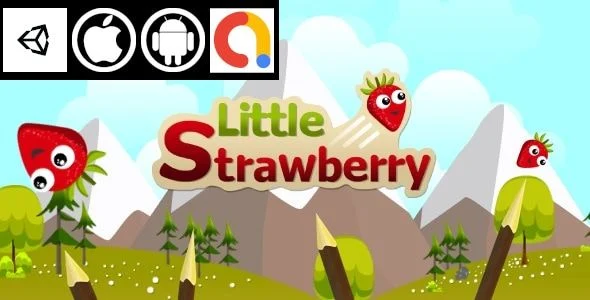
Little Strawberry is a Unity-engine endless runner source package, engineered for mobile studios and indie developers to ship a one-touch arcade title on Android and iOS with monetization pre-wired. The project removes the bottleneck of prototyping a score-based, jump-driven platformer from scratch by supplying a complete C# gameplay loop in which a strawberry character traverses forest obstacles using a quadruple-jump mechanic, where a single collision ends the run. Within a production pipeline, it operates as a reskinnable, store-submission-ready codebase: AdMob banner and interstitial units are integrated, and the build chain targets 64-bit IL2CPP output alongside Android App Bundle export.
Technical Specifications & Deployment Matrix
The following matrix consolidates every verifiable engineering parameter documented for this release.
| Engineering Metric | Deployment Specification |
|---|---|
| Base Technology / Framework | Unity engine; project loads in Unity 2018.4.11 or any higher version |
| Runtime & Scripting Backend | 64-bit IL2CPP compilation; export to Android App Bundle (AAB) supported |
| Monetization Layer | Google AdMob integration with banner and interstitial ad formats |
| Target Platform Compatibility | Android 9.0, 10.0, 11.0, and 12.0; iOS supported via Unity cross-platform build |
| Included Deliverables | Demo .apk build, layered PNG artwork, and a documentation file covering setup, editing, and reskinning |
One-Touch Jump Engine & Monetization Execution Pipeline
The core mechanism is a touch-driven jump state machine capped at four consecutive airborne actions per ground contact. Each screen tap dispatches an input event into the character controller, which consumes one unit from the jump budget and applies the corresponding vertical physics impulse. The budget resets only when the character lands on a platform surface, which means players must sequence all four jumps across obstacle gaps and hazards without touching down mid-air. Because the source documentation states that one mistake is sufficient to end a session, obstacle colliders are wired as run-termination triggers: any contact with a hazard collider halts the gameplay loop and transitions the session to the failure state, where the accumulated distance-based score is presented for evaluation.
Difficulty is governed by an increasing difficulty curve, a parameter-driven system that tightens obstacle spacing and raises the challenge threshold as the run progresses, so early segments remain forgiving while later segments demand precise jump timing. This design keeps the skill ceiling rising without any manual level authoring, which is the defining property of the endless-runner genre the package implements.
On the monetization side, the AdMob service layer is embedded at the project level rather than bolted on afterward. Banner units occupy a persistent placement during active runs, while interstitial slots are configured within the same ad service architecture, allowing revenue events to fire at natural session boundaries defined by the run-termination loop. Both formats operate through the official AdMob SDK path, so identifier configuration is a matter of substituting the ad unit references inside the documented project structure. For teams assembling a broader hyper-casual catalog on the same Unity-AdMob runtime, Color Path IO exists as a standalone alternative covering a distinct mechanic without sharing this codebase.
Core Technical Capabilities of Little Strawberry
- Quadruple-jump input controller: a jump-budget state machine grants up to four sequential mid-air actions per landing, resetting only on ground contact, which defines the entire skill model of the game.
- Integrated AdMob monetization layer: banner and interstitial formats are wired into the project, so ad unit configuration replaces SDK implementation work rather than preceding it.
- 64-bit IL2CPP build pipeline: the project compiles through IL2CPP and exports to Android App Bundle, satisfying the 64-bit binary requirements enforced by current app store distribution channels.
- Progressive difficulty scaling: an increasing difficulty curve adjusts obstacle challenge over the course of a run, generating open-ended play sessions without authored level content.
- Cross-platform compilation: a single C# codebase produces both Android and iOS binaries through Unity’s standard build targets, eliminating parallel platform implementations.
Production Implementation & Operational Resilience
Deployment begins with an environmental prerequisite: Unity 2018.4.11 or a later version must be installed before the project will load, and the included readme functions as the authoritative reference for editing, reskinning, and build configuration. Because the deliverables contain layered PNG artwork, a visual reskin is an asset-replacement exercise: designers swap the existing art layers directly in their image editor and reimport them, without redrawing sprite sheets or modifying collider geometry. Gameplay tuning, obstacle parameters, and jump behavior are all adjustable within the Unity editor since the entire logic layer is exposed as standard engine scripts rather than precompiled binaries.
Operational boundaries are worth stating plainly. The fail state is intentionally unforgiving: one collision terminates the run, which concentrates player sessions into short, replayable cycles and defines where interstitial ad events naturally fit within the session loop. Compatibility is verified against Android 9.0 through 12.0, and the 64-bit IL2CPP backend governs binary output for both stores. The package does not ship with server-side components; scoring is session-scoped to the endless-runner loop, so no backend persistence layer needs provisioning before launch. Studios comparing additional Unity 3D mobile titles before committing to a reskin can evaluate Bat way as an independent Android-plus-iOS codebase occupying a different genre niche.
Frequently Asked Questions
Does the download include a prebuilt APK for on-device testing before compiling the project?
Yes, the package ships with a demo .apk that runs the full gameplay loop with AdMob advertising enabled, allowing teams to validate mechanics, ad behavior, and device compatibility on target hardware before opening the Unity editor.
Are layered PNG files included so artwork can be replaced without recreating sprites from scratch?
Yes, the deliverables contain layered PNG assets, meaning a reskin replaces existing art layers directly inside an image editor rather than redrawing sprite sheets, and the bundled readme documents the editing workflow required to reimport the modified artwork.
Does the included documentation cover editing and reskinning, or only initial project setup?
Yes, the readme file distributed with the project details editing, reskinning, and related modification procedures in addition to setup instructions, so customization guidance is part of the shipped documentation rather than a separate deliverable.
Can the same source project be compiled for iOS as well as Android?
Yes, the project is documented as cross-platform, so the identical Unity codebase builds for iOS through the engine’s standard build targets without requiring a separate gameplay implementation for each platform.