PayLink – Laravel SaaS for Invoicing, Project & Asset Management, Billing & Finance
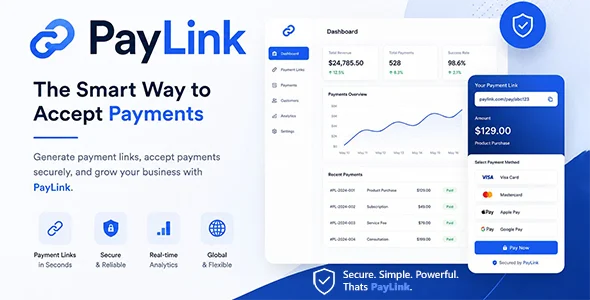
PayLink Laravel SaaS Overview & Multi-Tenant Business Engine
PayLink is a Laravel-based multi-tenant SaaS application engineered for agencies, freelancers, and growing service businesses to run invoicing, billing, project delivery, HR, and finance from one deployable codebase. The architectural bottleneck it resolves is fragmentation: rather than stitching together disconnected tools for invoices, payroll, support tickets, and asset tracking, the platform routes every registered company through a subscription-gated architecture with role-based permissions. In production it operates as three separate portals—Super Admin, Company, and Client—each sharing the same Laravel routing layer, queue workers, and scheduled task runner.
Technical Specifications & Deployment Matrix
| Engineering Metric | Deployment Specification |
|---|---|
| Base Framework | Laravel (MVC), Bootstrap front-end layer, JavaScript |
| Runtime Requirements | PHP 8.x, MySQL 8.x |
| Database / Persistence | MySQL 8.x relational schema driven by Laravel ORM and migrations |
| Communication Protocols | Stripe API, PayPal API, Zoom API, bank transfer reconciliation |
| Background Processing | Laravel task scheduling and queue processing for recurring invoices, bills, and notifications |
| Browser Compatibility | IE10, IE11, Firefox, Safari, Opera, Chrome, Edge |
| Localization | Multi-language support with full RTL rendering |
| Delivered Source Files | JavaScript JS, HTML, CSS, Stylus, PHP |
Multi-Tenant Subscription Architecture & Module Pipeline
Execution begins at the Super Admin layer, where administrators provision companies, define subscription plans, and switch individual features on or off before tenant requests ever reach module controllers. Once a company is activated, its staff operate inside a permission-scoped workspace spanning projects, Kanban-style task boards, client records, and a ticket system where both staff and clients exchange messages, file attachments, and voice recordings. Because attendance, approved leave, salary, and payroll records are wired together, monthly payroll generation inherits validated HR data instead of requiring duplicate entry.
Architectural & Functional Highlights
- Feature-gated subscription engine: The Super Admin panel controls which modules each tenant can access, letting operators sell tiered plans without maintaining separate deployments per customer.
- Invoice and billing pipeline: Recurring invoices and bills are automated through the scheduler, payments are captured via Stripe, PayPal, or bank transfer with partial-payment tracking, and PDF invoices plus secure payment links are generated for client delivery.
- HR and payroll automation: Departments, designations, leave balances, attendance, bonuses, and deductions feed directly into monthly payroll runs, producing printable PDF payslips and CSV-exportable HR reports with document expiry alerts.
- Finance and asset ledger: Income, expenses, lending, and debt records sit alongside an asset register capturing purchase data, warranty terms, maintenance history, and check-in/check-out state.
- Digital identity and meetings: A vCard plus QR code module generates shareable business cards, while the Zoom integration schedules and manages online meetings natively from the dashboard.
The digital identity module handles business-card sharing strictly within the tenant ecosystem. For creators who need only a standalone link-in-bio surface with QR generation and link analytics rather than a full business platform, SmartBio exists as an independent Laravel path operating outside this codebase.
Production Deployment & Implementation Considerations
Deployment targets a standard LAMP-style environment running PHP 8.x and MySQL 8.x, with queue workers and the task scheduler active so recurring invoice automation, email notifications, and in-app alerts fire on schedule. The included step-by-step installation wizard handles environment validation and automatic database configuration, which reduces the classic Laravel setup sequence—manual .env editing, key generation, migration execution—to a guided flow suitable for staging or first production pushes. Payment processing and meeting scheduling depend on valid Stripe, PayPal, and Zoom API credentials configured after installation; without those keys, those specific integration endpoints remain non-functional even though core modules continue operating.
Implementation boundaries are worth mapping before rollout. The package ships as a self-hosted source distribution containing JavaScript, HTML, CSS, Stylus, and PHP files, and extension work happens through standard Laravel conventions—controllers, Eloquent models, migrations, and Blade templates—so teams comfortable with MVC structure can add modules or modify payroll and invoice logic directly. Front-end adjustments run through Bootstrap and the included Stylus sources.
For engineering teams that prefer starting from a UI shell rather than modifying an existing business application, Silva offers a separate Laravel 12 admin dashboard template for building custom dashboards from scratch. Operators in food service evaluating domain-specific alternatives can likewise examine Forkiva, a distinct Laravel and Vue.js POS system built for restaurant workflows rather than tenant-based billing.
Frequently Asked Questions
Does the package include a guided installer instead of a manual command-line setup?
Yes. A step-by-step installation wizard performs environment validation, automatic database configuration, and quick setup, replacing the typical manual sequence of editing configuration files and running migrations by hand during initial deployment.
Can clients log in through their own portal separate from company staff?
Yes. The architecture exposes three distinct login surfaces—Super Admin, Company, and Client—so customers interact only with their data, support tickets, invoices, and payment links while staff operations remain isolated behind role-based permissions.
Are employee payslips generated as downloadable PDF documents?
Yes. Monthly payroll generation produces printable PDF payslips for each employee, and the HR module additionally supports CSV export for reports along with salary history tracking, bonuses, deductions, and configurable HR settings.
Is right-to-left language rendering supported for non-Latin locales?
Yes. Built-in multi-language support includes RTL compatibility, allowing the interface to render correctly for right-to-left scripts without requiring a separate translated fork of the codebase or third-party localization plugin.
-
v1.0.0 Latest