Offood – Recipe & Food Blog Elementor Template Kit
Offood Overview & Recipe Publishing Layout System
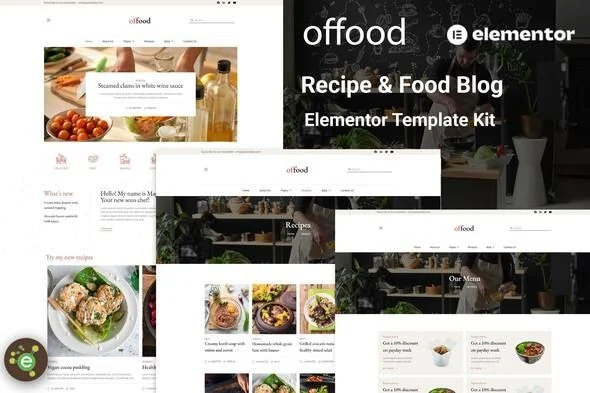
Offood is a recipe and food blog Elementor Template Kit engineered for food bloggers, culinary publishers, and agencies to launch editorial cooking websites without writing code. The package removes the layout-construction bottleneck by shipping import-ready structures — eleven full page templates, seven reusable sections, and eighteen element templates — that load directly into the Elementor editor. Within a production delivery workflow, it serves as the complete presentation layer for recipe catalogs, chef profiles, menu listings, blog archives, and contact funnels.
Technical Specifications & Deployment Matrix
| Engineering Metric | Deployment Specification |
|---|---|
| Base Technology / Framework | Envato Template Kit built on the Elementor page builder (Elementor 3.4.x through 3.10.x compatibility range) |
| Runtime / Language Requirements | WordPress installation with the free Hello Elementor theme (or any active theme) plus the Template Kit Import plugin |
| Data Exchange / Import Protocol | Serialized JSON layout payloads packaged as a single zip archive, uploaded through Tools > Template Kits |
| Front-End / Engine Dependencies | Elementor, Elementor Pro (required, acquired separately), ElementsKit Lite, PowerPack Lite for Elementor |
| Database / Persistence Footprint | None — layouts persist as standard Elementor page data; no custom database schema is created |
JSON Layout Composition & Design Token Pipeline
The kit operates as an import-driven layout system: each template arrives as a serialized Elementor JSON structure injected into the WordPress page tree through the Template Kit Import plugin. Once the archive is parsed, editors insert templates page by page, after which every widget and container becomes editable through drag-and-drop operations — no PHP templating, no stylesheet authoring. Typography and color decisions are governed by global design tokens, with the font stack expandable beyond the bundled selection to more than 600 Google Fonts families, so a rebrand propagates across all pages from a single settings panel.
The page inventory covers the full editorial funnel: Home, About Us, Recipes, What We Offer, Our Chefs, Our Menu, Coming Soon, Blog, Blog Single, Contact Us, and a 404 page. Section-level blocks — header, footer, hero, about, recipes, chefs, and contact — can be detached from their parent pages and recomposed into derivative layouts. To populate the recipes archive with structured posts without manual content entry, Auto Recipe automates recipe post generation on the same WordPress runtime, feeding the blog and single-post templates this kit renders.
Core Technical Capabilities of Offood
- Eleven complete page templates: full editorial coverage from homepage hero through 404 recovery, each mapped to a standard food-blog information architecture.
- Seven composable section blocks: header, footer, hero, about, recipes, chefs, and contact segments that detach from parent pages for reuse across new layouts.
- Eighteen element templates: pre-configured widget presets that keep visual repetition consistent between pages while remaining individually editable.
- Global design token system: centralized color and typography variables backed by a Google Fonts library expandable past 600 families, enabling single-panel rebranding.
- Multi-breakpoint responsive rendering: container structures adapt across desktop, tablet, iPhone, and small mobile viewports without duplicated layout work.
Production Implementation & Operational Resilience
Deployment follows a deterministic sequence: install the Hello Elementor theme, activate the free Elementor plugin, install the Template Kit Import plugin, then upload the purchased zip through Tools > Template Kits and follow the insertion prompts. Because the archive is parsed and expanded during import, environments running a low wp_memory_limit can abort mid-upload; raising the PHP memory allocation beforehand is a standard precaution on shared hosting. Import failures or broken widget rendering most often trace to an inactive dependency — Elementor Pro, ElementsKit Lite, and PowerPack Lite must all be running before templates are inserted, since element templates reference widgets those engines register.
Customization boundaries sit at the style-and-asset level: colors, fonts, spacing, and imagery are overridable through Elementor’s global settings and per-widget controls, while structural changes happen by reordering or duplicating containers rather than touching code. Demo photography is sourced from Envato Elements and must be separately authorized or swapped for owned assets before a client site goes live. For audiences consuming recipe content outside the browser, the Blogger Recipes App exists as an independent mobile distribution path built on the Blogger API v3, decoupled from this kit’s WordPress presentation layer.
Once pages render as front-end output, image-heavy recipe layouts benefit from caching applied at the WordPress layer; WP Rocket provides static page caching and deferred JavaScript execution that reduce load times on photography-dense food blogs.
Frequently Asked Questions
Does the Offood kit bundle Elementor Pro inside the download?
No. Elementor Pro is a required dependency that is not included in the package; it must be acquired and activated separately before the templates import and render their full widget set correctly.
Does the import process require the Hello Elementor theme specifically?
No. Hello Elementor is the recommended free baseline when no theme is installed, but the kit imports on any active WordPress theme because layouts are stored as Elementor page data rather than theme template files.
Was Offood issued Envato Template Kit certification?
No. The listing records the kit as uncertified, meaning it was not enrolled in Envato’s certification program; this status does not affect how its JSON templates import or render inside the Elementor editor.