Nutritist – Healthy Food & Nutrition Coach Gutenverse FSE WordPress Block Theme
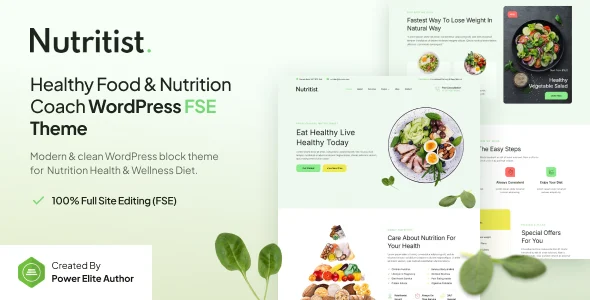
Nutritist Overview & Full Site Editing Architecture for Nutrition Practices
Nutritist is a Full Site Editing (FSE) WordPress block theme engineered for nutrition coaches, dietitians, and wellness consultancies to publish diet programs, nutrition therapy services, and healthy-food content without writing code. The package targets the structural bottleneck of legacy PHP-template themes—where headers, footers, and archive layouts were locked behind theme file hierarchies—by exposing every template region to the native WordPress Block Editor, extended through the React-powered Gutenverse plugin. Within an agency delivery pipeline, it operates as a deploy-and-configure foundation: a single demo import produces a complete front page, single post, archive, and 404 structure that staging teams can rebrand through Global Styles in a fraction of the time a hand-built build requires.
Technical Specifications & Deployment Matrix
| Engineering Metric | Deployment Specification |
|---|---|
| Base Technology / Framework | WordPress Full Site Editing block theme, extended by the Gutenverse plugin (React-based editor layer) |
| Runtime / Language Requirements | WordPress 6.2.x through 6.9.x; delivered as PHP, CSS, and JS files |
| Front-End / Engine Dependencies | Block Editor (Gutenberg) compatibility; Gutenverse 3.0.0 verified as of theme version 1.0.1 |
| Browser Coverage | Firefox, Safari, Opera, Chrome, Edge; high-resolution rendering; responsive layout engine |
| Layout & Persistence Footprint | Two-column layout structures; widget-ready regions disabled by design under the FSE model |
Block Template Pipeline & Rendering Execution Flow
Nutritist renders every page region through WordPress template files composed entirely of block markup. When an inbound request resolves against the template hierarchy—a front page, single post, archive, or 404 route—the engine loads the corresponding block template rather than a hard-coded PHP partial, and the Gutenverse layer supplies the additional design blocks, layout controls, and styling endpoints used to compose those regions. Because editing state is managed through React components in the editor, changes to a synced template part propagate to every page that references it, while async parts can diverge on demand, giving agencies one source of truth for global chrome and independent branches for campaign-specific sections. The prebuilt library covers headers, footers, single posts, archives, and error pages, and the one-click demo import wires these components into a functioning site before any customization begins.
Core Technical Capabilities of Nutritist
- Template-Based Site Structure Control: Headers, footers, front page, archives, and 404 routes are defined as editable block templates inside the Site Editor, replacing manual template-hierarchy file overrides with visual, revision-tracked edits.
- Synced and Async Template Parts: Shared regions can be synchronized globally for consistent branding or detached asynchronously where a landing page or campaign section requires an independent layout, all managed through the same editing surface.
- React-Driven Editor Layer via Gutenverse: The addon extends the Block Editor with additional design blocks and layout controls built on React, enabling complex customization to be handled client-side within the editor state rather than through server-side code edits.
- Performance-Conscious Block Output: Block-based markup and optimized asset practices reduce CSS/JS fragmentation, supporting faster loading that directly influences Core Web Vitals metrics such as LCP and CLS on nutrition coaching landing pages.
- Search Engine Indexing Structure: Well-structured markup allows crawlers to navigate and index content efficiently, and the theme runs alongside major SEO plugins such as Yoast SEO for per-page meta control.
For agencies weighing a different creative direction on the same wellness vertical, Nutricorp exists as a parallel WordPress option oriented toward creative presentation of coaching programs, meal plans, and results, evaluated independently rather than merged into this codebase.
Production Implementation & Operational Resilience
Deployments begin with the standard theme upload and activation flow, followed by Gutenverse plugin installation and a one-click demo import that populates the template library and starter content. In staging environments for nutrition practices, the practical boundary conditions are worth noting early: widget-ready regions are intentionally absent, so any legacy sidebar widget strategy must be replaced with block-based template parts before launch. Because the demo structures depend on Gutenverse blocks, the plugin must remain active for imported layouts to render and remain editable; removing it degrades the composed regions rather than failing silently. Responsive behavior is engineered across desktop, tablet, and smartphone viewports, which also feeds mobile ranking signals. Version 1.0.1 documents compatibility alignment with Gutenverse 3.0.0, and the release history indicates ongoing update releases that track WordPress core and Gutenverse version changes—so agencies should schedule staging validation after each core or addon upgrade. Styling overrides happen through Global Styles variables for typography and color, and structural changes happen in template editing, keeping the presentation layer decoupled from PHP file modification. Where a coaching practice expands into supplement or health-product retail requiring a store-driven stack, HealthMart serves as a separate pharmacy and medical store WordPress theme purpose-built for that commerce scenario, outside the coaching site architecture described here.
Frequently Asked Questions
Can the imported demo templates render and remain editable without the Gutenverse plugin installed?
No. The prebuilt headers, footers, and page sections are composed with Gutenverse blocks that extend the Block Editor with additional design and layout controls, so the plugin must be installed and active to reproduce, edit, and maintain the imported demo structures correctly.
Does this theme include classic widget-ready regions for sidebar content?
No. Widget support is disabled by design under the FSE architecture; headers, footers, and supplementary regions are managed as editable block template parts inside the Site Editor rather than through the legacy Appearance widgets screen, which alters how older sidebar content migrates.
Is code knowledge required to change colors, typography, or page structures?
No. Global Styles controls site-wide typography and color variables, while templates and template parts are edited visually in the Block Editor, so a production team can rebrand and restructure the entire presentation layer without modifying PHP, CSS, or JavaScript files directly.