Obrien – Organic Food Shopify Theme
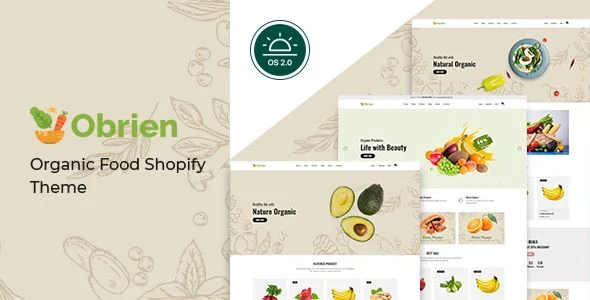
Obrien Organic Food Shopify Theme Overview & Storefront Architecture
Obrien Organic Food Shopify Theme is a responsive e-commerce storefront package built on the Shopify Online Store 2.0 architecture, engineered for farm producers, food retailers, and organic market operators who need a deployable produce-sales channel. The package resolves the bottleneck of section-restricted storefronts by exposing every Liquid section—slideshow banners, featured collection tabs, deal modules, and blog feeds—to drag-and-drop placement on any page without a third-party page builder. Within agency delivery pipelines it operates as a turnkey foundation covering shop grids, single-product layouts, About, Contact, FAQ, and blog templates across four distinct home variations.
Technical Specifications & Deployment Matrix
| Engineering Metric | Deployment Specification |
|---|---|
| Base Technology / Framework | Shopify Online Store 2.0 with Bootstrap 4.x front-end utility layer |
| Runtime / Language Requirements | Shopify-hosted Liquid templating engine; CSS and JS asset files included in the downloadable package |
| Browser Compatibility | Verified on IE11, Firefox, Safari, Opera, Chrome, and Edge |
| Front-End Dependencies | Ajax cart drawer, Ajax wishlist, QuickView modal, newsletter popup, 15+ preloader variants |
| Data Persistence Footprint | Catalog and order state managed by the Shopify hosted runtime; client-side cart and wishlist state synchronized via Ajax endpoints |
Liquid Section Rendering & Storefront Execution Pipeline
The core mechanism is Shopify Online Store 2.0 section-everywhere rendering: page structure is defined in JSON templates that reference modular Liquid sections. When a shopper requests a route, the Shopify runtime parses the corresponding JSON template, resolves each section reference, and renders its Liquid markup with store data injected at request time. Because version 1.0.6 migrated the entire package to this architecture, merchants can add, remove, and reorder sections on every page through the native theme editor, and the editor dispatches change events that re-render individual sections without a full page reload.
Ajax-driven commerce modules extend this pipeline beyond static rendering. Cart additions, wishlist toggles, and QuickView product lookups issue asynchronous requests to storefront endpoints, and returned payloads update drawer and modal state in place. The product page itself supports drag-and-drop arrangement of all its elements, plus a native FAQ/accordion section, while collection pages apply size and color filters through URL parameters scoped per collection.
Core Technical Capabilities of Obrien
- Ajax Cart, Wishlist & QuickView Synchronization: Commerce interactions execute as asynchronous storefront requests, keeping drawer, wishlist, and modal state consistent without full page reloads during browsing sessions.
- Drag-and-Drop Section Composition: Every page—including the product page—accepts section insertion, removal, and reordering through the Shopify theme editor, so custom landing pages can be assembled from default sections with no builder dependency.
- Per-Collection URL Filtering: The collection sidebar generates URL-parameter-based size and color filters for each individual collection, giving category-level variant navigation without duplicate template work.
- Region-Aware Unit Pricing: The product template renders unit price fields required for German and Japanese marketplace compliance, covering sellers operating under those regional pricing regulations.
- Conversion & Engagement Modules: Newsletter popups, notification bars, product deals with countdown tabs, brand carousels, blog feeds, Disqus and Facebook comment threads, and product video embeds ship as configurable sections.
For food-vertical merchants weighing adjacent storefront options on the same runtime, Eatzy targets the bakery, cafe, and cake-shop segment as an alternative Liquid package, while this theme remains oriented toward produce, farm, and organic goods catalogs.
Production Implementation & Operational Resilience
Deployment targets the hosted Shopify runtime, so no server provisioning, database configuration, or PHP memory tuning is involved—installation runs through the Shopify admin theme upload flow. The package ships with CSS and JS files only; demo imagery is excluded from the downloadable archive, which means agencies staging client previews must substitute their own media assets before launch. Cross-browser behavior has been verified against IE11, Firefox, Safari, Opera, Chrome, and Edge, and the layout adapts responsively across viewport widths, with a mobile-specific cart page design and an improved mobile header introduced during the 1.0.4 revision cycle.
Operational hardening is documented across the change log: a currency conversion defect was corrected in 1.0.5, the wishlist and compare-product modules were rewritten in 1.0.3, and the collection sidebar URL filter was repaired in 1.0.6 to guarantee that size and color parameters resolve correctly for every collection. A Coming Soon page and a password page template allow storefronts to run pre-launch holding states, and footer color options plus a configurable header top bar provide store-level visual identity control without stylesheet edits. The included documentation covers section configuration and setup procedures.
Merchants in adjacent retail verticals can evaluate Florace as a parallel Online Store 2.0 option built for florist and decoration catalogs, whereas this package concentrates its page templates and merchandising modules on organic food, vegetable, fruit, and farm-direct sales workflows.
Frequently Asked Questions
Are the demo images shown in the preview included in the downloadable package?
No, images are not part of the downloadable file. The archive contains the CSS files, JS files, and Liquid templates that power the storefront, so you must supply your own product photography and banner media before publishing.
Does the product page support unit pricing for German and Japanese sellers?
Yes. Version 1.0.6 added a product unit price field specifically for Germany and Japan, satisfying those markets’ regional pricing display requirements directly within the product template without additional code.
Can a custom page be built using only the theme’s default sections?
Yes. After the Online Store 2.0 migration, every section can be dragged onto any page, so merchants compose custom layouts from default sections and no page builder is required.