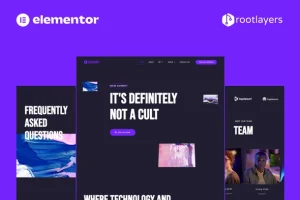
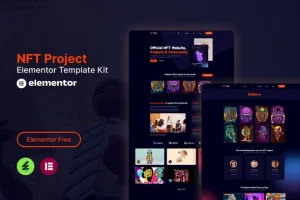
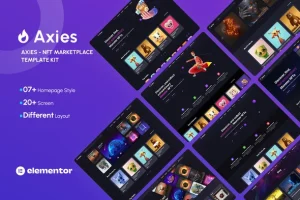
Nufti – NFT Collections Elementor Template Kit
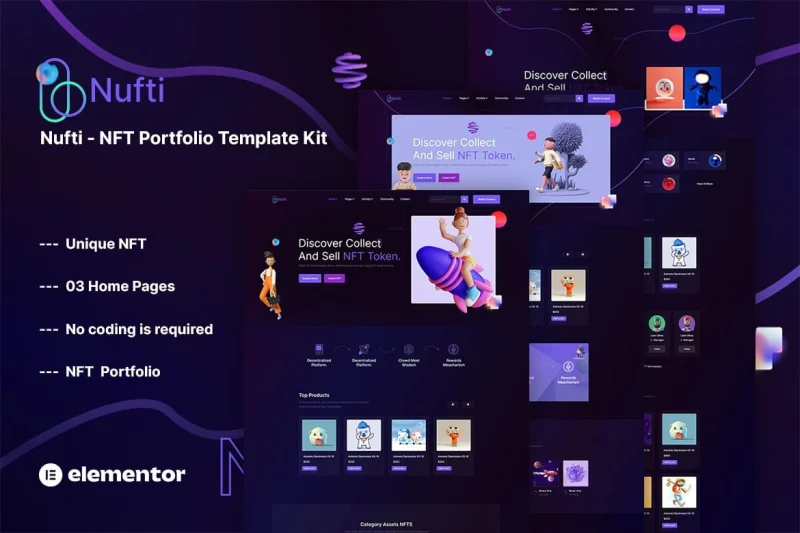
Nufti NFT Collections Elementor Template Kit Overview & Presentation Layer Role
Nufti NFT Collections Elementor Template Kit is an Elementor-based layout package engineered for digital artists, collectors, and Web3 agencies to publish NFT showcase and marketplace-front websites without writing code. The kit removes the bottleneck of hand-building dark, art-forward presentation layouts by shipping ten or more pre-structured templates—covering home, collections, about, and item-presentation surfaces—as importable Elementor page structures. Within agency delivery pipelines, it functions as a starting scaffold: teams import the layouts into a WordPress installation running the Elementor builder, then rebind imagery, copy, and global styles to match each client’s collection branding.
Technical Specifications & Deployment Matrix
| Engineering Metric | Deployment Specification |
|---|---|
| Base Technology / Framework | Elementor page builder on WordPress; JSON-importable template kit |
| Runtime / Language Requirements | Active WordPress installation with the Elementor plugin running; sufficient wp_memory_limit headroom for kit import |
| Data Exchange / Communication Protocols | Layout data transferred via the Elementor template-import mechanism (JSON structures) |
| Front-End / Engine Dependencies | Elementor rendering engine; responsive Flexbox/Grid container output |
| Database / Persistence Footprint | None of its own—imported layouts persist as page data inside the host WordPress site |
Design Token Architecture & Layout Execution Pipeline
The kit operates as a portable layout library rather than an executing backend layer. During import, the Elementor engine parses each template’s stored layout definition and materializes it as a tree of containers and widgets inside the page editor. Every layout is assembled from container structures governed by Flexbox and CSS Grid positioning rules, so column direction, gaps, and stacking behavior adapt to viewport width without per-page media-query overrides. Because each imported page inherits from global theme styles, a single typography or color token change propagates across the home, collections, and about surfaces simultaneously—this inheritance chain is the mechanism behind the kit’s documented global theme style support. The dark visual baseline keeps chromatic contrast high, meaning token swaps such as accent hues or link colors remain legible without recalculating contrast ratios section by section. Since the package carries no server-side execution logic, page rendering is delegated entirely to the Elementor engine and the host environment’s asset delivery stack.
Core Technical Capabilities of Nufti
- Container-based layout system: Templates are composed of nested Flexbox/Grid containers, letting designers reflow sections by adjusting container direction, gap, and width properties instead of authoring page-level CSS.
- Global design tokens: Typography scales and color palettes are defined at kit level, so a single token edit re-skins all imported pages in one operation rather than requiring per-template restyling.
- Mobile-first responsive output: Breakpoint behavior is embedded in each container definition, producing layouts that reflow across phones and tablets without maintaining duplicate page variants.
- No-code customization boundary: Content, imagery, and structural edits occur through drag-and-drop inside the Elementor editor; rebranding requires no PHP or stylesheet authoring.
For decoupled implementations outside WordPress—static hosting or headless front-ends—Cybox – NFT Collections HTML Template exists as an independent markup-based path covering a comparable NFT presentation use case.
Production Implementation & Operational Resilience
Deployment should begin on a staging copy of the target WordPress site, since the import step is the heaviest operation in the kit’s lifecycle. The JSON payload for a full template set is parsed and written as page and post records, and hosts enforcing a low wp_memory_limit can abort the import mid-transfer; raising the limit before starting is standard practice for Elementor kits of this scale. Because the package contains no PHP execution layer or custom persistence, the primary failure surface is environmental—missing Elementor activation, a memory ceiling, or an incompatible builder version—rather than code-level defects. Customization work should stay inside the documented boundary: swapping imagery, editing copy, adjusting container properties, and redefining global tokens. Structural changes beyond container-level controls fall outside the no-code scope and demand stylesheet work the kit itself does not ship. Agencies delivering broader client work in the same builder workflow often keep a second kit in reserve; Spora Digital Agency & Creative Elementor Template Kits occupies that slot for non-Web3 brand sites assembled through identical Elementor import mechanics.
Frequently Asked Questions
Does the package install like a conventional WordPress theme?
No. It is a template kit, not a theme; layouts are pulled in through the Elementor template-import mechanism and rendered by the Elementor engine, so a WordPress installation with the builder active is a prerequisite before any import can run.
Does the kit include page structures beyond the homepage?
Yes. The package ships ten or more templates spanning home, collections, and about surfaces, giving collection overviews and project context their own dedicated layouts rather than forcing everything into a single reusable page.
Do the imported layouts render consistently across Chrome, Firefox, and Safari?
Yes. The templates are documented as cross-browser compatible, and because their styling is emitted as standard CSS by the Elementor engine, no browser-specific overrides need to be authored after import.