Morris – WordPress Theme for Digital Agency
Morris Overview & Agency Site Delivery Architecture
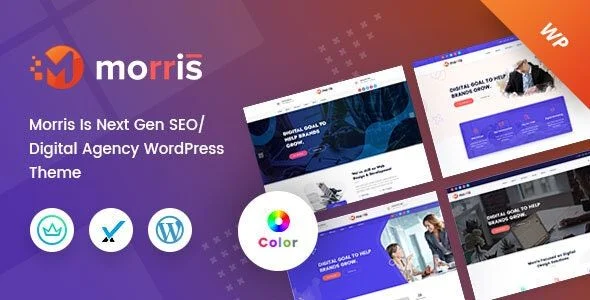
Morris is a Bootstrap 4.x-based WordPress theme engineered for digital, SEO, and marketing agencies to publish service catalogs, portfolio showcases, pricing tables, and conversion-focused landing pages. The package addresses the layout-prototyping bottleneck that stalls agency delivery by shipping pre-built blog layouts, two distinct landing page variants, galleries, and service grids as ready-to-populate templates. In production workflows, Morris operates as the presentation layer for client sites: agencies install it via FTP or the WordPress theme installer, run the one-click demo importer, and replace placeholder content on already-rendered page structures.
Technical Specifications & Deployment Matrix
| Engineering Metric | Deployment Specification |
|---|---|
| Base Technology / Framework | WordPress theme built on Bootstrap 4.x; PHP, CSS, and JS source files included in the package |
| Runtime / Language Requirements | WordPress 5.9.x through 7.0.x; server-side PHP execution with standard theme file registration |
| Data Exchange / Communication Protocols | Contact Form 7 form handling; WPML multilingual routing; localization via .pot translation files |
| Front-End / Engine Dependencies | Slider Revolution slider engine; Google Fonts library (600+ families); widget-ready sidebar regions |
| Database / Persistence Footprint | Native WordPress schema; theme options, demo content, and widget configurations persisted through standard options and posts storage |
WordPress Template Pipeline & Agency Content Engine
Morris renders every request through the native WordPress template hierarchy, with Bootstrap 4.x governing the responsive grid and an established theme options framework supplying stored site-wide configuration.
At execution time, an inbound request triggers template selection, after which the options panel retrieves persisted settings such as typography tokens, layout parameters, and social link assignments. The integrated page-building layer then composes variable content sections on a per-page basis, while registered widget areas dispatch sidebar and bottom-footer widget output into the DOM. Typography is resolved by enqueueing selections from the 600-plus Google Fonts library, with custom font upload support for brand-specific typefaces. On landing pages, the bundled Slider Revolution engine drives animated hero sequences, including fullscreen background slider presentations, above the 3-column content structures used for services and portfolio grids. Output is retina-optimized and verified across IE10, IE11, Firefox, Safari, Opera, Chrome, and Edge. Agencies comparing candidates for marketing-specific deployments can also evaluate Fexora as a parallel theme solution running on the same WordPress stack.
Core Technical Capabilities of Morris
- One-Click Demo Importer: Posts, page structures, widget assignments, and slider configurations load in a single post-activation batch, so agencies begin from designed templates rather than blank canvases.
- Slider Revolution Engine: The bundled slider plugin renders animated hero and fullscreen background sequences, removing the need to license a separate animation component for landing pages.
- Advanced Typography Layer: More than 600 Google Font families plus custom font support are selectable through the theme options panel, allowing per-brand type systems without direct stylesheet edits.
- Unlimited Sidebar & Widget Architecture: Unlimited sidebars register through the WordPress widget API, with bottom footer widgets and custom widgets managed from the admin panel for granular layout control.
Production Implementation & Operational Resilience
Deployment follows the standard WordPress lifecycle: upload the theme package, activate it, then execute the one-click importer against a fresh installation. Because the importer processes content, media references, and slider payloads together, staging on a clean database before client handover keeps production installs free of orphaned demo records. The supported runtime band spans WordPress 5.9.x through 7.0.x, so agencies should verify the target server version before migration. For agencies managing parallel client builds in the marketing niche, MarTech functions as an alternative theme with comparable one-click import workflows.
Customization boundaries are well defined: a custom CSS field absorbs style overrides without touching source files, and the clean, commented PHP/CSS/JS codebase supports child-theme-level modification where deeper changes are required. Since Morris is not optimized for the Gutenberg block editor, agencies that prefer drag-and-drop composition can build variable content sections through Page Builder by SiteOrigin, which operates through the standard WordPress widget and shortcode layer. Localization resilience is handled by shipped .pot files and WPML compatibility, while the IE10+ browser matrix confirms graceful legacy rendering. Contact Form 7 support covers inquiry routing, and demo content can be trimmed after import without breaking template assignments.
Frequently Asked Questions
Does Morris support full layout editing in the Gutenberg block editor?
No. The theme’s compatibility data explicitly lists Gutenberg optimization as absent, so page composition relies on its own page-building layer, widget-ready sidebars, and pre-built template structures rather than native block editor workflows.
Can Morris operate a multilingual client site?
Yes. The theme is WPML-compatible and ships with .pot translation files, allowing agencies to localize every string into multiple languages using the standard WordPress multilingual plugin ecosystem without modifying template source code.
Does Morris render correctly in legacy Internet Explorer environments?
Yes. The verified browser matrix includes IE10 and IE11 alongside Edge, Chrome, Firefox, Safari, and Opera, confirming that agency client sites maintain layout integrity on older enterprise browsers.
-
24 May 2022 LatestSeptember 30, 2026