Morphy – Personal Portfolio WordPress Theme
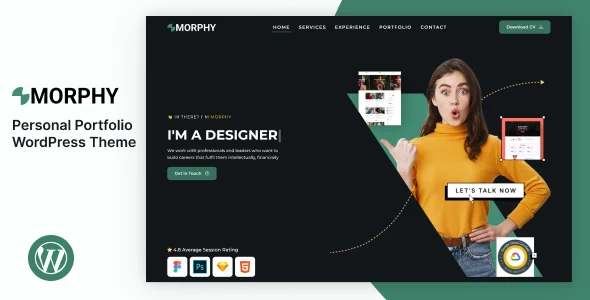
Morphy Overview & One-Page Portfolio Architecture
Morphy is a responsive one-page personal portfolio WordPress theme engineered for freelancers, graphic designers, photographers, and creative professionals to publish their resume and project work through a single-scroll Elementor-driven layout. The theme addresses the common bottleneck of assembling a personal presentation site from scratch by shipping a prebuilt one-page structure whose sections are composed visually rather than hand-coded in template files. In production agency workflows, the package functions as a rapid-deployment foundation: demo data is imported in one operation, branding is adjusted through a centralized options panel, and the resulting site renders across desktop, tablet, and smartphone viewports.
Technical Specifications & Deployment Matrix
| Engineering Metric | Deployment Specification |
|---|---|
| Base Technology / Framework | WordPress theme package (PHP, CSS, JS files) built on Bootstrap 4.x / 5.x foundations |
| Runtime / Language Requirements | WordPress 4.9.x through 7.0.x; PHP runtime with standard theme execution paths |
| Page Builder Engine | Elementor drag-and-drop page builder (visual layout composition, not Gutenberg-optimized) |
| Communication / Form Layer | Contact Form 7 plugin compatibility with pre-styled form output |
| Options & Persistence Layer | Redux Option Framework; widget-ready sidebars with bundled custom widgets; demo XML content importer |
Elementor Rendering Pipeline & Functional Capabilities
Page composition in this theme runs through the Elementor page builder rather than the native WordPress block editor. When an editor opens a section, the builder loads its layout model, renders editable widgets in a live preview frame, and writes the resulting structure back to the WordPress post store; the front-end then dispatches the theme’s CSS and JS assets alongside builder-generated markup to produce the final DOM tree. Template hierarchy behavior remains intact because the package ships standard PHP template files that wrap and enqueue the builder output, which means developers can still override specific template files without breaking the visual editing layer. Global configuration such as typography, color values, and layout parameters is persisted through the Redux Option Framework and read at render time by the front controller, keeping site-wide settings decoupled from individual page payloads.
Core Technical Capabilities of Morphy
- One-Click Demo Data Importer: A bundled XML payload replicates the reference site’s pages, posts, and media assignments in a single admin operation, eliminating manual section-by-section reconstruction during initial staging.
- Child Theme Package: A separate child theme is included so that template overrides, function injections, and stylesheet modifications survive subsequent parent-theme version updates during ongoing maintenance cycles.
- Redux-Driven Administration: The options framework centralizes theme parameters into a single admin panel, allowing configuration changes without direct file edits, and it reduces the risk of settings loss across updates.
- Responsive & Retina-Ready Rendering: Media queries and high-density asset handling adapt the DOM across phone, tablet, and desktop breakpoints, with touch and swipe event support wired into interactive components.
- Blog & Content Modules: Standard blog page templates, a load-more pagination button, Font Awesome icon sets, and Animate CSS effects extend the package beyond a static vcard into a maintainable content platform.
For project teams evaluating parallel presentation approaches on adjacent stacks, Dafolio – A Portfolio WordPress Theme exists as an alternative minimal portfolio implementation, while RekaStudio – Design Agency and Portfolio Elementor Pro Template Kit offers a kit-based path for teams that prefer importing prebuilt JSON layouts into an existing Elementor installation instead of activating a full theme.
Production Implementation & Operational Resilience
Deployment begins with standard theme activation, followed by the demo importer to reproduce the reference content structure, after which editors replace placeholder sections through the Elementor interface. The documentation bundled with the package walks through installation and configuration in detail, which lowers the onboarding cost for operators who do not work with PHP directly. Because the codebase is structured around the latest WordPress feature set with valid HTML5 and CSS3 output, extending behavior at the template level remains a documented developer task rather than a reverse-engineering effort. Child theme usage is the sanctioned extension boundary: custom functions, template overrides, and stylesheet additions belong in the child package, while parent files stay untouched to keep the update path intact. Contact handling routes through Contact Form 7, so form payload validation, spam filtering, and mail delivery behavior inherit that plugin’s established pipeline rather than a proprietary handler. Cross-browser verification covers Microsoft Edge, Firefox, Safari, Chrome, Opera, and legacy IE10/IE11 engines, and the dropdown menu system is built for mobile-friendly interaction on small viewports. Retina-aware asset delivery and animate-on-scroll effects execute client-side, so perceived performance depends on disciplined image sizing and script loading order during final optimization passes.
Frequently Asked Questions
Is Morphy optimized for the native WordPress Gutenberg block editor?
No, the theme is not Gutenberg-optimized. Its page composition engine is Elementor, so all layout editing, section arrangement, and widget placement occur inside the Elementor builder interface rather than the core block editor.
Does the package ship with widget-ready regions and custom widgets?
Yes, the theme is widget-ready and includes built-in custom widgets designed for its layout system. Sidebars and widget areas can be populated through the standard WordPress appearance controls without custom code.
Can the site be extended safely without losing changes during updates?
Yes, a child theme is included in the package. Template overrides, custom functions, and style modifications placed in the child package persist across parent-theme updates, keeping ongoing development and version upgrades compatible.