Axevia – Personal Portfolio WordPress Theme
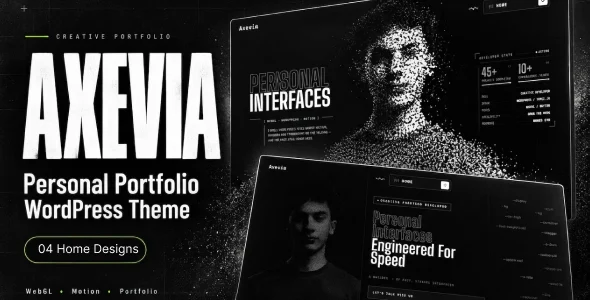
Axevia Personal Portfolio WordPress Theme Overview & WebGL Presentation Architecture
Axevia Personal Portfolio WordPress Theme is a hand-coded WordPress theme engineered for creative developers, designers, digital artists, and studios to publish interactive portfolio sites driven by WebGL visuals without any page builder dependency. It resolves the architectural bottleneck of shipping three.js hero scenes—interactive particle portraits, CRT shader effects, orbit point clouds, and rotating typography globes—inside the native WordPress template hierarchy. Within agency delivery and production workflows, it operates as a self-contained presentation layer where projects, case studies, and editorial posts are managed through standard WordPress content areas and one centralized admin settings screen.
Technical Specifications & Deployment Matrix
| Engineering Metric | Deployment Specification |
|---|---|
| Base Technology | Hand-coded WordPress theme (PHP, CSS, SCSS, JS files) with locally bundled three.js engine |
| Runtime Requirements | WordPress 6.0 or newer (verified through 7.0.x), PHP 7.4 or newer |
| Browser Compatibility | IE11, Firefox, Safari, Opera, Chrome, Edge; a WebGL-capable browser is required for interactive home scenes |
| Front-End Dependencies | No required plugins; Elementor compatible; widget ready; four webfonts bundled locally with no external font or CDN requests |
| Data Persistence | Standard WordPress database; contact submissions stored in the dashboard; demo content supplied as a WordPress import file plus a separate settings file |
WebGL Rendering Pipeline & Content Execution Flow
Axevia routes every inbound request through the standard WordPress template hierarchy, then enqueues scripts and styles only on the pages that require them. Because layouts are hand-coded rather than assembled from a builder, PHP templates, SCSS-compiled CSS, and JS modules load conditionally per page, keeping asset fragmentation across the DOM tree low and concentrating weight on pages that actually render a WebGL scene. Hero scenes execute through the locally bundled three.js engine, which avoids third-party CDN requests for the engine or the four bundled webfonts.
Seven home variants define the opening experience: Image Particles converts a photograph into thousands of interactive points that scatter around the cursor; CRT Portrait applies retro shaders, glitch effects, scanlines, and chromatic separation; Orbit animates a dispersing and reforming point cloud; Globe builds a rotating sphere from words alone; Four combines the word globe with an editorial column and halftone portrait; Five places the particle hero in a lighter, more spacious interface; and Immersive presents the original home scene. An on-page switcher appears only when multiple home designs are published and hides itself automatically when a single design remains. Where a client brief calls for a conventional showcase layout without WebGL scenes, Pegasus offers a parallel WordPress path oriented around speed-focused presentation for agencies and studios.
Core Technical Capabilities of Axevia
- Endless 3D project index: A numbered navigation rail tracks the current position and jumps visitors directly to any project; each card carries a thumbnail, description, and tags, with an optional muted video preview triggered on hover.
- Field-driven case-study assembly: Project pages at dedicated slugs are composed from structured fields—type, year, platform, role, client, timeline—plus an overview, video panel, four numbered story sections, a gallery band, and next-project navigation; optional sections stay hidden whenever their corresponding fields are empty.
- Plugin-free message pipeline: The built-in contact form requires no separate form plugin, stores submissions in the WordPress dashboard, and dispatches email notifications; saved messages remain accessible if delivery fails.
- Centralized settings surface: More than 100 settings cover colours, eight text-size controls, branding, the ticker, the statistics panel, navigation, and page text, with built-in defaults applied automatically when fields are left empty.
Production Implementation & Operational Resilience
Deployment requires WordPress 6.0+ and PHP 7.4+, with the theme verified against WordPress releases through 7.0.x and across the full browser matrix from IE11 to Edge. Resilience is handled at the rendering layer: when WebGL is unavailable, the canvas is hidden while essential text, navigation, contact details, and links remain accessible in HTML; animation loops stop for visitors who enable their system reduced-motion preference; particle counts decrease on tablet and mobile viewports; and scene rendering pauses whenever the browser tab is hidden. Page URL redirects preserve existing links when page slugs change, and a generated 404 page presents navigation assembled from published site pages.
Secondary development is supported through documented child-theme setup, included SCSS sources, and a .pot translation template for localization. Teams whose workflow is standardized on Elementor container structures rather than hand-coded PHP templates can follow an independent kit-based design path with Blaire, which supplies portfolio layouts as a separate template kit rather than a theme layer. The editorial blog adds a sticky table of contents generated from headings, estimated reading time, a progress indicator, a styled comment section, and in-place category filtering.
Frequently Asked Questions
Does Axevia require a page builder plugin such as Elementor to render its layouts?
No. All layouts are hand-coded PHP, SCSS, and JavaScript and render through the native WordPress template hierarchy without any page builder dependency; Elementor remains available only for authors who choose to compose additional content sections with it.
Are contact form submissions preserved when notification emails fail to deliver?
Yes. Every form submission is written to the WordPress dashboard storage before any notification dispatch occurs, so saved messages remain retrievable under the message management screen even if outbound notification emails fail to deliver entirely.
Does the theme degrade gracefully in browsers without WebGL support?
Yes. When WebGL is unavailable the canvas element is hidden while essential text, navigation links, and contact details remain rendered as accessible static HTML, so the site stays usable on locked-down or legacy browser environments.
Do particle effects adapt their workload on smaller screens?
Yes. WebGL scenes reduce particle counts on tablet and mobile viewports, animation loops stop entirely when a visitor enables the system reduced-motion preference, and scene rendering pauses to conserve GPU resources whenever the browser tab loses visibility.
Are the photographs shown in the demo preview included in the download package?
No. Preview photographs serve demonstration purposes only and are excluded from the package; the download instead provides the theme files, a WordPress demo content import file, a separate settings file, searchable HTML documentation, and a translation template for localization.
-
v1.0.0 LatestOct 18, 2026