Morata – Fastest Shopify 2.0 Theme
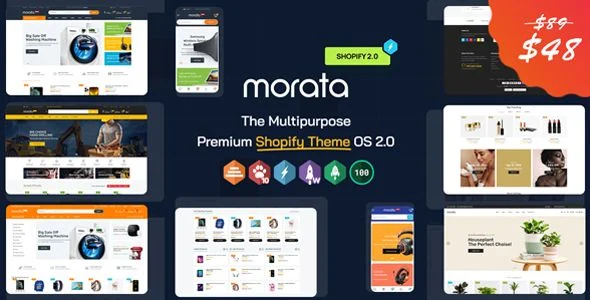
Morata Shopify 2.0 Theme Overview & Multipurpose Storefront Architecture
Morata is a Shopify Online Store 2.0 theme engineered for merchants and agency teams who need to deploy high-volume retail storefronts spanning mega stores, grocery shops, supermarkets, and organic product catalogs without commissioning custom front-end development. The package addresses a structural bottleneck in Shopify delivery work: producing distinct, conversion-oriented store experiences across catalog, product, and landing layers at a cost agencies can actually pass through to clients. In production workflows, it functions as a pre-built presentation and merchandising layer that sits on the native Online Store 2.0 runtime, cutting design iteration cycles down to section arrangement and style configuration tasks.
Technical Specifications & Deployment Matrix
| Engineering Metric | Deployment Specification |
|---|---|
| Base Technology / Framework | Shopify Online Store 2.0, Bootstrap 5.x, CSS3, HTML5 |
| Runtime / Language Requirements | Shopify 2.0 storefront runtime; Liquid templating with JSON template definitions |
| Data Exchange / Communication Protocols | Ajax cart, Ajax layered navigation by tags, quick shop, infinite scroll with pagination fallback |
| Front-End / Engine Dependencies | CSS files, JS files, Google Web Fonts; cross-browser support for Chrome, Firefox, Safari, Opera, Edge |
| Database / Persistence Footprint | Native Shopify platform persistence; includes multiple-currency support and product wishlist module |
Section-Based Rendering & Merchandising Execution Pipeline
The rendering pipeline is built on the Online Store 2.0 section model, where homepage structures are assembled from modular, reorderable builder sections rather than fixed page templates. Twenty-four homepage layout presets, three category page structures, and six product page variants operate as interchangeable composition layers, so a merchandiser restructures a storefront by dragging and reordering sections in the theme editor instead of editing Liquid files. Product data flows into these templates through Shopify’s native object model, while the theme’s Google Rich Product Snippets markup injects structured data into the document head so crawlers and answer engines can parse price, availability, and rating entities directly from the rendered DOM. Client-side merchandising behaviors — quick shop, Ajax cart popup, sidebar cart with quick edit and quick update, and Ajax load-more with product count — dispatch asynchronous requests to Shopify’s storefront endpoints and synchronize cart state without full page reloads, keeping interaction latency low on mobile connections. RTL support extends this pipeline to Arabic storefronts, mirroring layout direction at the stylesheet layer without requiring separate template forks.
Architectural & Functional Highlights
- Conversion instrumentation layer: Free shipping goal bars, countdown timers, stock countdown indicators, recent sales popup notifications, and product labels operate as behavioral widgets that read live cart and inventory state to create urgency signals on product and collection pages.
- Per-product content overrides: Custom product tabs and the advanced size chart system accept different content for each individual product, letting catalog teams attach garment-specific size tables or care instructions at the variant level rather than through global template edits.
- Media and navigation handling: Automatic image resize, lazy loading, image swap on hover, product image zoom with video support in the details page, video sliders, Instagram gallery modules, and an Instagram-style lookbook reduce payload weight while preserving merchandising richness.
- Navigation architecture: Advanced mega menu layouts, an A-to-Z brands page, multiple header and footer variants, and multiple mobile header options give large-catalog stores deep, alphabetically indexed browse paths across wide SKU inventories.
- Compliance and lifecycle widgets: GDPR cookie popup, newsletter signup popup, Ajax login and registration modals, one-click checkout, sticky add-to-cart bars, and wishlist modules cover the acquisition-to-retention loop within the shipped codebase, with lifetime free updates distributed through the package lifecycle.
Production Implementation & Operational Resilience
Deployment follows the standard Shopify theme upload path: the CSS and JS file bundle installs onto a Shopify 2.0 store, after which configuration happens through the visual editor rather than code edits — the vendor explicitly documents that no coding knowledge is required for setup. For agencies running client work in staging environments before production cutover, the twenty-four homepage presets and multi-layout category and product pages function as parallel draft branches, allowing a supermarket build, an organic shop variant, and a fashion catalog structure to be prepared on the same installation before the final structure is locked. Resilience at the browser layer is verified against Chrome, Firefox, Safari, Opera, and Edge, and the responsive layout adapts viewport breakpoints down to mobile, where separate mobile header configurations apply. Lazy loading and automatic image resize act as graceful degradation mechanisms on slower connections, while Ajax infinite scroll ships with pagination and product-count fallbacks so collection browsing never dead-ends if continuous loading is disrupted. Because the package rides on Shopify’s hosted runtime, there is no server, database, or cron-layer maintenance surface for the delivery team to own — operational responsibility collapses into theme configuration and app connectivity, with product reviews handled through a companion review app. For studios evaluating parallel storefront packages in adjacent retail verticals, FreshGo targets organic and supermarket food catalogs as an independent alternative, while Lapras covers fashion, furniture, and electronics niches as a separate responsive option outside this codebase. Upsell features, cross-sell placement, and the wishlist module round out the retention toolset for high-traffic seasonal campaigns.
Frequently Asked Questions
Can Morata power a right-to-left Arabic storefront without building a separate template fork?
Yes, the package ships with RTL support at the stylesheet layer, so layout direction mirrors automatically for Arabic stores and the same homepage, category, and product section structures serve both orientations.
Is the size chart configurable per individual product rather than globally?
Yes, the advanced size chart system accepts a different size chart for each product, allowing catalog teams to attach garment- or item-specific measurement tables at the product level instead of maintaining one global chart.
Does infinite scroll continue working if a shopper’s connection disrupts continuous loading?
Yes, the Ajax infinite scroll module ships together with pagination and a product count display, giving collection pages a numbered fallback path when continuous loading cannot complete on unstable mobile connections.