Lumilux – Jewelry and Accessories WooCommerce Theme
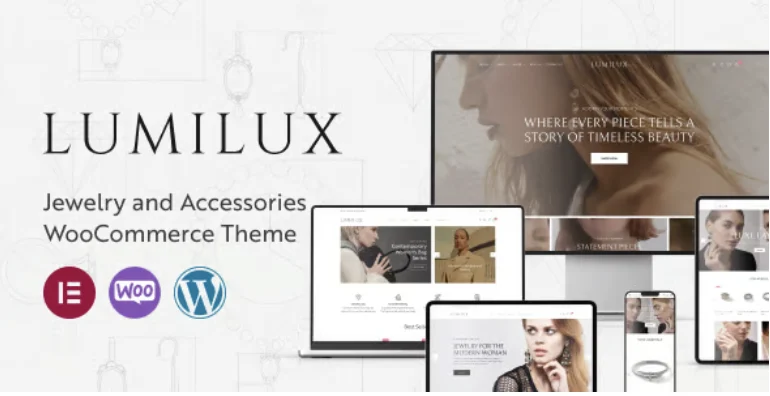
Lumilux Jewelry and Accessories WooCommerce Theme Overview & Storefront Architecture
Lumilux Jewelry and Accessories WooCommerce Theme is an Elementor-based WordPress e-commerce theme engineered for jewelry retailers and digital agencies to launch product-focused storefronts for gems, watches, bags, shoes, and fashion accessories. The package removes the bottleneck of hand-coding a product presentation layer by shipping 70+ prebuilt page-builder elements, a dedicated header and footer builder, and a one-click demo importer that reproduces live-preview content in under a minute. Within agency delivery pipelines, it operates as a drop-in WordPress 6.x theme layer that sits on top of WooCommerce 8.x and the releases tracked in its maintenance changelog.
Technical Specifications & Deployment Matrix
| Engineering Metric | Deployment Specification |
|---|---|
| Base Technology / Framework | WordPress theme (PHP, CSS, SCSS sources) built for WooCommerce; compatible with Elementor, Elementor Pro, and Foundation 6 |
| Runtime / Language Requirements | WordPress 6.0.x through 6.4.x; PHP template files with SCSS compiled into distributable CSS |
| Data Exchange / Communication Protocols | Ajax request handling for cart operations, quick view, and load-more pagination |
| Front-End / Engine Dependencies | Elementor page builder, bundled Slider Revolution, Contact Form 7, Font Awesome, 600+ Google Fonts |
| Database / Persistence Footprint | Standard WordPress and WooCommerce schema; demo content delivered as importable XML; no custom persistence layer documented |
Elementor Rendering Pipeline & Commerce Engine Integration
Lumilux renders every storefront page through the Elementor front-end builder while delegating cart, checkout, and inventory logic to WooCommerce. Because Elementor operates on the front end, designers assemble carousels, image widgets, and video blocks while observing the rendered result directly, removing front-end/back-end context switching during layout work. Page designs can be saved as reusable templates, then exported and imported across separate installations, which shortens multi-client production cycles considerably. The bundled header and footer builder generates distinct masthead configurations assignable to different site contexts, including sticky-menu variants and a mega-menu system with unlimited Google Maps styles and multiple map markers where store-location context matters.
Commerce behavior extends well beyond static templating. The Ajax cart intercepts add-to-cart events and refreshes the mini-cart drawer without a page reload, keeping its state synchronized with the server-side cart page through background requests. Merchandising is handled by a visual attributes engine covering color swatches, swatch gallery images, image-based swatches, and video thumbnails, complemented by 360-degree product image rotation, quick-view modals, custom product labels, and integrated wishlist and comparison flows. Archive filtering runs through sidebar widgets bound to WooCommerce attributes, and Ajax load-more replaces full pagination requests. Layout granularity spans portfolio, blog, and shop metro grids with Isotope filters and Packery arrangement. For agencies running a second jewelry build on the same WordPress stack, Velvet occupies the same retail niche as a parallel storefront option.
Architectural & Functional Highlights
- Elementor Header/Footer Builder: Masthead and footer regions are composed as builder layouts rather than hardcoded templates, letting teams assign different headers to different page contexts without touching PHP.
- Ajax Mini-Cart Synchronization: Cart mutations dispatch background requests that update the mini-cart in place and stay consistent with the cart page, avoiding full document reloads during shopping.
- Visual Attributes Engine: Color swatches, gallery-image swatches, video thumbnails, and 360-degree product image rotation feed product archives and detail views from WooCommerce attribute data.
- One-Click Demo Importer: XML-based demo payloads replicate live-preview sites in a single action, after which teams replace content rather than building pages from zero.
- Bundled Slider Revolution: The drag-and-drop slider editor ships inside the package, enabling hero scenes, carousels, and video headers without an additional plugin acquisition.
Production Implementation & Operational Resilience
Deployment targets WordPress 6.0.x through 6.4.x environments, and the changelog records compatibility work continuing through WooCommerce 10.8.x, indicating the codebase is actively tracked against WooCommerce point releases. Theme updates are applied from the dashboard through the Envato Market plugin mechanism rather than manual file replacement. A child theme is included in the download, so PHP template overrides and function additions belong in the child layer; placing them there preserves customizations across parent-theme updates. Source ships as PHP, CSS, and SCSS files, meaning teams can recompile palette and typography tokens globally through SCSS variables instead of patching generated stylesheets. The codebase is commented, was produced with debug mode enabled, and passes theme-check validation.
Operational boundaries deserve attention before rollout. The theme is not Gutenberg-optimized, so Elementor remains the intended editing pipeline, and classic widget-ready regions are not part of the layout system, with sidebar behavior instead provided through the theme’s custom sidebar and attribute-filter widget set. Translation readiness is handled through WPML-compatible string registration, and Yoast SEO plus JetPack compatibility are documented for search and content workflows. Maintenance mode, coming-soon mode, and option import/export simplify staging-to-production migration. Where manual account creation adds checkout friction, wiring Social Login alongside the WooCommerce checkout layer introduces one-click authentication and account linking without custom PHP auth code.
Frequently Asked Questions
Does the package include Slider Revolution without a separate plugin purchase?
Yes, Slider Revolution ships bundled inside the theme package, providing the visual drag-and-drop editor for sliders, carousels, hero images, and video scenes at no additional plugin cost.
Can pages be built using the Gutenberg block editor instead of Elementor?
No, the theme is not Gutenberg-optimized; the sales documentation flags Gutenberg support as absent and positions Elementor with its 70+ elements as the primary page-building environment.
Are classic widget-ready regions available for sidebar placement?
No, the package is not marked widget-ready in the standard sense; sidebar areas instead rely on the theme’s own custom sidebars and additional widgets that filter product lists by WooCommerce attributes.
-
1.0.9 LatestNov 2, 2026