Live Voice Translator with AdMob Facebook Ads Android
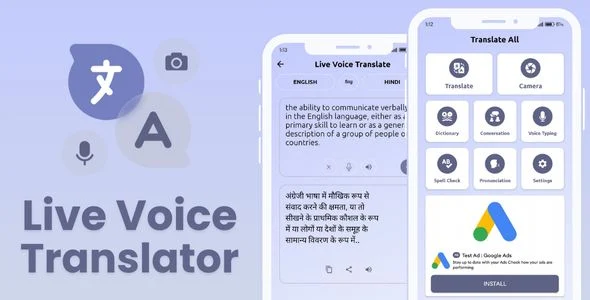
Live Voice Translator Overview & Real-Time AI Translation Architecture
Live Voice Translator is a native Android application source package, engineered for mobile developers and app agencies to ship an AI-assisted voice and text translation product on Google Play. The package resolves the core bottleneck of cross-language conversation by routing spoken or typed input through an AI-driven translation engine and returning target-language output in real time. Within a production delivery pipeline, it operates as a rebrandable, monetization-ready codebase that compiles directly in Android Studio against current SDK targets.
Technical Specifications & Deployment Matrix
| Engineering Metric | Deployment Specification |
|---|---|
| Base Technology / Framework | Native Android development in Java with XML layout resources |
| Deliverable Formats | .apk installer, .java source classes, .xml layouts |
| SDK Target / Runtime | SDK 36 with Android 16 support; device compatibility spans Android 9.0 through Android 15.0 |
| Data Exchange Layer | JSON-formatted requests dispatched to the AI translation service; device speech capture for voice input |
| Monetization Layer | AdMob and Facebook ad SDKs pre-integrated into the build |
| Local Persistence | Preference storage for voice settings, dialect selection, and saved phrases |
AI Translation Pipeline & Execution Flow
The core mechanism is an input-to-output translation pipeline that accepts speech, typed text, and photo-based text as source material. When a user speaks, the audio capture layer converts the utterance into machine-readable text, which is validated and packaged into a structured request for the translation engine. The response returns a target-language payload that the interface renders as readable text and, when voice output is enabled, passes to the device speech synthesis layer for audible playback. Because the package is distributed as raw .java and .xml files rather than a binary-only artifact, every stage of this flow — input capture, request dispatch, response parsing, and playback — remains inspectable and modifiable inside Android Studio.
The translation engine also feeds a chatbot layer that generates context-aware replies, so a dialogue session retains conversational continuity instead of degrading into isolated word-for-word swaps. Bidirectional language switching lets either participant in a conversation alternate between source and target languages on the fly, which is what makes the module practical for face-to-face two-party exchanges rather than single-direction lookups. For decoupled content backends outside this runtime, developers evaluating Firebase-driven Android deployments can study the Fact App with Firebase Admin Panel and Admob ads as an independent native source package.
Core Technical Capabilities of Live Voice Translator
- Instant voice-to-voice translation: Speech input is captured, transcribed, translated, and played back through the synthesis layer without the user leaving the active conversation screen, producing a single continuous interaction cycle.
- Text and speech input modes: The same translation pipeline accepts keyboard-entered text and spoken phrases, allowing written and spoken communication to share one request/response implementation instead of parallel code paths.
- Multi-language bidirectional switching: The engine supports a wide language range with rapid source/target reversal, so two speakers can alternate roles inside one session while the state layer tracks the active direction.
- Context-aware chatbot responses: Conversational context is retained across exchanges, letting the chatbot generate replies that account for preceding turns and produce dialogue that reads as natural speech.
- Configurable voice, dialect, and phrase storage: Preference settings persist dialect choices, voice parameters, and frequently used phrases locally, cutting repeat input for recurring expressions.
Production Implementation & Operational Resilience
Deployment begins by importing the .java and .xml sources into Android Studio and compiling against SDK 36, with the included .apk serving as a reference build for smoke-testing before any modification. The integration scope covers Android 9.0 through Android 15.0 plus Android 16 support, so release QA should exercise physical or emulated devices across that API span — older 9.x hardware behaves differently from 15.x targets in areas like speech recognition availability and permission prompts. Because translation cycles depend on a remote AI service, the operational envelope assumes network connectivity; offline sessions sit outside the designed runtime behavior, and publishers should plan error states for dropped connections during an active exchange.
Monetization slots for both AdMob and Facebook networks ship pre-wired, so the remaining publisher tasks are inserting their own network identifiers, configuring ad placements to match store policy, and completing the data-disclosure requirements that accompany any app embedding ad SDKs. User conversation data is handled with privacy as a stated design constraint, which shapes how dialogue state is retained on the device. Teams that want to study an alternative monetized Android codebase before committing to a category can examine Spin Wheel Decision Roulette with AdMob Ads Android as a parallel native package structured around a different interaction model.
On the customization boundary, the deliverables expose the full Java class hierarchy and XML layout tree, meaning reskinning, string localization, and UI restructuring are direct source edits rather than plugin configuration. Extending the language list or adjusting translation request parameters requires modifying the request-building layer, which stays visible because no obfuscated or closed binary layer sits between the developer and the pipeline.
Frequently Asked Questions
Does the package include a compiled APK alongside the editable source files?
Yes. The deliverables contain an .apk installer plus .java and .xml sources, so teams can smoke-test the stock build immediately and then import the editable codebase into Android Studio for modification and store release preparation.
Are both AdMob and Facebook ad networks already integrated into the codebase?
Yes. Both SDKs are implemented in the shipped build, with advertisement placements wired in; publishers supply their own network identifiers and verify placement behavior against store policy before publishing.
Can frequently used phrases be stored for faster access during conversations?
Yes. The customizable preferences module saves frequently used phrases locally alongside voice settings and dialect choices, so recurring expressions can be recalled without retyping or re-speaking them each session.
Does the chatbot produce context-aware replies rather than literal word substitutions?
Yes. The chatbot layer generates context-aware responses that account for preceding dialogue turns, producing conversation flow that reads closer to natural speech than isolated phrase-by-phrase translation output.
Easy Invoice – A Complete Saas Package for Quick Invoices & Accounting – Android | IOS | Website

Smart Invoice and Bill Maker – Invoice Maker – Easy Simple – Invoice Generator – GST Invoice Maker
Voice Calculator – Speaking Calculator – Calculator – Voice Typing Calculator – Talking Calculator