Halloween Solitaire – HTML5 Game – Construct 3
Halloween Solitaire Overview & Cross-Platform Card Game Architecture
Halloween Solitaire is a Construct 3 HTML5 card game engineered for web publishers, game portal operators, and mobile developers to deploy a Halloween-themed solitaire variant across desktop and mobile browsers from a single exported codebase. The package removes the bottleneck of porting deck-based card mechanics separately to PC, Android, and iOS runtimes by compiling once through the Construct 3 engine into portable browser-native output. Within production workflows, it functions as a reskinnable, ad-ready casual title suited to arcade portals, Webview embedding, and monetized mobile distribution channels.
Technical Specifications & Deployment Matrix
The following matrix consolidates the verifiable runtime parameters documented for the engine build.
| Engineering Metric | Deployment Specification |
|---|---|
| Base Technology / Framework | Construct 3 engine, exported to HTML5; editable c3p project file included in deliverables |
| Runtime / Language Requirements | JavaScript, HTML, and CSS executing in IE11, Chrome, Edge, Firefox, Safari, and Opera |
| Data Exchange / Communication Protocols | AdMob advertisement hooks exposed for monetization inside native mobile wrappers |
| Front-End / Engine Dependencies | Canvas rendering at a fixed 720×1280 portrait resolution; unified mouse and touch pointer input |
| Database / Persistence Footprint | None — fully static, client-side package shipping layered PNG artwork and bundled sound assets |
Higher-or-Lower Rule Engine & Game Execution Pipeline
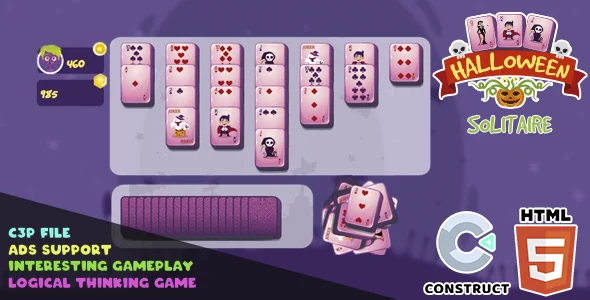
Each round initializes when the player reveals a covered card from the draw deck on the bottom left, which seeds the active stack displayed at the bottom right. The Construct 3 event system then validates every subsequent selection against a rank-adjacency rule: a grid card can be removed only when its value sits exactly one step above or below the visible stack card, with suits carrying no weight in the comparison. Aces operate as both high and low values, so a Queen or an Ace legally lands on a King, allowing the sequence to wrap around the rank spectrum. Jokers bypass validation entirely, functioning as wildcards playable at any moment while accepting any card on top of them, and pumpkin cards add a secondary special-card layer that assists the player in clearing the grid. Rendering occurs on canvas at 720×1280 with layered PNG assets preloaded before the first frame, while audio events route through the engine’s sound channels.
Core Technical Capabilities of Halloween Solitaire
- Suit-agnostic rank validation: The comparison layer checks only numeric rank adjacency (±1) between the selected grid card and the stack card, producing a deterministic clearing condition that removes every card from the board.
- Dual wildcard subsystem: Jokers act as unrestricted wildcards, and pumpkin cards supply an additional assist mechanic, giving the rule engine two distinct exception paths beyond standard adjacency checks.
- Unified pointer input pipeline: Mouse clicks and touch taps dispatch through a single Construct 3 input path, so the same build operates on desktop browsers and mobile touchscreens without input-mode branching.
- AdMob monetization hooks: The engine exposes advertisement integration points, enabling revenue generation when the HTML5 export runs inside native Android or iOS shell applications.
- Fixed-canvas deterministic layout: The 720×1280 portrait resolution locks element positioning across devices, eliminating per-viewport layout recalculation during gameplay.
Production Implementation & Operational Resilience
Deployment requires only a static file host: the HTML5 export folder can be uploaded to any web server or embedded through an iframe, and the same output runs inside native Webview containers on Android and iOS where the AdMob hooks become active. Portals expanding a browser arcade on this identical static-hosting pattern can deploy Fight Virus – HTML5 Game as an independent build beside this title, since neither package depends on shared server-side components.
Operational resilience depends on asset locality. Keeping the HTML entry point, JavaScript bundles, and audio files on the same origin avoids cross-origin resource loading failures; when assets are split onto a separate CDN, the server must return correct CORS headers or the canvas runtime will block them. The documented IE11 compatibility sets a hard syntax ceiling for secondary development — custom script injections should remain ES5-compatible or pass through a transpiler before shipping. The fixed 720×1280 canvas is raster-based rather than high-resolution vector output, so operators targeting high-DPI displays should account for scaling behavior rather than expecting resolution-independent art.
Customization follows a dual-track workflow. Designers replace the layered PNG sprites and sound files directly, while engineers open the included c3p project in the Construct 3 editor to modify event sheets, difficulty levels, or deck composition. Teams standardizing on this engine with wrapper-based monetization can also evaluate Save the Fish as a parallel c3p deliverable following the same AdMob exposure path for catalog consistency.
Frequently Asked Questions
Can the artwork be reskinned without modifying the game logic?
Yes, the deliverables include layered PNG source files, so a designer can replace sprites and audio while the rank-adjacency, wildcard, and deck logic inside the c3p project file remains untouched.
Does the build run in Internet Explorer 11?
Yes, IE11 appears in the documented browser compatibility matrix alongside Chrome, Edge, Firefox, Safari, and Opera, which constrains any custom script additions to ES5-compatible syntax during secondary development work.
Can an Ace be placed on a King during play?
Yes, aces function as both high and low values, so a Queen or an Ace is a legal placement on a King; suits carry no weight in the validation layer, which checks rank adjacency only.
Do the deliverables include sound assets and written documentation?
Yes, the package ships the HTML5 export files, the sound assets, documentation, and the editable Construct 3 c3p project, giving developers the complete material set needed for direct deployment or continued development.