GenesisExpo | Business Events & Conference WordPress Theme
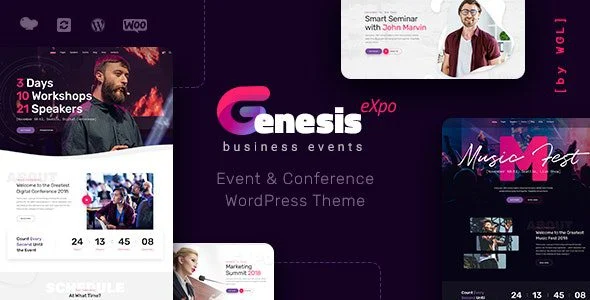
GenesisExpo Business Events & Conference WordPress Theme Overview & Event Site Foundation
GenesisExpo is a WordPress theme engineered for event agencies, conference organizers, and business coaches to publish expo, seminar, and workshop programs on the web. The package targets the operational bottleneck of assembling speaker profiles, multi-day schedules, and ticket sales flows by shipping pre-built page layouts, a flexible header builder with presets, timetable and timeline shortcodes, and WooCommerce store integration in a single codebase. Within agency delivery pipelines, it operates as a drop-in presentation layer: one-click demo import seeds the complete page structure across six distinct demos, and WP Bakery Page Builder governs every object on every page without manual template file edits.
Technical Specifications & Deployment Matrix
| Engineering Metric | Deployment Specification |
|---|---|
| Base Technology | WordPress theme package (PHP, CSS, JS files) built on the WP Bakery Page Builder engine |
| Runtime Requirements | WordPress 4.9.x through 7.0.x; PHP 8.2+ supported since version 1.4.10 |
| Commerce Layer | WooCommerce 5.x.x through 9.x.x template integration |
| Editor & Content Standards | Gutenberg-optimized, widget ready, high-resolution assets |
| Browser Coverage | IE11, Firefox, Safari, Opera, Chrome, Edge; responsive layout across desktop, tablet, and smartphone viewports |
| Persistence Footprint | Native WordPress database schema; no separate custom tables required at install |
WP Bakery Module Pipeline & Event Content Architecture
The theme routes every page through WP Bakery Page Builder, whose 30-plus configurable modules override the default WordPress template hierarchy. On an inbound request, WordPress resolves the template as usual, after which the builder engine assembles the DOM tree from module objects rather than static page markup. The header builder injects its preset-defined structure — navigation, logo placement, action buttons — at the layout root, while content modules render schedule rows, timeline entries, and team grids lower in the tree. Timetable shortcodes dispatch session data into structured, time-ordered markup; extended timeline shortcodes expose parameterized settings for program chronology; and the speakers module generates profile layouts with per-member configuration. Revolution Slider handles hero sequences, and smooth gallery modules output media collections without external gallery dependencies.
When a project outgrows the bundled module set — for example, custom post relations or dynamic speaker listings bound to query logic — integrating JetEngine adds query builders, forms, and dynamic content capability for Gutenberg and additional editors, extending listing architecture beyond the theme’s native shortcodes.
Architectural & Functional Highlights
- Flexible Header Builder with Presets: Header composition is managed through a preset system with stored configurations, letting developers switch navigation structures and button placements without regressing layout state across pages.
- Timetable and Extended Timeline Shortcodes: Schedule data renders through parameterized shortcodes, with HTML tag support in timetable descriptions added at version 1.2.2 for richer session annotation.
- Team Members and Speakers Modules: Dedicated modules emit structured profile grids; a responsive grid fix for the Clients module at version 1.2.13 documents the maintainers’ attention to module-level layout integrity.
- One-Click Demo Content Import: Full demo structures import in a single action, collapsing initial build time from component assembly to content replacement, with import issues fixed as early as version 1.0.10.
Production Implementation & Operational Resilience
For agency staging environments, the deployment path is deliberately linear: install the theme, run one-click demo import, then replace seeded content per client vertical. Six pre-built demos cover business summits, music festivals, ecology conferences, and educational scenarios, which reduces per-project layout engineering. For client work in the financial-advisory sector that sits outside the event vertical, Investment exists as an independent business-theme alternative purpose-built for advisor sites.
Override safety is structural: a child theme ships inside the package, so PHP logic adjustments and stylesheet extensions in the child’s functions.php and style.css survive parent-theme updates. The changelog documents a maintained release cadence — a local file inclusion vulnerability in an AJAX handler was patched at version 1.4.15, PHP 8 support arrived at version 1.4.1, and PHP 8.2+ compatibility landed at version 1.4.10, alongside WooCommerce template updates and WordPress 5.6/5.8 compatibility passes. Version 1.2.16 records dedicated SEO improvements to the underlying markup. Free lifetime updates propagate these fixes to existing installs, and a documented setup guide accompanies the package.
Commerce runs through native WooCommerce template integration spanning versions 5.x through 9.x, covering ticket sales, registrations, and merchandise, with mobile cart support added at version 1.0.10 and related-products options at version 1.0.7. For storefront-first projects where merchandising outweighs event programming, Capie stands as a separate minimalist WooCommerce theme with 17+ homepage layouts and header/footer builders. Cross-browser behavior spans IE11 through Edge, and the responsive grid reflows the same DOM across device classes. Translation-ready string sets enable multilingual builds, with translatable strings refined across multiple maintenance releases.
Frequently Asked Questions
Does GenesisExpo include a child theme for safe code overrides?
Yes. A child theme ships with the package, allowing developers to extend PHP logic and CSS in separate files that persist through parent releases; a child-theme issue was identified and fixed at version 1.0.2 to guarantee this override layer functions correctly.
Can the theme run on servers with PHP 8.2 or later?
Yes. Compatibility with PHP 8+ was introduced at version 1.4.1, and version 1.4.10 extended support to PHP 8.2 and later, alongside bundled plugin updates, confirming current-generation runtime readiness.
Is the theme translation ready for multilingual event sites?
Yes. String sets are translation ready, and translatable strings were updated in releases including versions 1.0.10 and 1.0.11, allowing localization of interface text for international conference audiences.