Farmor – Farm Farmer WordPress Theme
Farmor: Technical Overview & Architecture
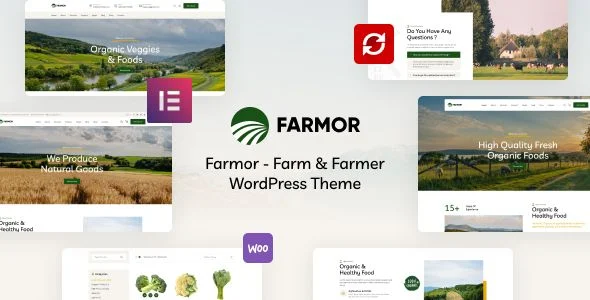
Farmor – Farm Farmer WordPress Theme is an agricultural WordPress theme built on an Elementor-driven front-end layer, engineered for organic farm operators, poultry producers, and local grocery retailers who need a storefront-grade website without custom development. The template ships with pre-optimized DOM structures that keep markup depth under Elementor’s default widget nesting, which reduces render-blocking during product grid and gallery loads on category pages holding 50+ SKUs. Front-end state changes — cart quantity updates, filter applications, and form submissions — run through localized AJAX endpoints, so the UI refreshes targeted fragments instead of triggering full document reloads. Elementor widgets assemble every section through drag-and-drop composition, and the underlying codebase registers its shortcodes and template parts through standard WordPress hooks, meaning nothing breaks when WooCommerce or Elementor pushes a major update. A centralized theme options panel exposes granular controls over color palettes, Google Font pairings, layout container widths, sticky header behavior, and shop archive column counts, all persisted through the WordPress Customizer API.
Key Functional Features of Farmor for Modern Deployments
- Elementor Page Builder Integration: Every demo section is delivered as an editable Elementor template with nested widget structure exposed in the sidebar, allowing pixel-level adjustment of spacing, typography, and section ordering without touching a single line of CSS.
- WooCommerce Storefront Layer: The theme overrides default shop, product detail, and checkout templates with farm-specific layouts, including product badges for organic certification, harvest-date display fields, and grid/list view toggles that persist via browser storage.
- Header & Footer Builder: Headers and footers are constructed as reusable Elementor blocks, supporting sticky positioning, transparent-over-hero modes, and multi-column widget placement for contact details, operating hours, and social links.
- Niche-Specific Demo Library: Pre-built homepages cover crop farming, poultry operations, and organic shop verticals, each with matching inner pages (About, Services, Shop, Blog, Contact) that swap in through the demo importer without overwriting existing WooCommerce product data.
- Contact Form 7 Compatibility: Native styling hooks target Contact Form 7 field wrappers, so order inquiry forms, wholesale quote requests, and CSA subscription signups inherit the theme’s typography and validation states automatically.
- Responsive Breakpoint Control: Layout rules are defined across five breakpoints (widescreen, desktop, tablet, mobile landscape, mobile portrait), with per-element visibility toggles in Elementor that let you hide decorative imagery on small screens to protect LCP scores.
Production Deployment & Use-Case Scenarios
- Organic Produce e-Commerce: A vegetable CSA deploys the organic shop demo, configures WooCommerce variable products for weekly box subscriptions, and processes recurring orders through the themed checkout — the entire catalog goes live in a single afternoon with zero custom PHP.
- Poultry & Livestock Operations: A free-range egg producer uses the poultry demo to publish husbandry practices, feed sourcing details, and farm tour booking forms, converting the site into a direct-to-consumer channel that replaces printed brochures.
- Farmers Market & Local Grocery: A neighborhood grocer combines the grocery-style homepage with WooCommerce product categories and location widgets, publishing seasonal availability lists and pickup-window information that update through the standard WordPress editor.
Technical Architecture & Compatibility Standards
The theme runs on PHP 8.0 through 8.3 and requires WordPress 6.0 or higher, with Elementor and WooCommerce tested against their current major releases. Template files follow WordPress coding standards, enqueue assets conditionally so scripts only load on pages that reference them, and register image sizes through add_theme_support rather than hard-coded dimensions — a structure that keeps Cumulative Layout Shift near zero on product archives.
Core Web Vitals targets are addressed at the markup level: hero imagery uses responsive srcset output, system font fallbacks prevent invisible-text flashes, and deferred JavaScript execution keeps Total Blocking Time within the “good” threshold on mid-range mobile hardware. The theme also interoperates with popular SEO plugins, cache layers, and translation frameworks including WPML and Polylang, so multilingual farm storefronts inherit the same template logic without code overrides.
Frequently Asked Questions
Does Farmor require coding knowledge to build a farm storefront?
Yes, the theme operates entirely through Elementor’s visual editor and the centralized options panel, so layout, typography, and color changes are applied without writing HTML, CSS, or PHP code.
Can I sell organic products directly through the Farmor theme?
Yes, native WooCommerce integration delivers themed product archives, variable product support, and a customized checkout flow, allowing physical and digital farm goods to be sold out of the box.
Does Farmor include demos for poultry and livestock businesses?
Yes, the demo library covers crop farming, poultry operations, and organic shop niches, and each demo can be mixed with pages from another without conflicts.
Is the Farmor theme locked to a single farm website layout?
No, headers, footers, and every page section are rebuildable through the Elementor header/footer builder, so layouts can be restructured freely rather than being fixed to the shipped demos.
Will Farmor remain compatible with future WordPress and WooCommerce updates?
Yes, the codebase uses standard WordPress hooks and template overrides instead of core file modifications, which preserves compatibility through major platform releases with routine theme updates.
-
24 October 2023 LatestSeptember 22, 2026