EstateHub – AI-Powered Real Estate Marketplace Property Management Platform
What Is EstateHub? Real Estate Marketplace Architecture & Overview
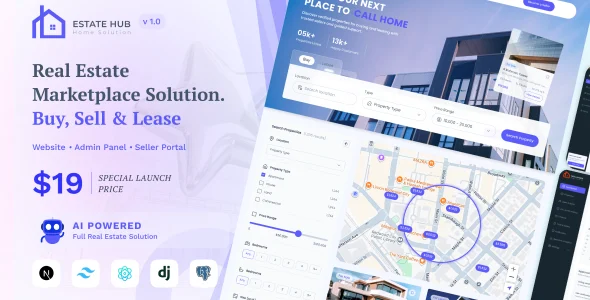
EstateHub is a React/Next.js and Django REST Framework marketplace application engineered to run a complete multi-vendor property platform for listing, touring, buying, and renting real estate. It addresses the four engineering bottlenecks that stall marketplace development: search that must feel instant, deal pipelines that run for weeks, identity verification, and controlled money movement. In production it delivers three coordinated surfaces — the public website, the seller portal, and the admin console — as one self-hosted package containing the full source of both the TypeScript front end and the Python API.
EstateHub System Requirements & Technical Compatibility
| Parameter | Verified Specification |
|---|---|
| Front-End Runtime | Node.js 20.9 or newer, pnpm, TypeScript, Next.js |
| API Runtime | Python 3.12, Django REST Framework |
| Data Layer | PostgreSQL, Redis |
| Compatible Browsers | Firefox, Safari, Opera, Chrome, Edge |
| Hosting Target | Any Next.js-capable host; VPS or equivalent for Python, PostgreSQL, and Redis (PHP-only shared hosting is insufficient) |
| Included Artifacts | Dockerfiles, Docker Compose stack, Swagger UI, ReDoc, Postman collection, two PDF guides |
Marketplace Transaction Pipeline & Capabilities
Every transaction moves through a stage-based checklist your team defines and controls.
Verified Capabilities & Core Highlights
- Optional AI Sentence Search: Visitors can type queries such as a house in Austin under 600k with 3 bedrooms and receive matching listings with filters populated automatically. The feature stays off until an OpenAI, Google Gemini, or Anthropic key is configured, and standard filter search operates fully without it.
- Cost-Free Map Search: Property maps run on OpenStreetMap with no API key or billing account, supporting radius searches up to 50 km around a dropped pin or the visitor’s location, with every filter state written to the address bar as a shareable link.
- Real-Time Chat: Messages, typing indicators, and read receipts stream as they occur, and conversations started from a listing remain open in a docked panel while the buyer continues browsing.
- Tour Scheduling: Buyers book only within time slots the seller has opened, preventing double-booking for in-person or video tours.
- Commission & Payout Engine: Sale and rental fees are set once, funds flow through the platform account, staff confirm bank transfers from uploaded receipts, and approved seller payouts are released in batches. Teams layering additional monetization channels beyond commission revenue sometimes pair such platforms with PTC Pro for advertising inventory management.
On the operational side, a six-step guided KYC flow verifies customers, seller applications capture business details, and both queue into one staff review workspace. Listing approval supports single or bulk actions, and the admin console handles announcements, branding settings, and integration keys without server file edits. Light and dark themes apply to the admin console and seller portal. Developers comparing AI-assisted front ends across the WordPress ecosystem, such as Exhibz for conference scheduling workloads, will find the same provider-key pattern here: keys are entered once, displayed only as configured, and never rendered back.
Implementation Scope, Customization & Deployment Boundaries
Deployment follows a standard container path: the download ships Dockerfiles for the front end and API plus a Docker Compose file that runs the entire stack, and a seed command populates the database with demo users, listings, tours, and conversations for client presentations. Because the codebase uses TypeScript, Django REST Framework, and conventional tooling, an in-house team or freelancer can modify it without proprietary frameworks. Third-party service keys for AI search, email (Resend, SendGrid, Mailgun, or SMTP), and cloud storage (Cloudinary, S3, Google Cloud Storage, or Azure) are managed through the admin console integrations screen. Operators requiring only a presentation-layer property site rather than a transactional marketplace can evaluate Houseland for WordPress-based agency workflows instead. Version 1.0 boundaries are explicit: payments are handled by bank transfer only with no card gateway, the interface is English-only, the public site and customer account are light theme, no mobile app is included, and the Agent, Investor, and Auction modules remain in development.
Frequently Asked Questions
Does the download include a mobile application?
No. The package contains the website and its API only. However, Swagger UI, ReDoc, and a Postman collection documenting the full REST API are included, so a mobile client can be built against the same back end later.
Which payment method does version 1.0 support?
No card gateway is included. Buyers pay via bank transfer into the platform account, staff verify each transfer from an uploaded receipt, and approved seller payouts are released in batches. Rental and sale commission rates are configured once in the console.
Is demo data included for client demonstrations?
Yes. A command fills the database with demo users, listings, tours, and conversations, and a read-only online demo exposes admin, seller, and customer roles. Saving, sending, and uploading are disabled in the demo environment.
-
v1.0.0 Latest