Domiex – Next.js TS Tailwind Admin Dashboard Template (Next 15 APP Router)
Domiex Overview & App Router Dashboard Architecture
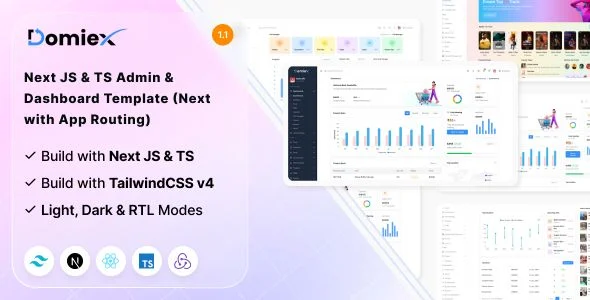
Domiex is a Next.js 15 admin dashboard template built on TypeScript and Tailwind CSS, engineered for front-end developers and delivery agencies that need production-grade admin panels without rebuilding UI primitives. The package targets a concrete bottleneck in utility-first development — markup that bloats with ten or more Tailwind utility classes per element — which the authors solve by registering a custom Tailwind plugin that maps each design pattern to a single semantic class. Within agency workflows, it operates as a pre-assembled foundation of 11+ applications, 235+ pages, and 200+ UI components that teams rebrand, restyle, and extend against their own data layers.
Technical Specifications & Deployment Matrix
| Engineering Metric | Deployment Specification |
|---|---|
| Base Framework | Next.js 15 with App Router file-system routing |
| Language Variants | Parallel TypeScript and JavaScript codebases, both included |
| Styling Engine | Tailwind CSS with a custom single-class plugin; tokens managed in tailwind.config.js |
| Component Inventory | 200+ UI components, 5+ layout variants, 9+ dashboards, 4+ landing page templates |
| Internationalization | i18next with react-i18next, 10+ bundled languages |
| Persistence Footprint | None — stateless front-end template; API integration is developer-supplied |
Single-Class Utility Pipeline & Rendering Execution Flow
Every page resolves through the App Router’s file-system routing, where nested layout segments compose the shell — sidebar, header, and content region — before React hydrates the interactive layer on the client. Theme and locale state stay synchronized through React context rather than scattered DOM mutations: switching between light, dark, and system modes rewrites the active theme class once at the root, and nested components react without page reloads. Locale switching follows the same pattern through react-i18next, which loads dictionaries for more than ten languages and swaps rendered strings without remounting the route tree.
The single-class pipeline is the package’s central engineering decision. Instead of repeating utility strings across every element, the custom Tailwind plugin encapsulates grouped utilities — spacing, typography, color, and radius rules — into named classes generated at build time from tailwind.config.js. Developers adjust one configuration object to restyle the entire dashboard, and markup stays readable because each element carries a single class token. Since both a TypeScript and a JavaScript codebase ship in the package, teams choose strict typing for long-lived products or plain JavaScript for rapid prototyping without diverging from the same component inventory. Delivery groups building decoupled Vue-based products outside the React runtime can evaluate Tairo as an independent Nuxt and Tailwind dashboard system — a separate codebase, not an extension of this one.
Core Technical Capabilities of Domiex
- Single-class Tailwind plugin: Groups utility declarations into named classes at build time, reducing per-element class strings to one token and centralizing all restyling inside tailwind.config.js.
- App Router layout composition: Nested route segments share layout shells, so sidebar colors, sizes, and layout variants swap globally without per-page edits.
- Dual TypeScript and JavaScript builds: Both codebases ship together, letting a team adopt strict typing or rapid JS iteration on identical component APIs.
- Multi-mode theming engine: Light, dark, and system modes plus multiple dark variants, primary color options, and sidebar color and size switches operate as root-level state.
- i18next localization layer: react-i18next delivers 10+ language dictionaries with runtime string substitution across all 235+ pages.
Production Implementation & Operational Resilience
Deployment treats the template as a stateless client bundle: Next.js builds the route tree, and no database, ORM, or server-side session store ships with the codebase. That boundary matters for staging and client handover — developers wire their own REST or GraphQL clients into the pre-built application modules for e-commerce, CRM, analytics, email, hospital, file manager, projects, school, and music use cases, and they own payload validation, cross-origin handling, and authentication logic from that point forward. The bundled authentication and error pages are presentational routes: they render the correct states but contain no token issuance or session enforcement, so those mechanisms must live behind a team’s own API layer.
Presentation-side resilience is covered by design: the layout is responsive and retina-ready, asset weight is optimized for fast loading, and rendering is verified across Chrome, Firefox, Safari, Edge, Opera, and IE11 on their supported platforms. Customization stays inside configuration rather than source surgery — theme colors, layout dimensions, and typography adjust through the Tailwind config and included CSS support, while the bundled editable design files let designers prototype changes before code moves. Agencies maintaining parallel products on non-React stacks can treat Tailwise as a standalone Tailwind kit covering HTML, Vue, and Laravel — a separate codebase outside this runtime.
Frequently Asked Questions
Are editable design files included in the Domiex package?
Yes, the download includes editable design resources alongside the CSS and JS files, so designers can adjust layouts, tokens, and page mockups before committing any changes to the production codebase.
Is separate documentation provided for the JavaScript and TypeScript versions?
Yes, each codebase ships with its own dedicated documentation set covering setup, configuration, and customization, so teams working in either language variant follow instructions matched to their chosen version.
Does the template ship with live REST endpoints or a persistence layer?
No. This is a front-end UI package; no database, API server, or data persistence mechanism is bundled. Developers connect their own backend services to the pre-built application and dashboard pages during integration.
Does Domiex include ready-made landing page templates?
Yes, the package bundles four or more landing page templates in addition to the dashboards and 235+ interior pages, allowing marketing surfaces and application screens to ship from one themed codebase.