Dirt Drift – Construct 3 Game (HTML5, AdMob, C3P)
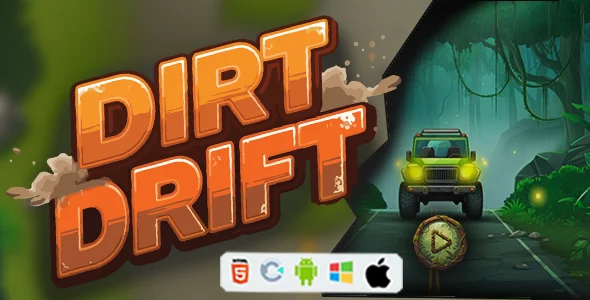
Dirt Drift Overview & HTML5 Arcade Racing Architecture
Dirt Drift is a Construct 3 HTML5 arcade racing game source package, engineered for mobile game studios and web publishers to deploy an off-road, traffic-dodging racing title across browsers and Android devices. The package addresses a recurring production bottleneck: converting a fast-paced, high-score-driven driving concept into a shippable build without authoring a custom game engine, plugin stack, or platform-specific rendering layer. In practice, it functions as a turnkey delivery asset — studios receive the editable C3P project, a compiled Android APK, and an HTML5 export ready to drop onto any web host or WebView container.
Technical Specifications & Deployment Matrix
| Engineering Metric | Deployment Specification |
|---|---|
| Base Technology / Framework | Construct 3 (plugin-free event system) |
| Runtime / Language Requirements | HTML5, JavaScript, JSON, CSS, XML output |
| Browser Compatibility | Chrome, Edge, Firefox, Safari, Opera, IE8–IE11 |
| Delivery Artifacts | .c3p source project, Android APK, HTML5 build, PDF documentation |
| Persistence Footprint | Client-side high-score state, no server database required |
| Resolution Support | High-resolution rendering, responsive across desktop, tablet, mobile |
Event-Driven Gameplay Execution & Rendering Pipeline
The core mechanism is Construct 3’s event-sheet runtime, which dispatches per-tick logic to drive the vehicle, spawn obstacles, and score passes through traffic. Instead of handwritten game loops, the engine evaluates conditional event blocks each frame; when the player’s dirt racer intersects a traffic entity or roadside obstacle, a collision event fires, triggers the run-termination state, and flushes the session score into local comparison against the persisted best-score value. Rendering runs on the HTML5 canvas layer, where sprite-based road scrolling, obstacle positioning, and player drift movement are composited at the browser’s frame cadence. Input arrives through two parallel channels — keyboard events on desktop and native touch listeners on mobile — with the same event handlers resolving both, which keeps the interaction layer device-agnostic.
Core Technical Capabilities of Dirt Drift
- Plugin-Free Construct 3 Runtime: Every gameplay behavior is expressed through native event sheets, so the exported HTML5 bundle carries no third-party plugin dependencies, reducing runtime conflicts and simplifying re-export pipelines.
- Responsive Multi-Device Input Layer: Touch controls activate automatically on mobile form factors while keyboard input governs desktop sessions, letting a single build serve phones, tablets, and desktop browsers without forked code paths.
- Editable C3P Source Structure: The included .c3p project opens directly in the Construct 3 editor, exposing event sheets, sprite assets, and layout objects for level adjustments, visual replacement, and parameter tuning prior to re-export.
- High-Score Persistence Logic: Session scores are compared against locally stored best-run values, producing the chase-the-record loop that drives retention in endless, traffic-dodge racing formats.
- AdMob-Referenced Android Build Path: The deliverable ships with a compiled Android APK aligned with the AdMob monetization tag in the product identity, giving studios an installable reference build alongside the HTML5 export.
For teams assembling multi-title arcade catalogs, this package slots into the same deployment pattern as other Construct 3 source releases. Where Dirt Drift covers the racing and obstacle-dodge segment, Zombie Hunter 3D occupies the 3D action segment as a separate standalone Construct 3 build, and Word Search addresses the casual puzzle audience — each operating as an independent embed rather than a shared codebase.
Production Implementation & Operational Resilience
Deployment follows the standard HTML5 game pattern: upload the exported build folder to any static host, and the game initializes in the browser without server-side execution, database connections, or backend configuration. This zero-backend footprint means hosting costs stay flat regardless of player volume, and CDN distribution works because every asset is static. On Android, the prebuilt APK provides an immediate install path, while studios intending to publish to the Play Store can re-export from the C3P project after adjusting icons, package identity, and advertisement configuration.
Customization boundaries are well defined. Visual changes — car sprites, road tiles, obstacle art, and background scenery — are handled by replacing image assets inside the Construct 3 editor and re-exporting; no code editing is required for reskins. Gameplay tuning, including speed parameters, obstacle density, and scoring rules, lives in the event sheets, which the bundled PDF documentation walks through. Because the runtime is plugin-free, there are no extension versioning risks to manage during Construct 3 editor updates. The broad browser matrix, extending back to legacy IE builds, indicates conservative use of web APIs, though teams targeting only modern evergreen browsers gain nothing extra by disabling that compatibility layer. One operational note: since persistence is client-side, best-score data does not travel across devices, so any leaderboard ambition would require adding a separate backend outside the shipped scope.
Frequently Asked Questions
Does the package include the editable Construct 3 source file, or only compiled builds?
Yes, the deliverable contains the full .c3p project file, which opens in the Construct 3 editor and exposes every event sheet, layout, and asset for modification, alongside the compiled HTML5 and Android APK outputs.
Is a ready-to-install Android APK included with this release?
Yes, an Android APK ships in the package, providing an immediate reference installation for testing on physical devices and a baseline build before studios perform their own re-exports for store submission.
Do I need additional plugins or extensions to run or re-export the project?
No, the game is built entirely with native Construct 3 functionality, so the exported runtime carries no third-party plugin dependencies and re-exports work from a standard Construct 3 editor installation.
Does the game handle touch input on mobile devices without a separate build?
Yes, responsive touch controls are implemented in the same build that serves desktop browsers, so a single HTML5 export handles phones and tablets without maintaining a separate mobile-specific version.