Diego – Creative Personal Portfolio Resume WordPress Theme + RTL
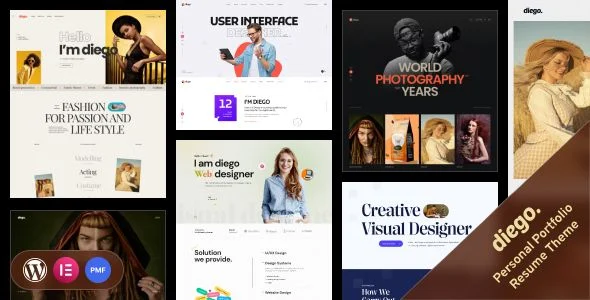
Diego: Technical Overview & Architecture
Diego – Creative Personal Portfolio Resume WordPress Theme + RTL is a resume WordPress theme built on a lightweight, widget-driven architecture assembled through the Elementor Page Builder, engineered specifically for freelance web developers, UX/UI designers, and independent consultants. Internally, the theme keeps DOM depth deliberately shallow by structuring portfolio grids, hero sections, and case-study blocks as flat, reusable section templates rather than deeply nested wrapper divs, which reduces rendered node count and keeps layout recalculation costs low on content-heavy pages. Content updates such as project filtering, contact form submission feedback, and portfolio pagination run through AJAX request cycles that patch only the affected container, so the UI state changes without a full document reload and the browser never loses scroll position or animation state.
Component assembly integrates directly with Elementor’s native widget registry, meaning every portfolio card, skill bar, and timeline block is a drag-and-drop element rendered server-side and hydrated client-side without proprietary build dependencies. The centralized Theme Options panel consolidates configuration for typography (with a live Google Fonts picker and per-heading font assignment), the global color system used by both dark and light modes, container widths and spacing scale, CSS3 animation triggers and timing curves, and the site-wide text-direction switch that activates the RTL stylesheet chain. Each parameter writes to a versioned options store and regenerates static CSS on save, eliminating per-request style computation.
Key Functional Features of the Diego Theme for Modern Deployments
- Elementor Page Builder Compatibility: All homepage and portfolio layouts are composed from Elementor widgets, with live front-end editing, inline responsive breakpoint controls (desktop, tablet, mobile), and per-element visibility rules executed at render time.
- Centralized Theme Options Panel: A single administrative screen controls typography, color tokens, layout widths, animation behavior, and direction settings, regenerating cached CSS on save so changes propagate without touching template files.
- Switchable Dark and Light Modes: The dual-mode system swaps a CSS custom-property palette at the root level, toggling in under a frame with no repaint of the underlying layout, and remembers the visitor’s selection across sessions.
- Complete RTL Language Support: Direction-aware stylesheets mirror grids, navigation, and typography for Arabic and Hebrew deployments, correctly flipping paddings, transforms, and icon placement without manual CSS overrides.
- CSS3 Animation Engine: Entrance transitions, hover reveals, and scroll-triggered effects run on GPU-accelerated transform and opacity properties, with timing curves and triggers configurable per section from the options panel.
- SEO-Friendly Codebase: Templates emit semantic HTML5 landmarks, a strict single-h1 heading hierarchy, and clean internal markup that search crawlers can parse without executing JavaScript-dependent content injection.
Real-World Deployment Scenarios
- Freelance Developer Portfolio: A developer publishes project case studies with tech-stack tags, live URLs, and repository links; AJAX filtering lets visitors narrow by technology while lazy-loaded screenshots keep initial payload under control, producing inquiry-ready project pages.
- UX/UI Designer Case-Study Hub: A designer structures in-depth process documentation using the timeline and gallery widgets, pairing dark-mode hero sections with alternating case layouts, so research artifacts and final mockups sit on one narrative page that loads without layout shift.
- Small Creative Agency Site: A three-to-five person studio presents a unified brand front on a shared homepage while assigning each member a dedicated portfolio route, using distinct homepage layouts per role and the RTL layer to serve bilingual client markets.
Technical Architecture & Compatibility Standards
The theme targets WordPress 6.x running on PHP 8.0 or higher, uses the standard WordPress customizer and options APIs rather than deprecated frameworks, and registers its Elementor widgets through documented hooks so major Elementor updates do not break layout rendering. Core Web Vitals budgets are respected through deferred non-critical assets, native lazy loading on imagery, zero bundled jQuery dependencies for the animation layer, and CSS custom properties that avoid runtime style recalculation during mode switches. Output targets an LCP under 2.5 seconds on a standard shared-hosting configuration with a lightweight caching plugin active.
Browser coverage extends to the current and previous two major versions of Chrome, Firefox, Safari, and Edge, with RTL layouts verified against mirrored flexbox and grid behavior. The theme interoperates with common WordPress extensions, including SEO plugins that override meta output, caching and minification layers, contact form plugins via standard widget areas, and multilingual plugins that supply their own string-translation pipeline on top of the built-in RTL direction chain.
Frequently Asked Questions
Does Diego include complete right-to-left layout support?
Yes, the theme ships direction-aware stylesheets that mirror grids, menus, and typography for Arabic and Hebrew content, activated directly from the Theme Options panel without manual CSS overrides.
Can the theme run without any paid plugins installed?
No, no premium plugin is required; every layout and widget works with the free Elementor core, so the theme functions fully on a standard WordPress install without additional licensed dependencies.
Does the dark and light mode switch persist for returning visitors?
Yes, the mode toggle writes the visitor’s selection to local storage, applies it via a root-level custom-property swap before first paint, and restores it automatically on every subsequent page load.
Is the codebase structured for search engine visibility?
Yes, templates emit semantic HTML5 landmarks, a strict single-h1 hierarchy per page, and crawlable text content without JavaScript-dependent injection, allowing SEO plugins to manage meta output cleanly.
Can photographers deploy high-resolution galleries on this creative portfolio theme?
Yes, the grid layouts pair with native browser lazy loading and responsive image sources, so full-resolution photography renders sharp on large displays while the initial page payload stays within Core Web Vitals targets.
-
1.1.8 LatestNov 12, 2026
-
1.0.7September 20, 2026